Even amidst Nintendo’s vast pantheon of iconic game franchises, I’ve always had a soft spot for Splatoon. It’s one of the few series I’ve had the pleasure of watching grow since the day the Wii U game was announced, all the way through to its most recent Nintendo Switch incarnations. Being one of the company’s more iterative (as opposed to innovative) titles though, my interest in the series has waned over time, especially since the release of Splatoon 3 arrived a lot sooner than I expected it to.
While I’ve always loved Splatoon’s unique Turf War multiplayer, I’ve had more of a mixed relationship with the single player campaigns which, up until Splatoon 2’s Octo Expansion, always felt like an afterthought and lacked the design strengths of Nintendo’s other flagship IP.
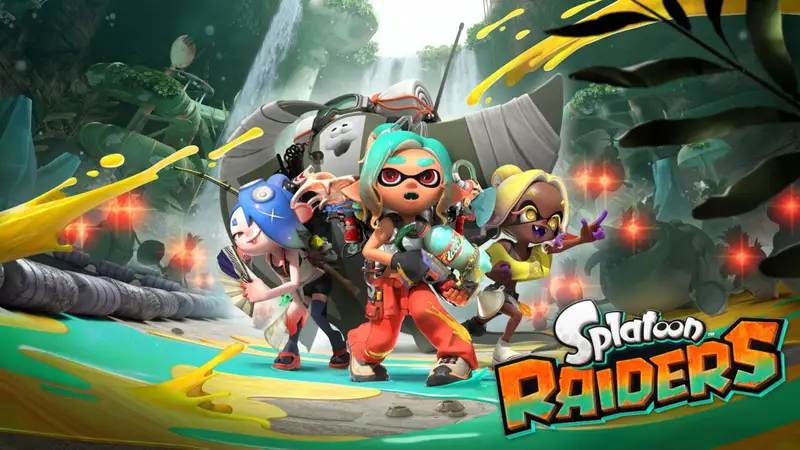
It’s for these reasons that I initially passed on Splatoon Raiders, a single-player/co-operative spin-off that ditches the Turf War multiplayer for a focused campaign that draws inspirations from Splatoon 3’s Salmon Run horde mode. Colour me surprised then that, one impulse purchase ahead of a lazy weekend later, Splatoon Raiders has become one of my favourite shooter campaigns that I’ve played in years.
Narrative
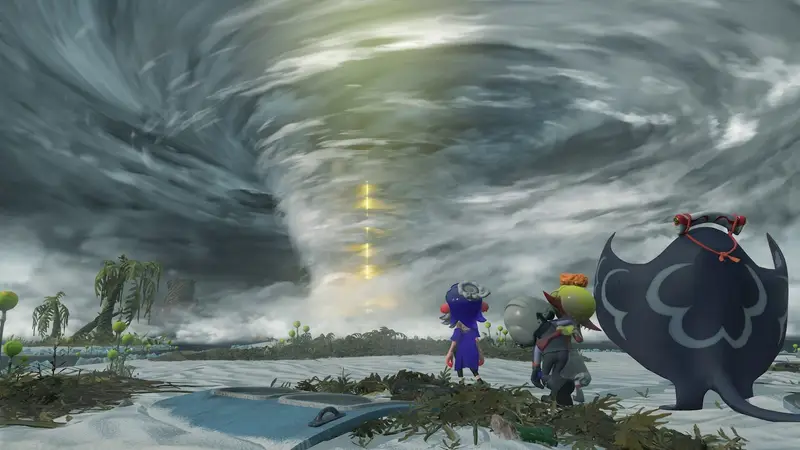
Splatoon Raiders kicks off with the crew of Splatoon 3’s Deep Cut idol group crash landing on the outskirts of the Spirhalite Islands, an uncharted location that’s suddenly resurfaced. After regrouping and forming a base of operations, the player takes control of a nameless Mechanic to assist the group in raiding the island for treasure and fending off Salmonids.
The Splatoon single-player modes have always had deceptively dense stories owing to the copious lore documents and scrolls that can be obtained as players progress deeper into their worlds, but Raiders’ commitment to a dedicated structure and expanded presence for the Deep Cut cast members make it the strongest story this series has seen yet.
A special emphasis is put on Shiver, Fry, and Big Man as the player’s key companions, and as a result they are given more room for development than any other characters in the series thus far. The game provides space to explore their unique dynamic and flesh out their backstories, also giving meaningful insight into their relationships and their music and its influences on their personalities.
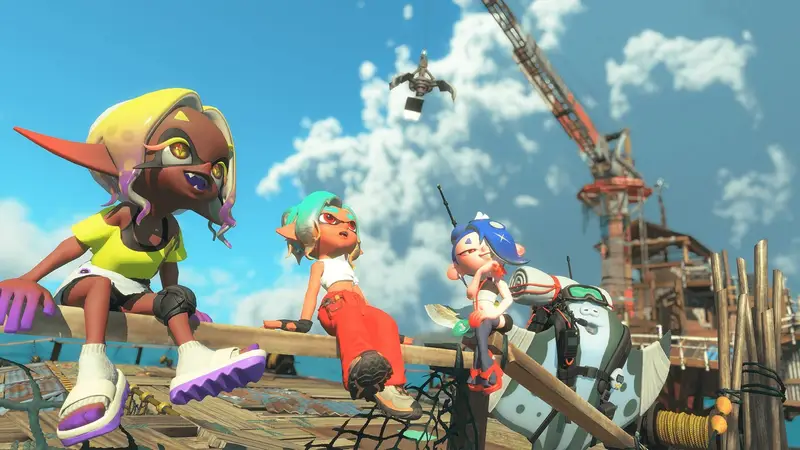
It also helps that Splatoon Raiders heightens the spectacle of its story sequences to an absurd degree, matching the intensity of the gameplay as things reach the conclusion. This results in one of the best finale sequences Nintendo has produced in years, rivalling the unforgettable over-the-top conclusions of Super Mario Odyssey, Kirby and the Forgotten Land, and Donkey Kong Bananza.
While it’s not bound to win any awards for its writing or nuance, Splatoon Raiders is the best and most thorough glimpse we’ve had into this colourful and bizarre world yet, delivering some whimsical character moments and fun set pieces across its nearly 20 hour campaign.
Gameplay
As previously mentioned, Splatoon Raiders ditches the traditional single-player and multiplayer structures introduced in the Wii U original and later iterated upon on the Switch. This is Nintendo’s fresh take on a loot-based action RPG in the vein of Borderlands or Destiny, adapting Splatoon’s unique shooting mechanics into a constantly rewarding loop of frantic combat and character progression.
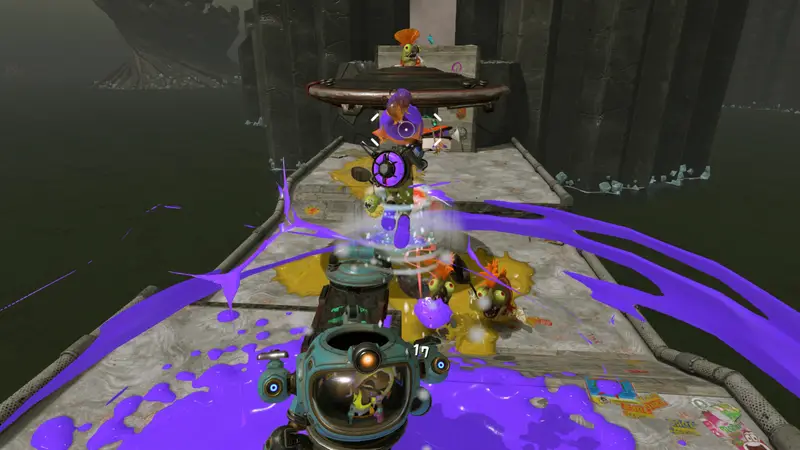
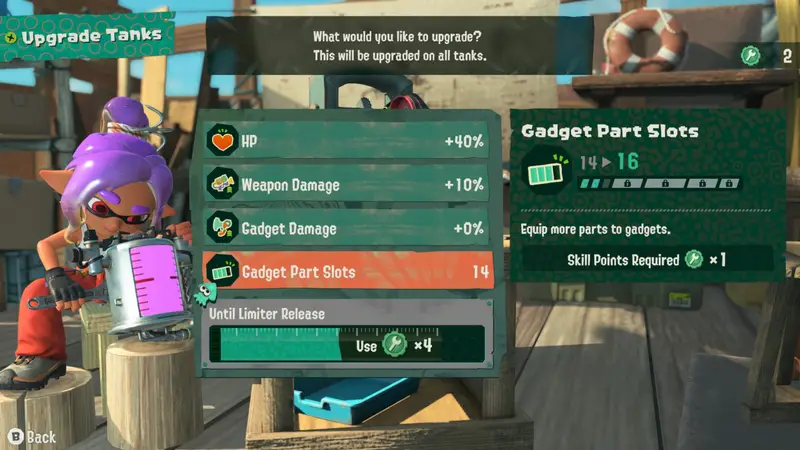
The base mechanics start out the same. Players shoot their ink along terrain and towards enemies, which provide space for them to quickly maneuver in squid (or octopus) form. Instead of classes, playstyles in Raiders are structured around three unique Ink Tanks, focused on Power, Speed, and Tactic abilities that can be interchanged between levels. Each of these feature unique attributes and upgrade paths tied to their Gadgets; Raiders’ replacement for subweapons that help define the flow of combat.
Power and speed Gadgets range from a strong ground slam that wipes a group of enemies to a powerful dash forward that can help you escape an impending swarm, while tactics Gadgets enable the player to throw a turret to help fend off enemies from range. Initially only two Gadgets can be equipped per build, however each possess slots for Trinkets to be assigned to upgrade their stats and properties such as area of effect or elemental effects.
These, along with Splatoon’s wide arsenal of weapons accrued over the three mainline installments, set the baseline for the loot players will be rewarded with when they set out to raid the Spirhalite Islands. It’s here that they’ll encounter Splatoon Raiders’ distinct realisation of the series’ already brilliant combat loop owed to its excellent level design and broad enemy variety.
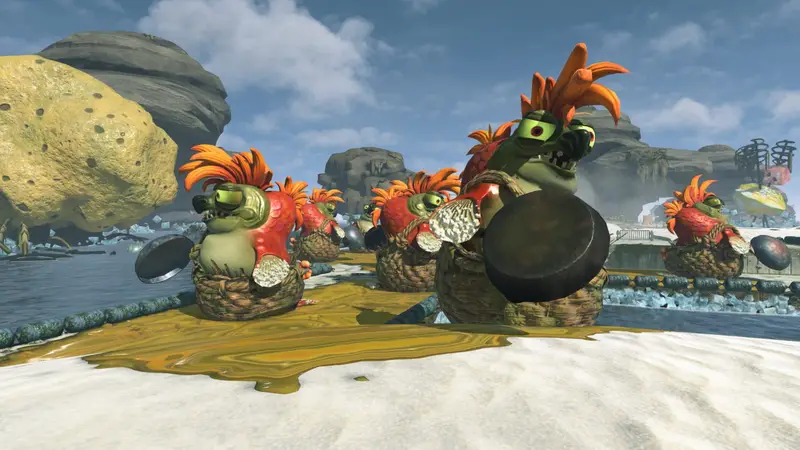
Returning from Splatoon 3’s Salmon Run, the Salmonids in Raiders take numerous shapes and forms that continue to ramp up in complexity as the campaign progresses, encouraging constant intricate manoeuvring and tactical positioning as strong as I’ve seen in the likes of Doom Eternal and Titanfall 2. The frantic tension is bolstered by smart level design that trims the tight corridors and clunky platforming of the previous campaigns for larger open levels that give plenty of room for tightly squeezing away from the intensifying Salmonid hoards.
The introduction of the Exploration Bot also adds a new dimension to exploration and combat opportunities. This NPC companion can be controlled by one of the Deep Cut members during each level, supporting the player during battles and allowing them to make use of one of each character’s ultimate abilities and gain extra verticality when spring jumping from it. This gives way for extended maneuvering when facing large crowds and diverse level designs with stronger platforming elements than those found in past entries.
All of this contributes to a quickly addictive flow of character progression and combat experimentation that continues to intricately build right up to and beyond the credits. That’s because even after the nearly 20 hours it took me to reach the finale, Splatoon Raiders ensured it wasn’t done with me, revealing a plethora of complex post-game content for me to sink my teeth into in the grind towards its level cap. Part of this is presented early on, when “Spicy Raids” are introduced, allowing players to revisit earlier areas at higher levels in reward for rarer upgrade materials and loot drops, but even these achieve a higher tier of complexity in the post-game.
Needless to say that if Nintendo’s decision to price this as a budget release left you concerned that it’s nothing more than a passable incremental spin-off, much as my assumption was before playing it, you are sorely mistaken. Even as a solo player, teaming up with random online Inklings and Octolings for cooperative multiplayer raids has borne great results, both in terms of online connectivity and in rewards, with difficulty also scaling appropriately to keep each party member on their toes.
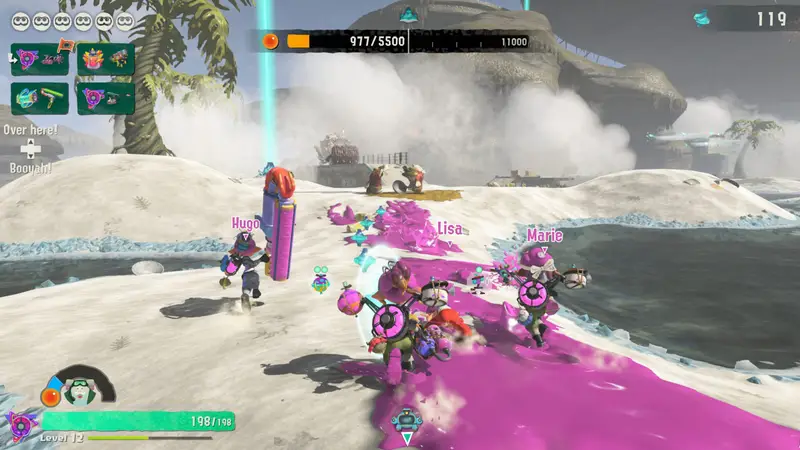
The experience wouldn’t be nearly as rewarding as it is without a carefully designed difficulty curve that isn’t above blindsiding you with a few harsh spikes as its conclusion approaches. Extraction isn’t the aim of the game here though, as even failures allow players to return to the Hideout Ship with the loot they’ve acquired in tow to come back stronger. The difficulty is generously balanced to allow for experimentation well past the opening, which meant that even when I was stuck on a single dungeon for a few attempts I could still feel myself making meaningful progress, oftentimes just one adjustment off overcoming any hurdle.
As with other movement shooters, the controls only become more complex over time. If you had difficulty with the previous games’ twitchy control schemes centered gyroscopic aiming, there’s a chance that Splatoon Raiders will help onboard you thanks to its more generous learning curve and PvE combat, although even as a long-time fan I’ve never been particularly fond of how the series has controlled on the Switch hardware itself. Compared to using the Switch 2 Pro Controller, gyro aiming in handheld mode seems less consistent and more prone to drifting, requiring me to press the recenter button frequently to control the camera in the heat of battle.
While still envisioned as a spin-off, Splatoon Raiders’ tightly focused progression loop and diverse combat sandbox offers a new branch in the path forward for Nintendo’s freshest shooter franchise – one that I’m hopeful to see expanded on either through continued support or bold iteration in the future.
Visuals & Audio
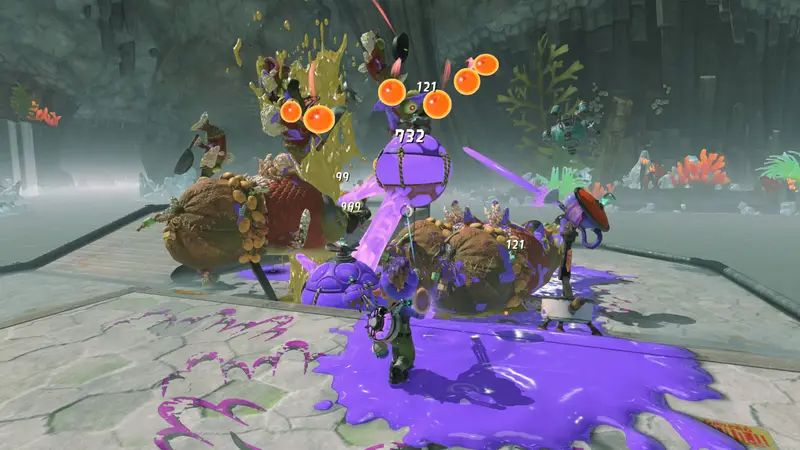
Graphically, Splatoon Raiders is perhaps underwhelmingly on-par with Splatoon 3’s Nintendo Switch 2 upgrade, even slightly undercutting it in terms of raw resolution numbers. It’s understandable why there’d be some disappointment surrounding this given that it’s a year two first-party Switch 2 title that seems to have initially taken life as a Switch 1 game, but having fought through its vast Salmonid hordes it’s clear as to why this needed the next-generation technology to reach its full potential.
Beyond matching the distinct character animation and strong art direction of the previous game, Splatoon Raiders’ gameplay relies heavily on the ever increasing Salmonid numbers to create its scrappy shooting galleries that, despite its intensity, never once taxes Nintendo’s latest hardware no matter how many characters or effects are crowding the screen.
The UI also deserves some praise for how Nintendo has managed to streamline its presentation in a genre that is often home to some of the worst menus in modern gaming. I rarely encountered any friction when navigating its inventory or reward menus, and even in the busiest of encounters it’s always easy to read both the environment and HUD elements without drifting focus too far away from combat.
My biggest disappointment with Splatoon Raiders and a major downgrade from the mainline single-player campaigns is in the music. To capture the atmosphere of the Spirhalite Islands, the catchy garbled pop tunes and bustling electro beats of the past are replaced with often unmemorable ambient tracks, most of which are lost in the busy sound mix.
Most of the time these tracks are unmemorable purely due to their buried mixing but the ones that do poke through don’t leave a great impression compared to past soundtracks. There are moments where Deep Cut take center stage and deliver some catchy squid pop, and others where more familiar sounding electronic tracks appear, but more often than not I was left wishing the score had stuck closer to the series’ distinct style overall.
Verdict
Through laser sharp design in its progression and combat mechanics, Splatoon Raiders offers one of the best shooter campaigns of the year. It takes all of the learnings from its predecessors and expertly adapts them to an addictive looter shooter that’s packed to the gills with content and wrapped in a delightfully endearing package.
Splatoon Raiders is available now, exclusively for Nintendo Switch 2.