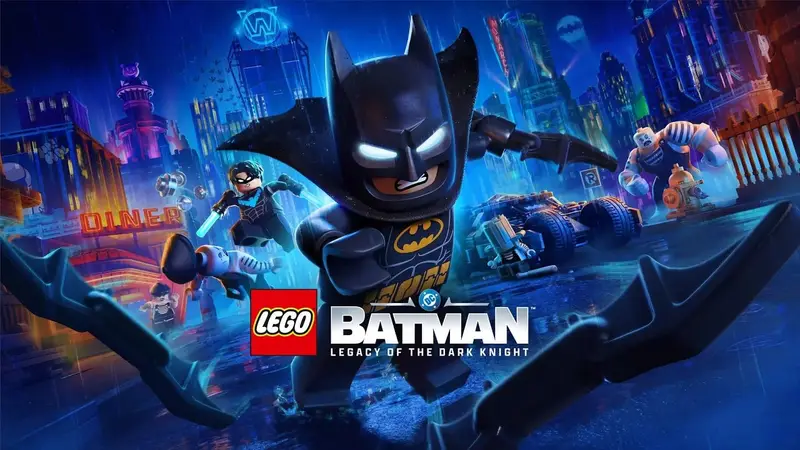
Not long ago, the LEGO video game series was an all gas, no breaks machine with developer Traveler’s Tales and its various subsidiaries pumping out multiple titles a year until the release of 2018’s LEGO DC SuperVillains. Following this, the team and publisher WB Games decided to take a more considerate approach to the construction toyline inspired games, taking four years to develop the far more ambitious LEGO Star Wars: The Skywalker Saga, which carved out a new identity for the LEGO games as mechanically diverse, family friendly open world games.
It’s perhaps fitting then that the team’s next task after relaunching the series was to adapt these teachings to the Batman franchise. Batman has been in a similarly rough spot with video games since the conclusion of Rocksteady’s beloved Arkham series in 2015, with multiple VR games carrying the torch to varying levels of success. Since then there has also been the middling reception to the co-operative focused spin-off Gotham Knights, and the dramatic failure of Rocksteady’s follow-up, Suicide Squad: Kill the Justice League. With Warner Bros seemingly not knowing where to take the series next, and another Arkham game likely years away, something was needed to bring the Caped Crusader back into the fold as other masked heroes have taken the spotlight in his absence.
By marrying the slapstick fun and mechanical simplicity of its LEGO universe with the fundamentals that made Rocksteady’s incarnation of the vigilante so great, LEGO Batman: Legacy of the Dark Knight has taken that mantle as an approachable and wonderfully lighthearted return from the World’s Greatest Detective.
Narrative
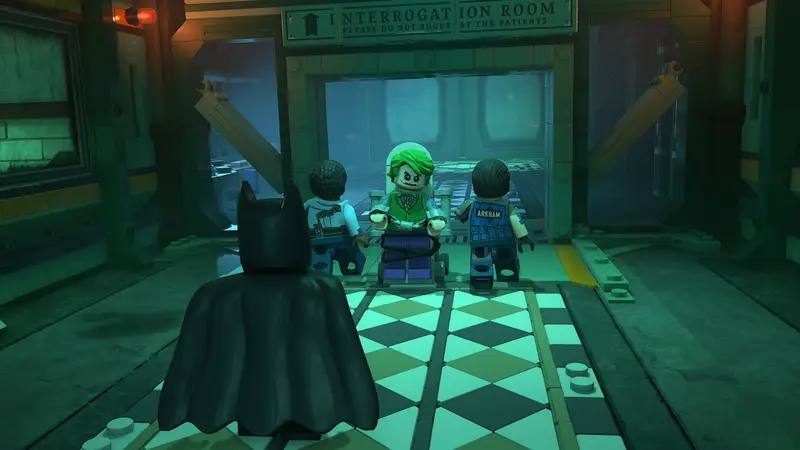
This fourth entry in the LEGO and DC Comics crossover is a reboot of sorts. Similar to The Skywalker Saga, it adapts almost all of the main live action Batman films starting with Tim Burton’s 1989 film starring Michael Keaton. The difference here is that Legacy of the Dark Knight takes pivotal moments from these films and works them into its linear story rather than giving the players the option to play through condensed versions of all of the films.
The story starts with a spin on Batman Begins’ depiction of Bruce training with Ra’s al Ghul, before spinning its own version of Bruce’s meeting with Jim Gordon as seen in 2022’s The Batman, before once again shifting its attention to The Joker’s origin story from the 1989 film. These lead to fun opportunities for humour, such as creatively explaining how the suave and theatrical Jack Nicholson Joker becomes the deranged and maniacal Heath Ledger incarnation.
All of this is the same flavour of comedy that fans have come to know and love from past LEGO games and films. The writers are unafraid to take jabs at the silliest elements of the DC universe and even manage to incorporate some deep cut villains such as Condiment King and Egghead. Like all humour, whether it works for you will be a matter of taste, but there was just as much that made me laugh that didn’t, and even the bits that didn’t land for me felt like they’d probably go down well with children.
In terms of storytelling, LEGO Batman: Legacy of the Dark Knight is safely the most ambitious title this studio has crafted at least since the mostly original LEGO City: Undercover. Its light hearted tone never lets up and is sure to tug at the nostalgia of anybody who grew up with the films and other pieces of Batman extended media. It also manages to come just short of outstaying its welcome while clocking in at a reasonable 13 hours, at least during my playthrough.
Gameplay
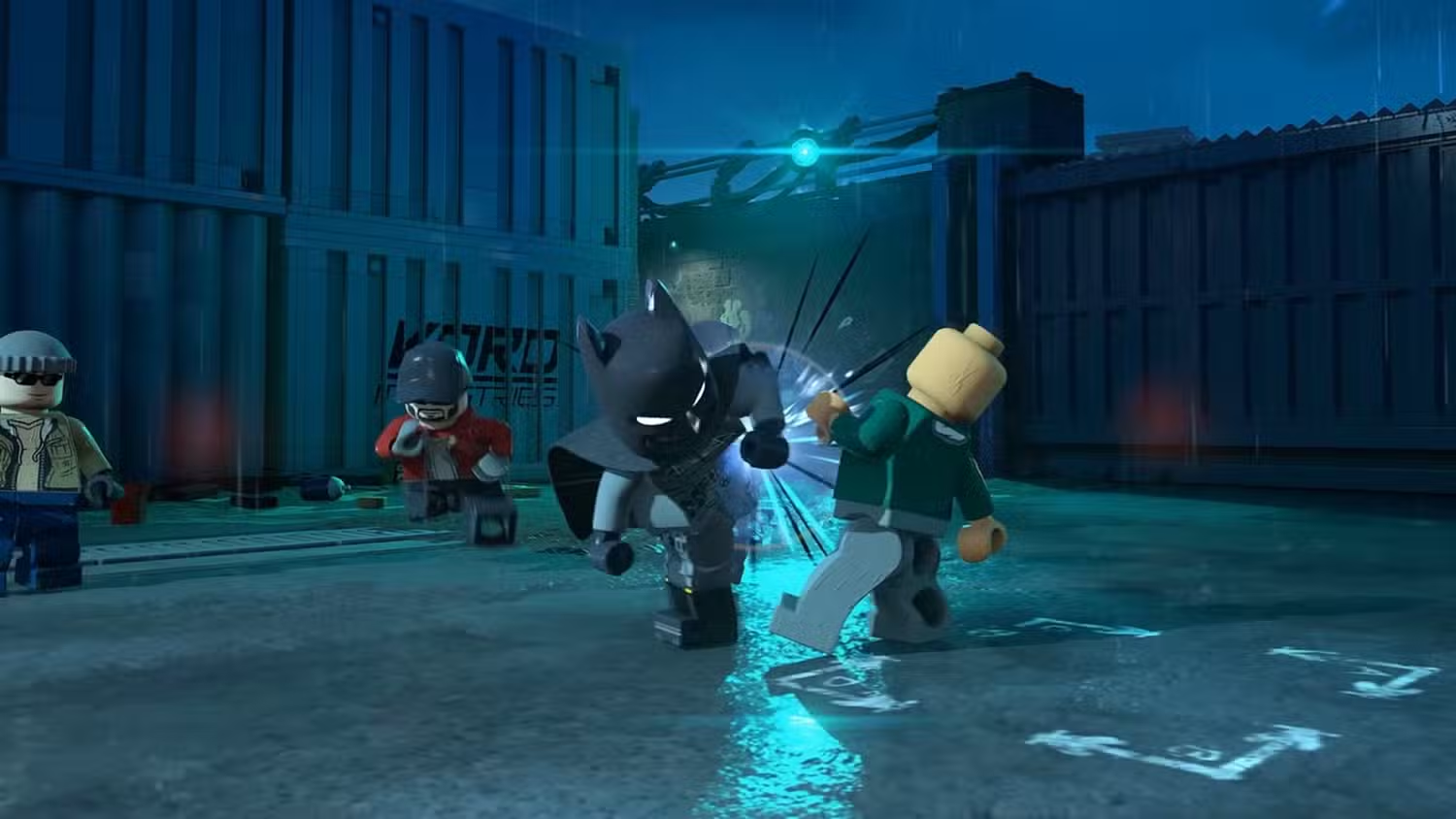
As previously noted, Legacy of the Dark Knight’s gameplay takes a lot of inspiration from Rocksteady’s Arkham series while still maintaining the feel of TT Games’ recent LEGO titles. The majority of main story missions take place in distinct linear levels where players solve puzzles using Batman and the Batfamily’s unique abilities that unlock as the story progresses, while taking down enemies in either combat or stealth.
Combat is a direct adaptation of the ‘Freeflow’ combat system that defined Rocksteady’s trilogy. That said, the feel of combat has been simplified substantially, with more basic enemy attack patterns and less depth to the skill tree, which doesn’t offer any unique abilities or combos. Each playable character also has a focus meter that rises as they fight, allowing them to perform a slapstick ultimate ability that instantly wipes enemies. These help to keep things engaging, as mashing the attack button and occasionally countering can sometimes grow dull as enemies flood arenas.
Of all of the games that have lifted the Freeflow combat system, Legacy of the Dark Knight’s take feels solid but lacks depth, mainly owing to the fact that combat is just one of the many elements the game is balancing in its attempt to blend everything that’s made playing as Batman great before it. If one thing is for certain then it’s that it is a vast improvement over the combat of previous LEGO Batman games, and is almost certainly the best in TT Games’s LEGO series.
Stealth is also heavily inspired by the past Batman series, but pales in comparison to the combat. While the fundamentals are here, with characters wielding the ability to sneak attack enemies and grapple to surrounding environments for cover, the lack of gadgets or other means to manipulate enemies from the shadows leave most stealth sequences feeling clumsy and make detection feel inevitable. The gadget system is deliberately limited as to not overwhelm younger players, and rightfully so, but the lack of variety leaves the stealth feeling like an afterthought.
Open World
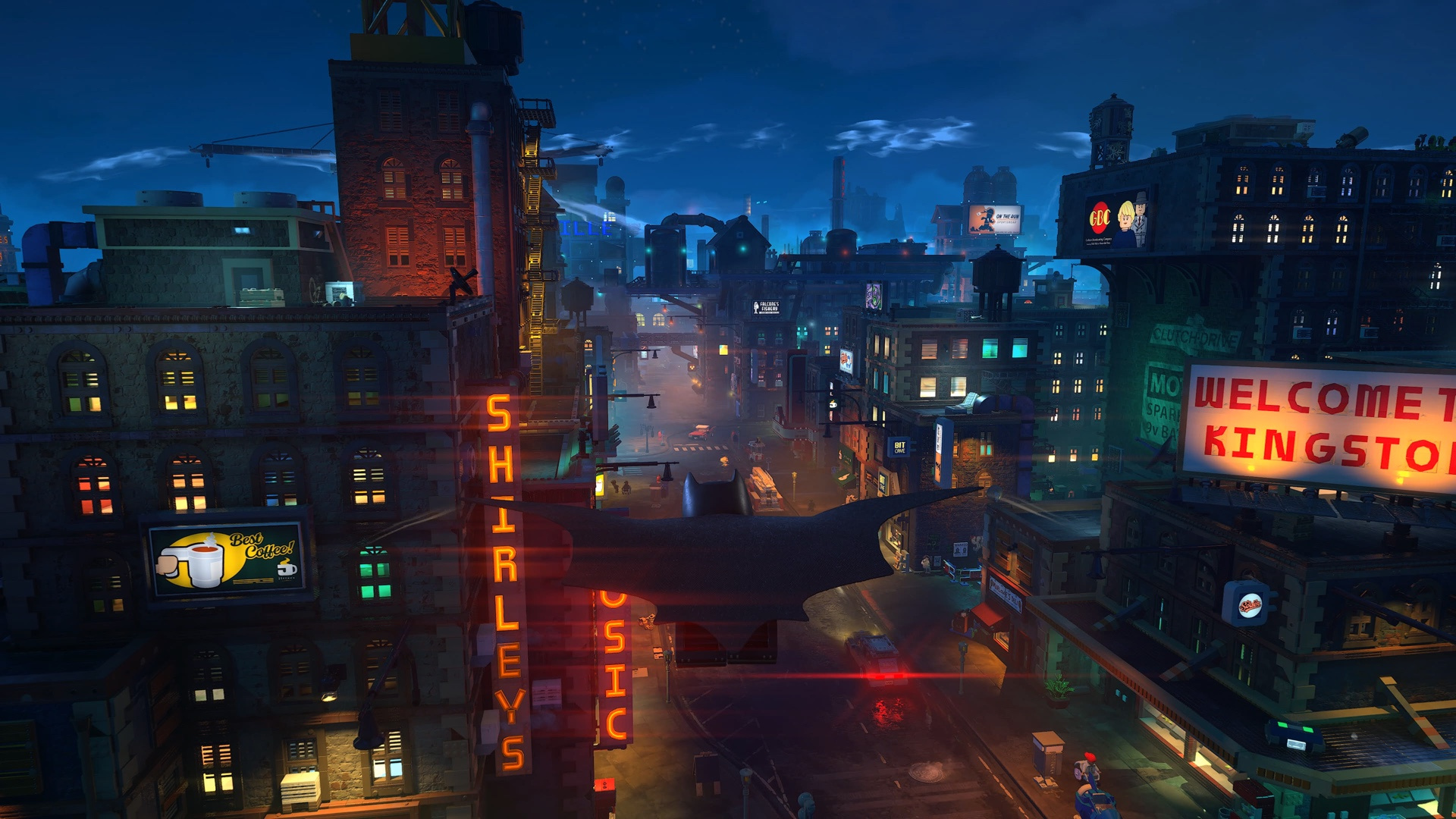
The open world Gotham is designed similarly to the environments found in previous free roaming LEGO titles. It’s thankfully one of the more reasonably small open world maps that I’ve experienced in recent memory and feels appropriately sized given the limited variety of activities to be found. Throughout Gotham players will solve Riddler puzzles, complete racing, combat, and traversal trials, open up ‘SubWaynes’ (the game’s fast-travel checkpoints), and partake in more activities that are unlocked as the story progresses.
Traversal is split between the option to drive the Batmobile or grapple and glide around the city, although these features don’t fully come into play until the second chapter. While the open world is split into three segments that are gradually opened throughout the main story, traversing the open world during the opening chapter is a complete slog due to the withholding of abilities such as grappling and gliding. This happens to be one of the longest story sequences in the game, meaning it takes a bit too long for the game to fully open up, but once it does the player is given all of Batman’s traversal options at once, making getting around the city far easier.
Everything is exactly as those who have played the Arkham games will remember them with regard to grappling and launching off of buildings, but the gliding feels noticeably different, with the default option feeling more akin to Spyro the Dragon’s in terms of floatiness. It isn’t as much of an issue in the open world and actually allows for vast distances to be traversed in no time, but during the linear levels it can be awkward trying to shift between vantage points and properly land from above.
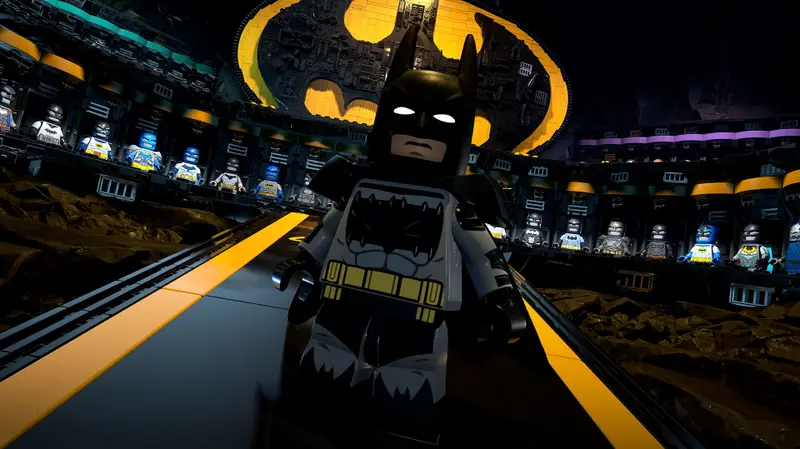
Between missions players can also relax in the Batcave. Legacy of the Dark Knight’s Batcave features an impressive variety of customization options, with it even being possible to fully decorate some corners with a suite of items that can be bought from Batmite. Here, players can also admire and unlock new suits and vehicles, and partake in even more side activities. It’s charming seeing cozy game elements incorporated into LEGO Batman of all things, and I can imagine that it’s bound to steal hours from those who have always fantasized about designing their own Batcave, even if the scope of the customization is limited.
While the brick building has been sidelined (but crucially not erased), LEGO Batman: Legacy of the Dark Knight succeeds in adapting everything that fans have missed from the Batman franchise’s past video games into something that can be enjoyed both alone or with family and friends in local co-op, making it the perfect entry point for those looking to virtually wear the cowl, albeit a plastic one.
Visuals & Audio
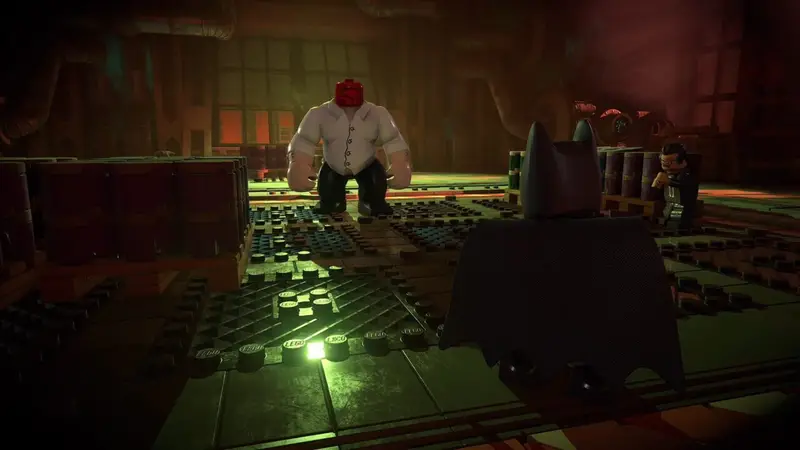
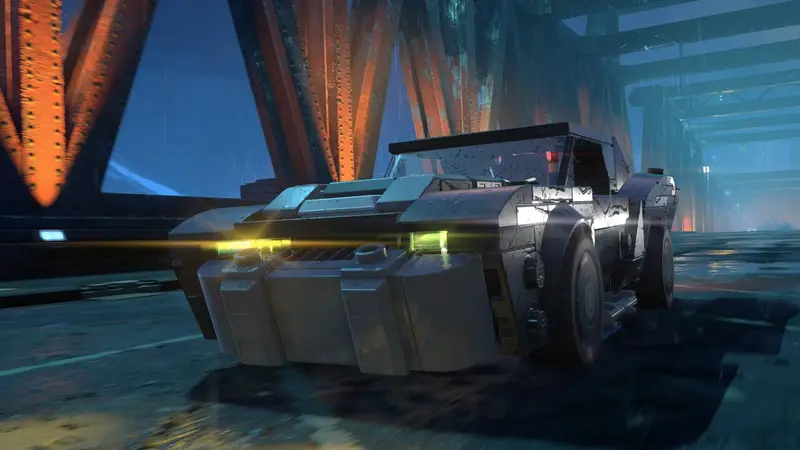
Visually, Legacy of the Dark Knight is the best looking game in Traveler’s Tales’s series to date. The rendering of materials is leagues above what the studio has achieved in the past, with noticeable wear and scratches on characters under specific lighting being a standout. Unlike other titles such as LEGO Horizon Adventures or the LEGO Movie game adaptations, this studio’s usual work blends plastic constructs with realistic environments, which can sometimes leave the art direction looking somewhat inconsistent but the bump in visual quality does both justice here.
On base PlayStation 5 the game features a quality and performance mode, the former of which locks to 30 frames-per-second, with the latter locking to 60. Performance mode is not accessible during local co-op, however there are impressively few limitations on the open world here. Both modes look great, with my preference going towards the performance mode, although there are sequences where the frame-rate seems to fluctuate between 30 and 60 frames-per-second later in the game.
Much like past entries, the music lifts heavily from Danny Elfman’s scores for the ‘80s films and ‘90s animated series, but there are some surprising licensed tracks that have appeared throughout the films. The voice acting is somewhat inconsistent though. While most characters are fine, Batman’s feels like a weak impression of Will Arnett’s take on the character from the LEGO Batman film and lacks range for some of the wittier lines, while Talia al Ghul’s never seems to commit to a distractingly comical French accent. Alfred’s actor delivers some of the best lines in the game and What We Do in the Shadows star Matt Berry’s take on Bane is exactly as hilarious as you might have imagined given the casting.
Finally, some bugs persist post-launch. Nothing severe, but hit detection during combat can be troublesome, with auto-advancing attacks towards enemies failing to connect at times. I also encountered some audio desync issues during cutscenes, sequences that lacked sound effects, and random crimes-in-progress that failed to load.
Verdict
LEGO Batman: Legacy of the Dark Knight creates a clever throughline between the imagination of the brick-building video games and the mechanical genius of Rocksteady’s Arkham series, resulting in the strongest LEGO game yet. Full of endearment to its source material and approachable for audiences of almost all ages, regardless of whether your childhood Batman was Adam West or Robert Pattinson. It may not be quite the hardcore video game comeback we wanted from the Dark Knight, but it’s a surprising win nonetheless.

LEGO Batman: Legacy of the Dark Knight is available now for PC, PS5, and Xbox Series X/S. A Nintendo Switch 2 version is slated for later this year. The game was reviewed on PlayStation 5.