
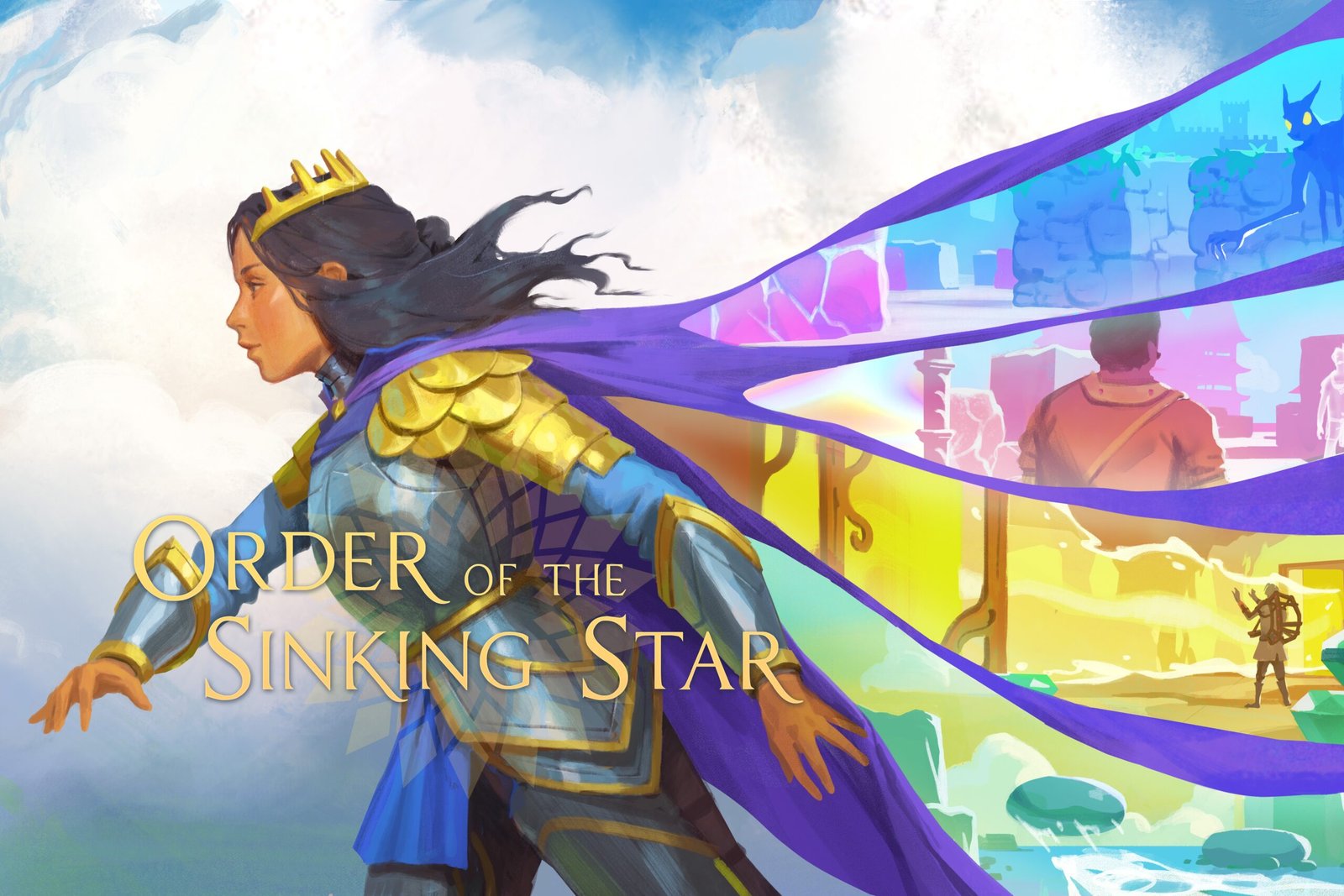
It’s hard not to have high expectations for Order of the Sinking Star; the third game led by renowned game designer Jonathan Blow. It’s based on the work of three of the game industry’s best puzzle designers, and packed with more than 1,000 puzzles. As a fan of Blow’s previous titles (Braid, The Witness) and sliding-block puzzling, I considered OSS a must-play this year, and I plunged headfirst into its labyrinthine world with a mix of anticipation, curiosity, and a hint of apprehension. While I delighted in Order of the Sinking Star’s brilliant, evolving puzzle design, the whole experience felt bogged down by the heavy trappings of the game’s worldbuilding and narrative elements, leading me to wish that they just weren’t there.
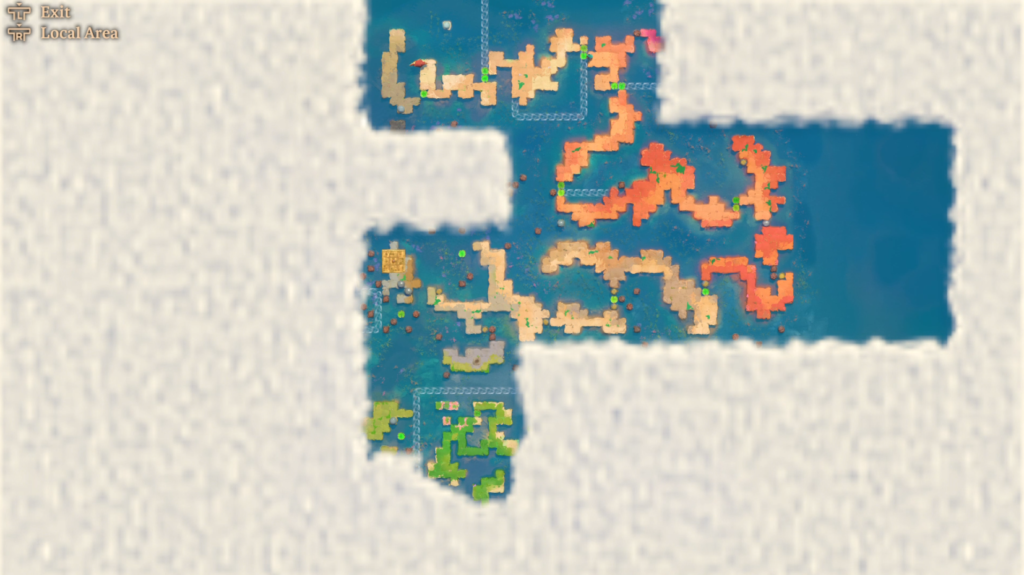
The Order of the Sinking Star, led by Jonathan Blow and developed by his studio, Thekla, Inc., is a colorful, sprawling Sokoban (sliding block puzzle) game, with an overworld of star-shaped “doorways” leading to individual levels scattered across its grid-based expanse. You traverse the overworld as a regal queen who has randomly appeared in this world of puzzles, screen by screen, with a fog of war covering the areas you have yet to visit. Most of these areas act as puzzles themselves, mirroring the mechanics of the region you are exploring, and often I would find myself unable to reach certain screens until beating specific levels to remove blockades or unlock shortcuts. Thankfully, OSS has a fun fast travel system where you teleport to a miniaturised version of the overworld to walk between sun-shaped fast travel points on the ground.
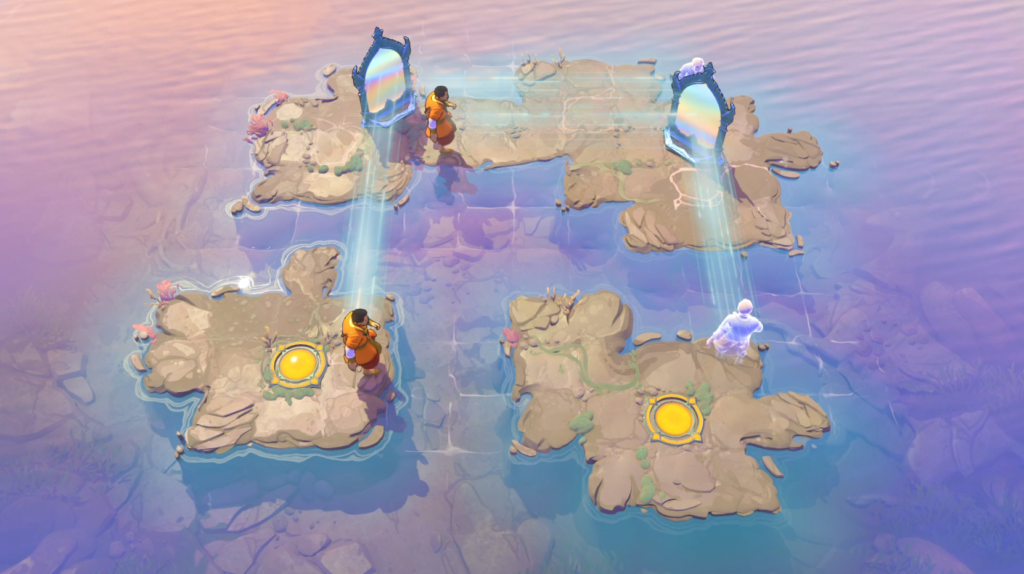
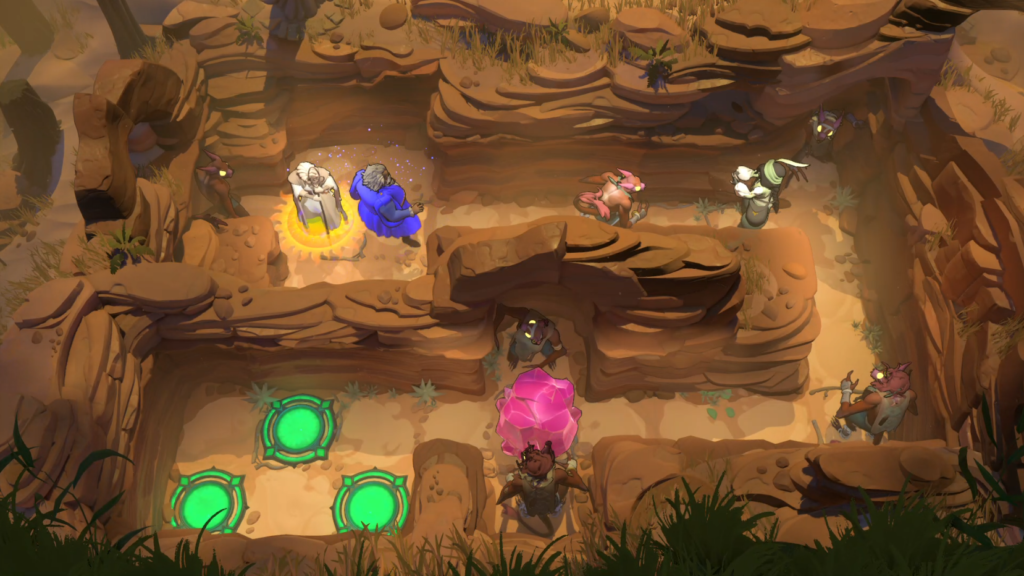
You start at the centre of this overworld, and in the four cardinal directions of North, South, East, and West are four regions, each with its own collection of puzzles with their own mechanics and characters. These four regions are the basis for OSS and were originally designed as individual puzzle games by three different designers: Alan Hazelden (Skipping Stones to Lonely Homes, Mirror Isles), Sean Barrett (Promesst), and Jonah Ostroff (Heroes of Sokoban). These four games-turned-regions act as the foundation for the rest of OSS, offering a wealth of different mechanics to discover and experiment with, from the seafaring merchant using water currents and skipping stones to travel across sandy archipelagos to a full Dungeons & Dragons-style adventuring party, with a fighter who can push things, a wizard who can swap places with various objects, and a priest who protects themselves and their neighbours from taking damage.
These regions stick to their own mechanics and explore them to their limit; but what ties them all together, and OSS as a game, is the spaces between them, where worlds collide, characters meet one another, and mechanics are intertwined. This is where the puzzles shift up a gear in complexity, requiring you to not only recall all that you have learned so far about the various rulesets you have encountered, but now understand how they interact with one another. These were some of my favourite puzzles, and the ones I spent most of my time furrowing my brow, trying and retrying various methods until either working out or stumbling across the answer hidden right in front of me. Some might be put off at the idea of being roadblocked by a puzzle, but that is where OSS’s large-scale and fast-travel system comes into play, offering alternative paths for you to explore and puzzles to solve. Often, I found that taking a break from a puzzle to attempt another not only led to further progress but also helped either give me a fresh perspective on the previous one or helped me learn something new to experiment with.
The keys to making all of this puzzling work and feel satisfying are a few cleverly implemented mechanics that take a lot of the friction out of the moment-to-moment puzzling and exploration. The first is the option to rewind any movement you have made by one step with the press of the button, which will speed up if held down to go back quicker. The second is the option to reset a puzzle (not usable in the overworld), which you can also undo by rewinding. The last mechanic pulls you back from what you’re looking at, giving you a full view of the overworld from two distances, or any multiscreen puzzles in their entirety. These options make the trial-and-error of puzzle-solving much less time-consuming, as well as making it easier to see where you need to go next, or a puzzle element you may have missed. This little toolset was invaluable during my 50-plus hours with OSS, and I dread to think how long I would have taken to see credits without them.
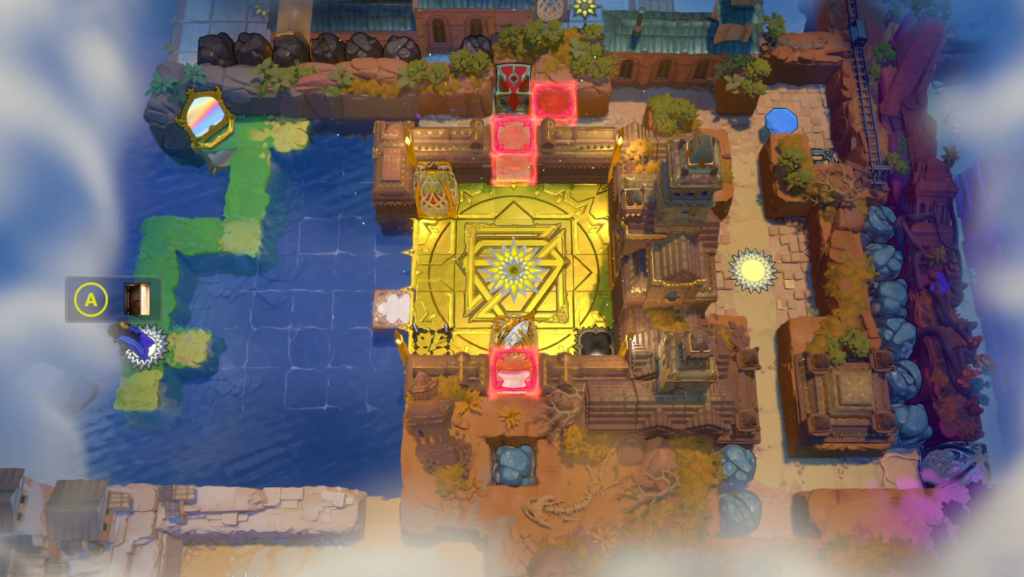
Speaking of credits, Order of the Sinking Star has several endings, and while I did play past this point, I interpret reaching the first ending as a standard playthrough. As you explore the overworld as the queen, entering and solving puzzles to unlock interactions and remove obstacles back in the overworld, your goal is to solve the Gold Room puzzles. The first stage is to reach these conspicuous gold platforms, then complete their puzzles, after which you need to finish at least six other puzzles in their respective region. This opens a teleport which, when all are activated, unlocks a final puzzle. It’s a steep but steady climb up this pyramid of puzzles, and I never felt that I was at a complete loss. OSS’s open-world design, puzzle variety, practical toolset, and constant stream of eureka moments work in harmony to make the game challenging but fair.
Another factor that elevates the whole experience of playing OSS is its visuals and art direction, with each environment, character, and object looking and feeling distinct and easy to read from a gameplay sense. The game is awash with colour, perfectly exemplified by the adventuring party and their outfits, each one wearing one colour to make a full spectrum when gathered together. Regions also have individual details and topography, the dark, gem-littered caverns intermingled with arid, sand-covered ruins and dense jungles, and I particularly liked when a puzzle was framed by elements in the foreground, giving the impression of peeking into their world from beyond. Coupled with some satisfying sound design and gentle music that rises and falls to avoid becoming irritating, the audio-visual execution and feedback are fantastic. I will say that while the game runs smoothly for the most part, it did chug now and then on the overworld, dropping frames for a few seconds.
However, while OSS has some of the best puzzles this year, and certainly the most impressive collection, I found the world, characters, and narrative threads to be unassuming at best and dry and obnoxious at their worst. Much of the writing in the game feels verbose for the sake of it, and dialogue between the cast feels awkward, with barely a straight sentence said between them. This also goes for the audio logs you find in the overworld as the queen, left behind by a man who explored this space before you. I found that these were just long-winded descriptions of what I had already seen or experienced in the game, or ruminations left hanging unanswered. There are even moments that felt like they were meant to feel eye-opening or impactful, often leaning into meta elements about game design, but these either came off as patronising or navel-gazing.
Ultimately, there is very little to dig into around all of OSS’s puzzles, and while that wouldn’t matter in the majority of pure puzzle games, OSS offers a mysterious world with various commentaries running throughout, but none of them are interesting. Every high from a solved puzzle or moment of progress was dampened by the game’s obtuse writing and worldbuilding, like a heavy, wet blanket.
Final Thoughts
Order of the Sinking Star’s sprawling world is a triumph of puzzle design, giving its countless mechanics room to develop, intersect, and surprise long after their initial introduction. Yet while its interconnected structure gives the gameplay a genuine sense of depth, the same cannot be said for its narrative. Its verbose dialogue, meandering audio logs, and self-conscious musings on game design seem to reach for the sort of philosophical complexity that defined Blow’s previous works, but rarely offer anything worth reflecting on. The result is a game whose puzzles continually reward curiosity, while its attempts at profundity leave me wishing there was less to read and more to solve.

The Order of the Sinking Star is out now on PC, PlayStation 5, and Nintendo Switch.
The Order of the Sinking Star was reviewed on PC with a controller.
We would like to thank Thekla, Inc. for the review key.
Have you picked up Order of the Sinking Star? How are you finding its plentiful puzzles? Let us know in the comments below, and join the Gamer Social Club Discord to chat about your favourite games, play in community game nights, take part in giveaways, and more!