Despite coming of age as an anime fan in the early 2010s, I’ve never had much love for the Isekai genre. Even in parody, stories of average everyday humans being transported to fantasy worlds have rarely appealed to me despite my entrance into anime culture at the zenith of popularity for franchises such as Sword Art Online and Re:Zero.
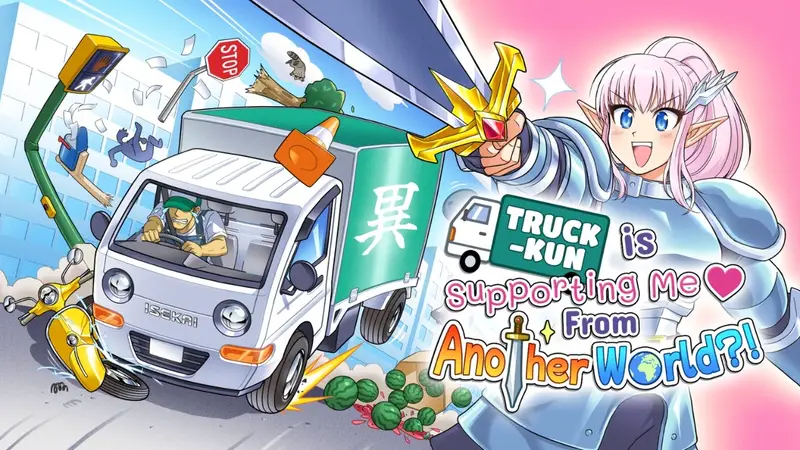
It’s perhaps because of this disposition that ‘Truck-kun is Supporting Me from Another World?!’ caught my attention. It’s a game blatantly riffing on the eponymous ‘Truck-kun’ trope with an arcade gameplay spin reminiscent of Crazy Taxi and developed by Strange Scaffold, a studio that’s past projects have built a cult following for their witty writing and satisfying gameplay loops.
While there are instances of this charm to be found in Truck-kun is Supporting Me From Another World?!, it quickly wears out its welcome with a barebones structure and lack of gameplay variety that fails to sustain its modest 3-4 hour runtime.
Narrative
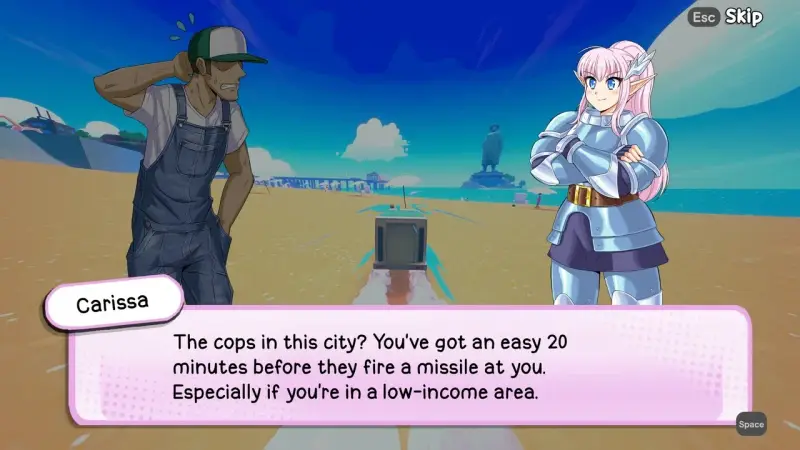
Truck-kun is Supporting Me from Another World?! starts as most Isekai do – with protagonist Clarissa being hit by a truck on the way to work just as she is set to receive a life-changing promotion. As she awakens in a fantasy realm she retains communication with her real-world, truck driving assailant, and the two quickly learn that she can return home by wielding the truck’s magical connection to this fantasy realm to aid her in defeating the Skeleton King.
Amid the absurdity of its anime tropiness and deliberate camp there are moments where Clarissa and the Driver’s discussions briefly touch on serious topics such as burnout culture and escapism. Thankfully, the game doesn’t approach these conversations in a way to present itself as more serious or important than it is, retaining a comedic backbone right up until the credits roll, which I admittedly found to be a bit refreshing given the juxtaposition of its gameplay.
Put bluntly, I can’t imagine Truck-kun’s world, characters, or story sticking with me – and honestly, I’m fine with that. The game bills itself as an “OVA-sized campaign”, and it’s comfortably found itself nestled in the cache of my memory alongside all of the forgettable but fleetingly fulfilling OVAs I watched on KissAnime as a teenager.
Gameplay
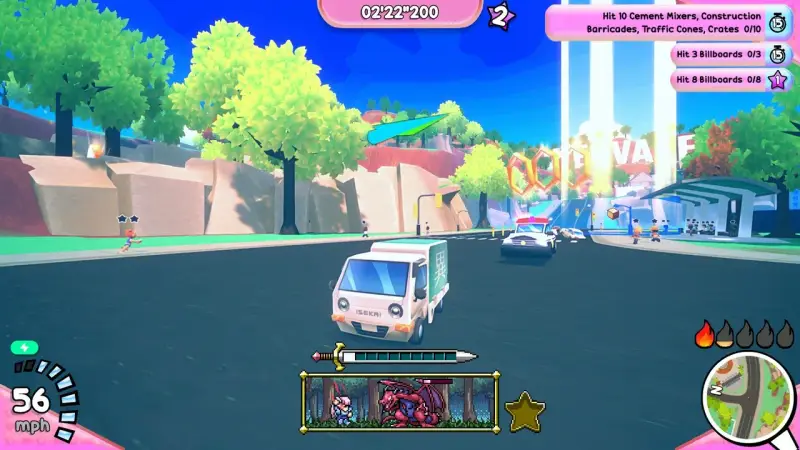
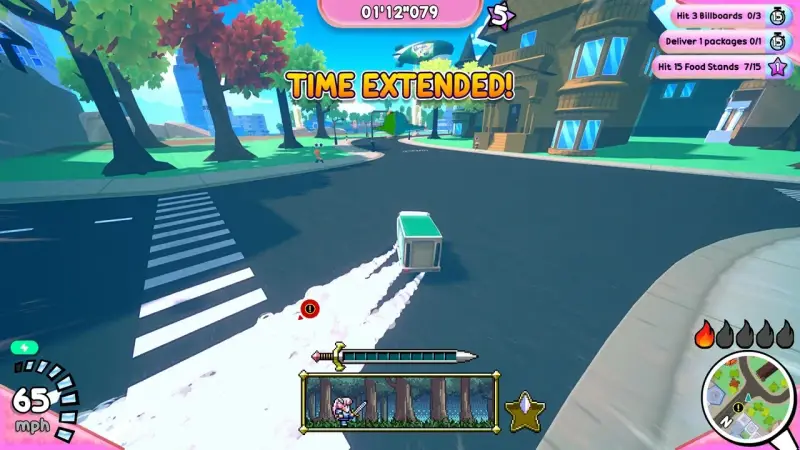
From here the game takes on an arcade-like structure, centered around timed runs through an open city where completing fast-paced objectives grants the player bonus time and stars, contributing to broader ‘Milestones’ that progress the story. These objectives range from simple tasks like driving a certain amount of meters in a specific direction, spending a designated amount of time in the air, and ramming into a set number of parked cars, but quickly intensify as time progresses.
There are also deliveries to complete, with a familiar giant green arrow assisting navigation as you contend with the micro-challenges to keep the timer going while traveling to your destination. It also isn’t long until Clarissa and the Driver attain the attention of the police, with them randomly spawning around the player to frequently obstruct your progress.
During all of this, a window at the bottom of the screen displays a pixelated Clarissa on her own journey, as ramming pedestrians sends enemies her way to battle (apparently they’re fine). The player can influence these battles by activating Clarissa’s ultimate attack once it has been charged up, adding an incremental turn-based element to the open-world traversal as defeating these enemies contributes to achieving a Star, which contributes to overall Milestone progression.
The frantic nature of completing tasks while managing Clarissa’s battles for Stars lend the early moments of Truck-kun a sense of thrill. I quickly took note of locations like a packed parking garage for when I needed to plough through a row of parked cars, and the beach for when I needed to decimate a couple of chairs, but after a few runs of familiarizing myself with the environment, a huge flaw with the game’s progression began to take form.
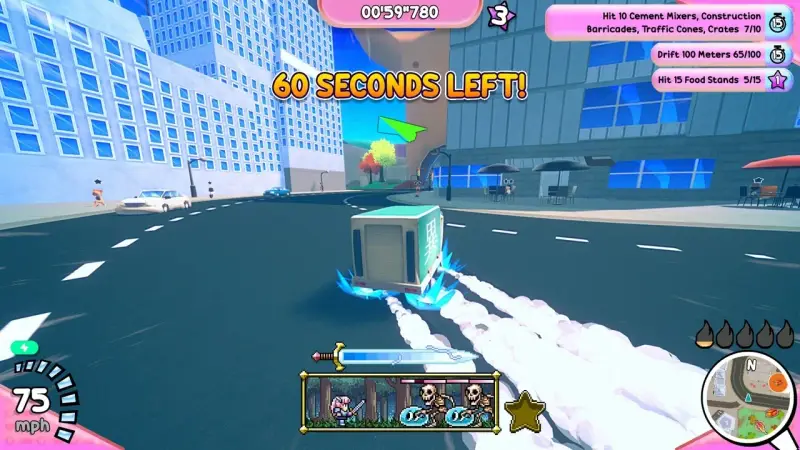
Once I was familiarized with the city’s layout, all that was left was to repeat the same patterns ad nauseam until I reached the finale, with the overarching Milestones quickly reaching the point of tedium. Around the halfway point, the game shifts from dishing out Milestones in batches, incentivizing completing multiple goals per run, to handing out egregiously dense challenges one-at-a-time, insisting on multiple runs (which can last up to 10 minutes) centered around completing very specific tasks like ramming a large total amount of pedestrians or completing a set number of deliveries to contribute to a single larger goal.
Completing runs with no sense of progression only highlights how shallow Truck-kun is Supporting Me from Another World?!’s design actually is. In terms of mechanics, nothing meaningfully changes between your first frantic race through its world and your last, bar from the actual finale sequence. These progression gates only seek to pad the experience, with the most egregious even forcing the player to complete an “Outing” after achieving all of the available Milestones, the only reward for which being a cutscene that introduces the next set of Milestones. This happens multiple times and feels like blank space where the designers forgot to come up with something to reward the player for engaging in the sole, static gameplay loop.
Given its arcade influences, it begs the question as to why this structure was implemented at all. There’s no traditional score system or leaderboard implementation, and once the game is complete there is no replay value outside of replaying the same unchanged loop again. All that is unlocked for completing the game is a free-roam mode that removes the objectives and time-limit entirely (although Strange Scaffold does promise a ‘Garage’ coming to the game roughly a week after launch, which will allow players to customize their truck. The lack of replayability or a bespoke mission mode feels like sorely missed potential for a game with such strong arcade influences.
Technical
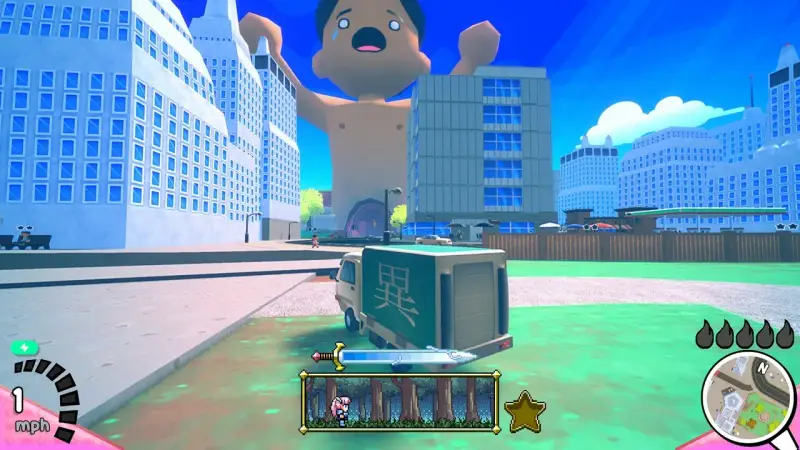
Another major issue stems from the game’s technical performance on PC. Given that its comedically written minimum requirements list asks for an Intel integrated graphics card and a vague “@ 2GHz” processor, you’d Truck-kun is Supporting Me from Another World is optimized to run well on a variety of low-end hardware. In my experience across both a dedicated gaming laptop and Steam Deck, the game’s optimization is very poor, with performance fluctuating aggressively below 60 frames-per-second depending on which part of the map I was traversing – with the Steam Deck dipping well below 30 frames-per-second at points.
This resulted in a dizzyingly unstable gameplay experience that required me to take breaks given the fast-paced nature of the game’s traversal. It’s made even worse by a lack of any graphics options in the game’s menus, leaving only one performance profile available even though it clearly wasn’t even demanding that much from my hardware.
As always, there’s the chance that there is better optimization prepared to arrive in the day-one build or even post-launch, but my experience with the review build was that of a severely unoptimized game that I can’t recommend to those that are sensitive to severely inconsistent frame-rates.
Art & Audio
As for the art of Truck-kun is Supporting Me from Another World, cutscene cinematics take influence from both early 2000s anime and visual novels with charming hand-drawn art setting the story in motion. It’s charming and invokes the same deliberately loud pastel aesthetic as those found in Doki Doki Literature Club and PC-Engine visual novels. The opening and closing sequences also benefit from appropriately campy voice acting, which I would have liked to have heard throughout the story instead of in its bookends.
The music is also catchy, featuring some ska and reggae influenced tunes from Dredge composer David Mason. The game only features a handful of tracks though, leading to them becoming repetitive in quick succession.
Verdict
It’s disappointing that even in the three and a half hours I spent making my way through Truck-kun is Supporting Me from Another World?!’s story, I was validated in feeling like I’d seen everything after my third or fourth romp around its small open-world. While I admire the modest scope that Strange Scaffold set out to achieve with this tightly focused premise, its structure is quickly burdened by a lack of variety.

Truck-kun is Supporting Me from Another World?! is available now for PC and Xbox Series X/S. The game was reviewed on PC and Steam Deck.
Gamer Social Club would like to thank Strange Scaffold and Frosty Pop for the review code.