When it comes to influential games, there are many names that get thrown around as pivotal historical points that have had a huge impact. Super Mario Bros., Doom, Resident Evil, Grand Theft Auto III. All of these games have gone on to define fundamental principles of game design that persist today.
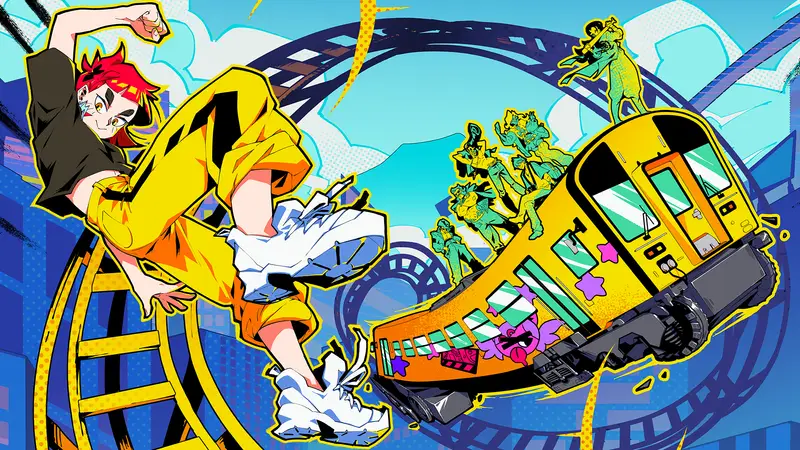
For every game that’s had huge ripples throughout the medium, there are a dozen titles that have had very specific effects on certain genres and subcultures within gaming as it’s grown over time. In this regard, it’s fascinating to watch the legacy of Tony Hawk’s Pro Skater and Jet Set Radio at play in Undercoder’s ‘Denshattack!’ – a game where you control a train through a series of environments, racking up scores by pulling off sick tricks and dodging hazards at lightning-fast speed. It’s a game that owes a lot to its very clear influences, but with a vision to mold their ideas into its own.
Gameplay
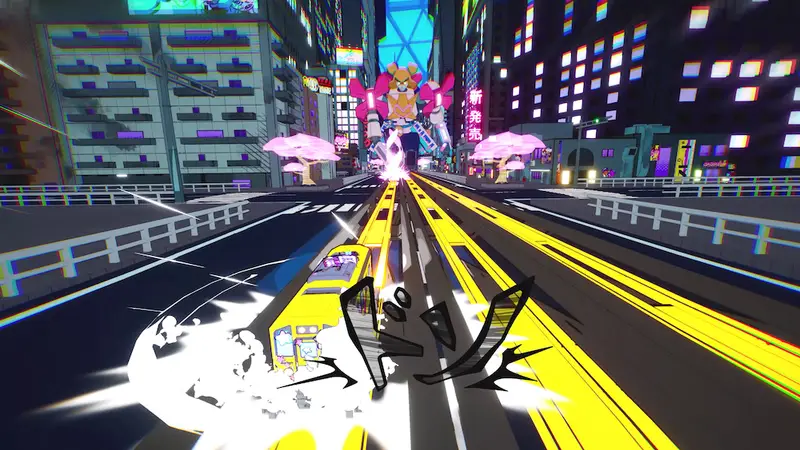
A bit like its forefathers, it’s hard to stick a genre on Denshattack! The game mixes linear 3D platforming elements with the arcadey high-score based trick systems of its influences to create something truly distinct. Regardless, from the second I set my locomotive into gear (that’s how trains work, right?) and the Hideki Naganuma-esque electro-funk started blaring, I knew Denshattack! was going to be something special.
Players control protagonist Emi’s train as it navigates on a series of (mostly) linear tracks, reacting and adjusting to all that approaches as you blitz by. From the outset Emi’s train can jump, drift, and grind, with each emphasizing the train’s considerable weight. Right from the first tutorial I found myself feeling incentivized to get creative with my tricks, with all of the possible input options for combos available right from the start. It’s as things progress that traversal itself becomes more complex, as Emi learns combo extenders such as manuals, mid-air lane switching, and even multi-lane drifting.
Levels rotate between linear goal focused stages, score-based trials, traditional races, and open stages that require the player to complete three objectives in a looping environment, with each route leading to a unique goal. Every level also features a set of ‘Dares’, themselves sub-objectives that reward the player with medals and act as the true completionist rewards. These range from collecting items scattered around each area to unique mini-trials, all of which are possible to complete on your first attempt.
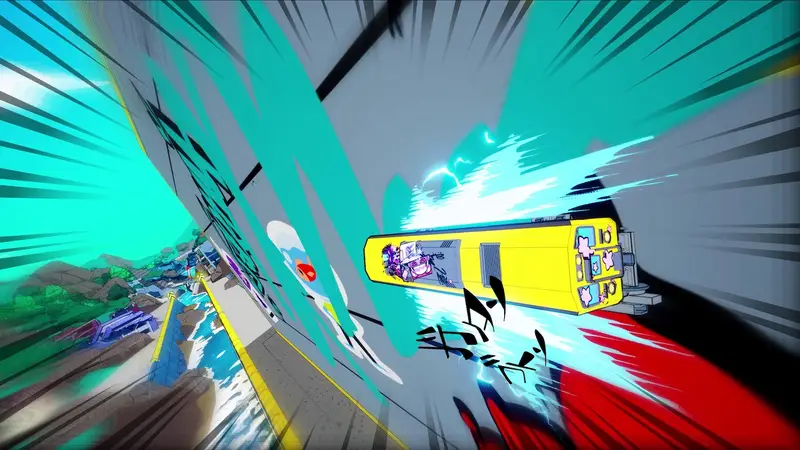
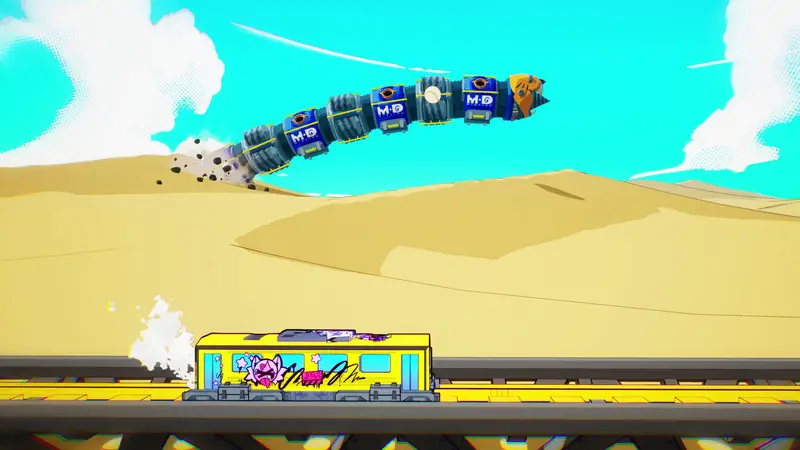
While this reads as a very limited set of stage types, things are generally kept fresh thanks to the variety in the actual goals that players are required to complete each time. Certain levels also end with boss encounters which is where the game really reaches into its anime influences with a scale of spectacle that continuously impressed me, getting me hyped up in the moment as I dodged and tricked around scenes that felt pulled right out of a Platinum Games title, even making similar swings for the occasional genre break.
Level variety is also supported by the rate of new mechanics being introduced. In the opening hours I was shocked at how many new traversal options were frequently being presented to me with each new region and sets of levels. That is… until around the halfway point.
Following the conclusion of chapter 5, Denshattack’s structure starts to lose steam (sorry) as it becomes obvious that the story’s commitment to a shonen anime structure of rival conductors becoming allies is beginning to hold the pacing in stasis, as Emi competes in the same couple of qualifying performances each chapter. This results in a series of fairly repetitive stages where the spectacle feels undercut by the pattern of progression that’s been established, and this feeling that I’d seen everything followed me through to the end of the game, even as new mechanics were introduced.
This isn’t to say that Denshattack! becomes boring or that it lost my interest, but that after a point the game feels beholden to its narrative structure, and I wrapped things up wishing that a good chunk of its levels had been split from the main story into some kind of challenge mode as tying the game’s progression and narrative structure wears each of them thin over time. Separating the two would have made for an experience that I’d likely be more interested in returning to over time.
Narrative
To speak on that narrative – Denshattack! follows a young ramen chef named Emi, who lives in the outskirts of Japan’s Kyushu region, delivering her specialty by high-speed train until she encounters a boy named Fernando. Fernando introduces Emi to Denshattack – a high-speed sport performed by competing against other train drivers with precision and style. Learning that she is a natural prodigy, Emi and Fernando embark on a journey throughout Japan to grow her abilities as a Denshattacker and uncover a truth behind a post-climate catastrophized country, ruled by a corporation forcing citizens to live in air-purified domed cities connected by railway systems.
As Emi and Fernando traverse each individual Japanese region they encounter Denshattacking gangs each based on distinct fashion subcultures. These almost all play out in that traditional shonen anime pattern of enemies recognizing a shared goal and joining the party as allies, to the point where the entourage eventually becomes so big that it feels like early game characters such as Fernando are forgotten by the writers until the finale approaches. All the while, Emi is centered as a prodigy of Denshattacking, growing her skills and climbing the ranks Pokémon or Yu-Gi-Oh style.
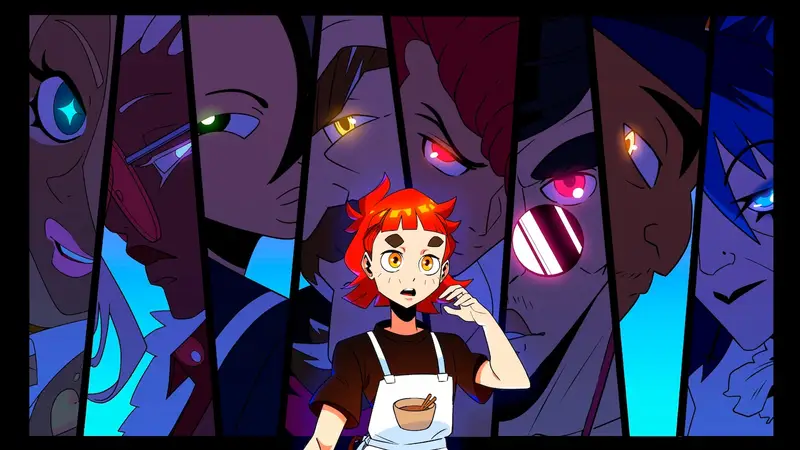
For all of the praise that I can give Denshattack’s anime influence and dedication to spectacle in its levels and boss encounters, it pains me to admit that the narrative itself ultimately left me wanting a lot more. There’s huge potential in its cast of train-conducting misfits, but despite the story’s intrusions on the game’s flow it never gives enough space for any of this crew to grow beyond their initial archetypes before being forgotten once the next major plot element or location is introduced.
It would also be easier to forgive the narrative’s hold over the game’s pacing if it had more to actually say. Upon introducing its climate apocalyptic setting, the opening cutscene’s narrator claims that the game’s world is “A future not so distant from yours.” It’s a tongue-in-cheek swing at light political commentary, sure, but it instilled somewhat of an unfair expectation in me as to where Denshattack’s writing would eventually land. The furthest the game goes in this direction is concluding on a fairly unremarkable anti-AI stance that has about as much weight as a modern Doctor Who episode and comes as a huge missed opportunity given how heavily it’s leaning into punk and anti-establishment culture with its main cast.
You could argue that it’s “not that deep” and that this is ultimately just a game where you can manual a train while Lotus Juice raps in the background and I’d agree with you that that’s pretty awesome in it’s own right – but these are the kinds of things that push games like Denshattack! into above and beyond territory for me and it’s a shame that it missed the mark there.
Art & Technical
Thankfully, as far as games where you can manual a train are concerned, the game’s art direction elevates all of its eccentricities into something truly memorable. The cel-shaded anime aesthetic feels plucked right out of SEGA’s Y2K Dreamcast era. Environments are stunning and massive in scale, gorgeously interpreting various iconic Japanese locations as towering megaconstructs, beautifully decorated with winding railways and somehow all in a way that feels readable for the player at what feels like the speed of light.
Emi’s train can be customized as the journey progresses with sticker decals and paint options. The train itself can even be swapped out for a large variety of others that each feature their own designs and gameplay modifiers, both positive and negative, each of which can be selected at the beginning of a level.
The sticker system for customization somewhat underwhelmed me. While I would have appreciated a more in-depth customization suite for the train, with modifiable individual parts, it’s clear that it would have been a huge undertaking for the studio. What’s here is good, but didn’t hold my attention for very long once I realized there was little depth.
What the characters lack in narrative memorability they more than make up for in their designs too, which mix multiple urban subcultures to create its charming cast including Japan’s gyaru and America’s rockabilly. Given that these characters rule each region with their respective gangs facing off against Emi as she progresses to face them, they help give each area a distinct aesthetic that helps to distinguish things even when similar environments are reused with different occupying gangs in later portions of the games.
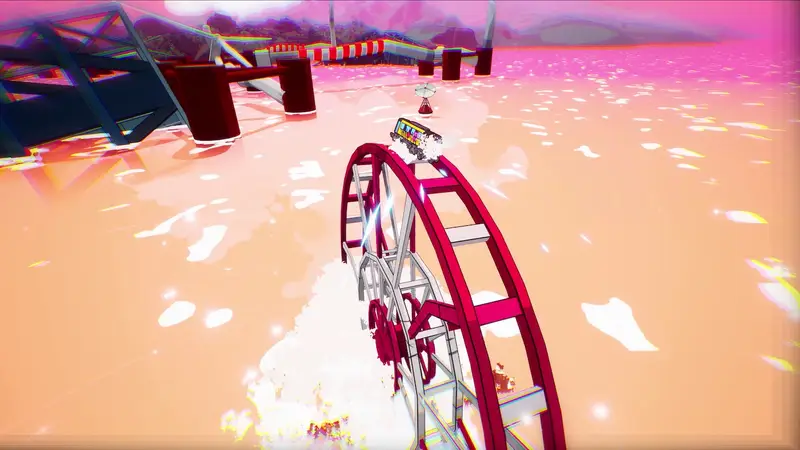
Where I’m less enamored with Denshattack! is absolutely in its technical performance. While Undercoders and Fireshine Games have been transparent with us that there are plenty of bugs prepared to be addressed in the game’s day one patch, I’d be remiss not to at least mention that I was often stopped in my tracks (sorry, again) frequently by crashes on both my gaming laptop and Steam Deck.
After almost each major story encounter I experienced on Steam Deck I was forced to restart after a “Fatal Error” message, alongside other issues such as my train respawning off the track multiple times, forcing me to restart entire levels, and increased performance issues as I progressed the game regardless of my settings. During the final level I even encountered drops as low as 10 frames-per-second where control was completely taken away from me for up to one minute until it eventually sorted itself out.
There’s a strong likelihood that some, if not all of these issues will be fixed by the time the game releases, but my experience was compromised multiple times by enough issues that made me wish that the game was in a better state.
Music
I’d be doing the game a huge disservice not to dedicate a whole section of this review to the music. A pre-launch trailer touted that the game features compositions from huge names such as Richard Jaques (Jet Set Radio Future), Tee Lopes (Sonic Mania) and Shoji Meguro (Persona), and the final product does not disappoint one bit. The music is the kinetic energy that sets the pace for each level, with the speed of the train feeling (and sometimes quite literally being) matched perfectly to the BPM of whatever track is playing.
Verdict
Denshattack! takes all the best from its long list of influences and mashes them up into a truly one-of-a-kind experience, complemented even further by fluid controls and stunning artistry in its art and music. That being said, an unengaging story and intrusive technical issues tend to derail things, making for a bit of a bumpy ride.

Denshattack! is available now for PC, PS5, Switch 2, and Xbox Series X/S. The game was reviewed on PC and Steam Deck.
Gamer Social Club would like to thank Undercoders and Fireshrine Games for the review code.