

There is something refreshing about a game that knows exactly what it wants to be. As genres blend and games incorporate larger and more complex systems, it’s getting harder to find those unalloyed experiences. This is especially true for action-adventure games, which have adopted all manner of extra content and mechanics over the years, from bloated and often incremental loot or skill progression to shallow relationship systems. To my delight, Motorslice does away with all of that, cutting straight to the point, literally and violently, with a chainsaw. The result is an experience that lives and dies by its atmosphere and moment-to-moment action, and somehow ends up feeling far bigger because of what it chooses not to include.
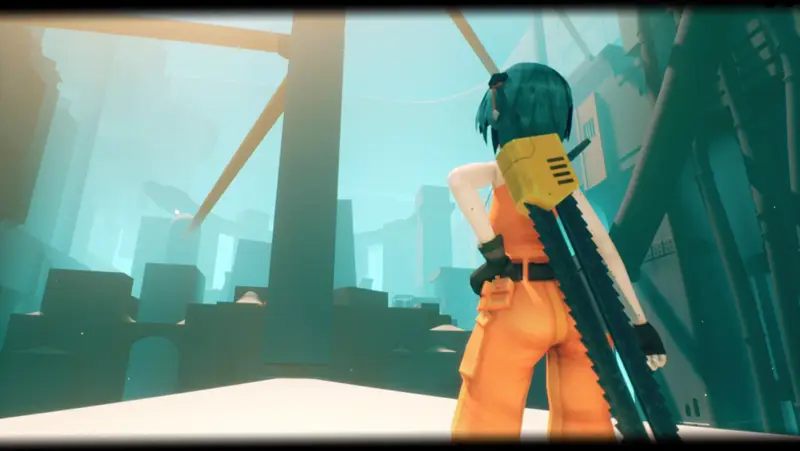
Developed by Regular Studio, a small indie team comprised of two brothers, Luqui & Saiki, Motorslice is a 3rd person action-adventure game with a heavy focus on fluid movement using parkour techniques. You play as a young woman called P as she goes through her routine job as a Slicer. What this actually entails is P entering and exploring colossal megastructures, destroying the malfunctioning machines she finds inside, and leaving. This time, she discovers that this particular piece of massive infrastructure houses far larger and more dangerous machines than anticipated.
That is the setup and entire premise of Motorslice, and one of the things I love most about it is how the game never strays from that original idea, nor P from her goal. That’s not to say there isn’t worldbuilding and narrative beats, but they are mostly contained within brief slice-of-life moments and environmental details, and the game ends in a way that has me begging for a sequel, or at least some DLC.
That singular focus is Motorslice’s greatest strength, and, just like the central pillar P uses to ascend each level, all elements of the game’s design are thoughtfully and expertly tied back to that unshakable foundation. There is no levelling system to grind through, no quests to track, or skill trees to fill out. Your progress is measured simply: by looking down over an edge and seeing just how far you’ve come. P has a job to do, and failure is forbidden. With the objective in mind, all that is left to do is move forward and let the gameplay, world design, and music carry you through, and let me just say, you are in for one hell of a ride!

Motorslice is divided up into chapters, each one set on a different level of the megastructure, and ending with a boss fight. The game starts with a short prologue, which sees P exiting a hatchway into an endless desert environment with the looming destination only a short distance away. Here we get to grips with P’s diverse movement mechanics, from wall-running and sliding to swinging on poles to tucking into a ball to cushion hard landings. Traversal uses a generous environmental lock-on system, meaning that with the right directional input and a tap of the jump button, I was leaping and sliding around with ease.
Moving around as P feels fantastic, with prompt responses to inputs and smooth animations that flowed from one to the next, everything I did looked as good as it felt. Regular Studio has been very clear about being inspired by games like Mirror’s Edge and Prince of Persia, and they can be happy in the knowledge that they have done an excellent job in capturing the same expressive and exhilarating energy those titles did through traversal.
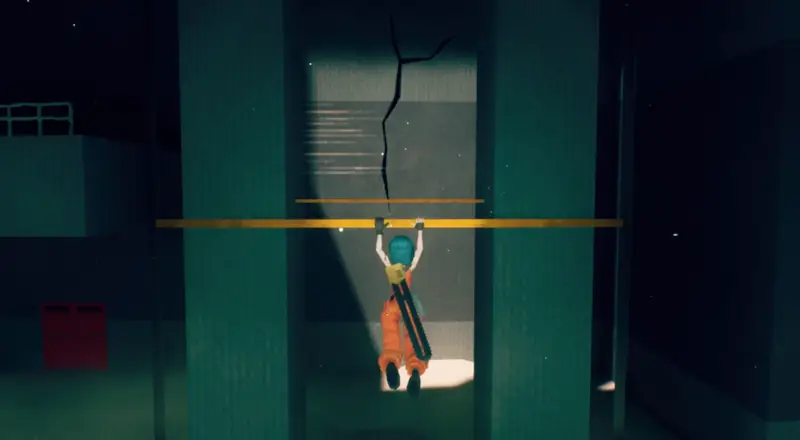
One of my favourite parts of Motorslice was figuring out how to collect all of the lost orb drones scattered about each chapter. Using P’s scanner to highlight them in the environment, reaching them, and returning them to one of several triangular evac points without dying, with some needing to be delivered within a time limit or as a group, provided some extra challenge, as well as scratching that collect-athon itch.
Let’s take a moment to talk about arguably the coolest element of the game, P’s chainsaw, the eponymous Motorslice. As her main piece of equipment, P is very handy with her chainsaw, able to wield it for combat as well as traversal. Nothing will beat having P plunge her chainsaw into exposed orange metal, riding along a wall as she cuts through it, leaving a glowing line of hot metal behind. It’s badass in its own right, but what really sells it, along with the rest of Motorslice’s gameplay, is the audible and visual feedback. The growl of the chainsaw as it tears through metal, the molten edges of a machine’s various pieces glowing, the sparks that fly out, and the crackle of hidden circuitry when moving the camera close to P during chainsaw traversal. It is all designed to make everything you do look and feel cool, and it really does!
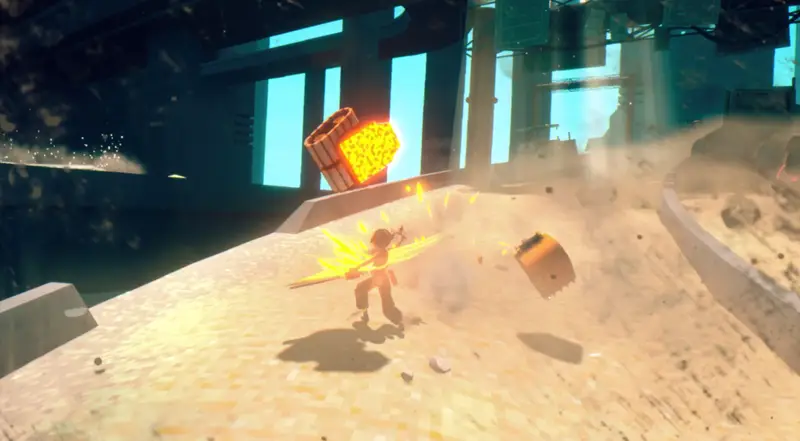
Motorslice’s combat is deliberately streamlined, tying P’s attacks and parry to the same button, and making your clashes with the smaller machines you encounter feel like frenetic skirmishes. The regular machines you encounter, mini excavators and flying buzzsaw launchers, are taken down with a single slice (or a parried projectile), black oil splashing on P and the surrounding area. Larger rollers are taken down by having P ride her chainsaw like she does when traversing, and while these three enemy types are distinct in behaviour, it would have been nice to have a few more to add in the mix. That same lock-on during traversal is present in combat, meaning P’s attacks will automatically go towards the currently focused foe, making jump attacks equal parts lethal and delightful. I wouldn’t say combat is challenging, but you do need to stay aware, as enemies come at you fast, and a single hit will kill P.
Thankfully, Motorslice has a very forgiving and quick respawn system, and each chapter features several checkpoints that can be selected from the main menu. In fact, Motorslice has an abundance of QOL details that allow the game’s fluid and linear gameplay experience to shine. A perfect example of this is the player camera, which has no UI, as there is no extra information the player needs to be concerned with. There is nothing to clutter the screen, no stamina bar to manage or objectives to track; there is just P, the machines, and the megastructure.

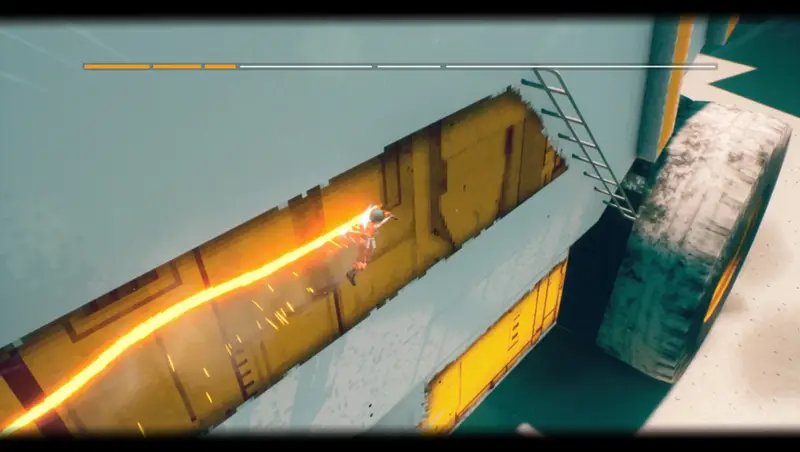
The last facet of Motorslice’s gameplay, its crowning jewel, is the boss fights. At the end of each chapter, P must face down a machine of often colossal proportions, from a giant dump truck to a towering mech. These massive match-ups play out much more like traversal puzzles than actual fights, with a strong resemblance to Shadow of the Colossus, the team’s other inspiration. Bosses have a health bar broken up into segments, with each segment representing a “weak point” on the boss. These weak points are the orange metal areas on surfaces that P uses her chainsaw to traverse, so as you navigate the boss, you are doing damage to them, filling each segment of their health bar until they are defeated.
These encounters varied in difficulty and complexity, with some taking a few attempts to beat, but the option for there to be checkpoints along the way is a personal highlight of Motorslice’s design. I relished facing each of these mechanical menaces, and have since gone back to do them all again at least once!

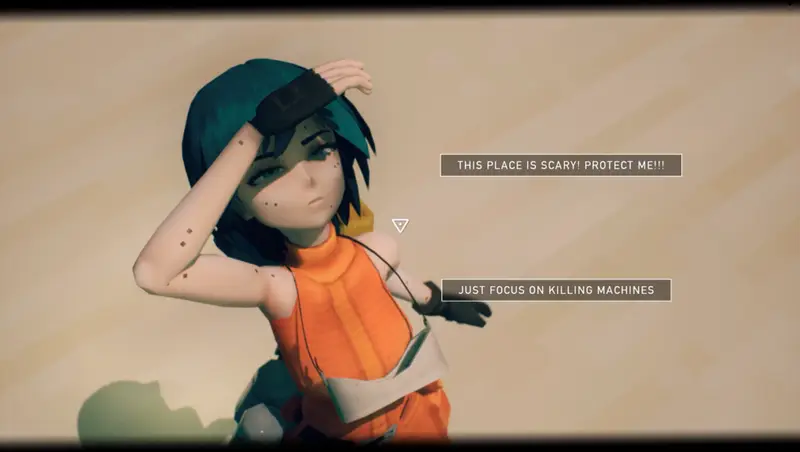
Regular Studio has gone a step further, including the player in their cohesive design of Motorslice, making the camera a character. You are technically controlling Orbie, a floating orb-shaped drone that follows P on her job as part of her employment. During the “Slack Off” moments you find along your path, short interludes with P play out, often with her musing about her work or talking to Orbie. Each of these slice-of-life moments is a nice reprieve from the action, as well as a way to add some light exposition, just enough to raise my curiosity about Motorslice’s world. Listening to P refer to other locations and entities in passing felt reminiscent of the loose, incomplete worldbuilding that FromSoftware is known for.
You also get to interact with P in each of these moments, picking between very different responses to the situation. One is very by-the-book and not willing to put up with P slacking, while the other behaves more like a lovesick puppy. Overall, I enjoyed these breaks, and even if one or two of these “Slack Off” moments did have me cringing, the choice in responses was greatly appreciated. While these are a fun use of breaking the fourth wall, I must mention the fact that as you follow P around, dirt will get stuck on the camera, with clicking in on the right stick making Orbie blink, cleaning the lens. It’s another example of the developers’ attention to detail and continued effort to tie every facet of the game together, and they can also be adjusted in the game’s menus.
There are so many little things I want to highlight, like the way you can hold down the right trigger during combat to lock the camera to an enemy, zooming in for a more intense-looking angle, or the many idle animations that P has depending on what she is standing near. So much has been poured into this game, and yet it remains clean-cut and precise; everything is done in service to the core experience.
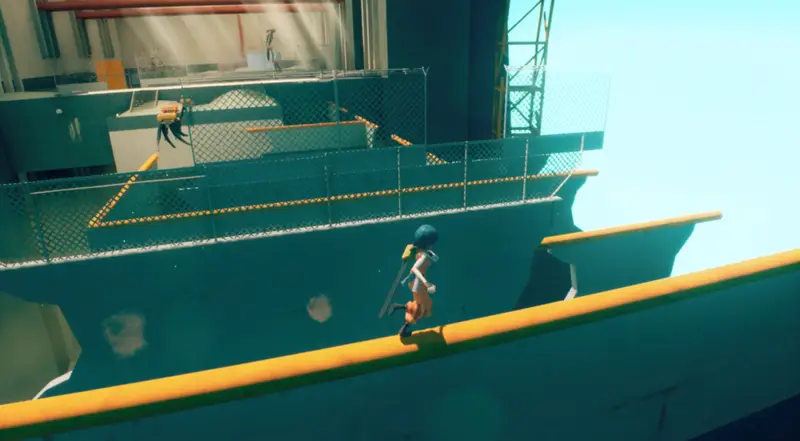
Sticking with its pared-back design, Motorslice’s art direction is doing a lot of work with very little, making the megastructure that is overwhelming and enticing all at once. Standing within a sea of sand and under an endless blue sky, the megastructure looks like a giant sun-baked construction site, the muted grey concrete and ever-present sand dominating every scene. Stark shadows cast from structures hundreds of feet above criss-cross the environment, and interiors often require P to use her flashlight to see through the encroaching darkness. It’s what you’ve come to expect from a megastructure, imposing and borderline impossible, and yet, Motorslice’s atmosphere is warmer and manages to feel approachable without losing a sense of awe.
There is also an understated but fascinating layer of environmental storytelling woven throughout Motorslice’s megastructure. It felt reminiscent of Tsutomu Nihei’s BLAME!, particularly in the way the structure felt as though it was not designed for humans, nor with a specific intention. That ambiguity extends to the game’s quieter details. Between everlooping highways and rows upon rows of nondescript pillars, huge clusters of sand piles in the shapes of the smaller enemies you face fill the shadows, like mass graves. Even the lost orb drones scattered across each chapter subtly imply previous Slicers who may have come before P. But Motorslice doesn’t stop to explain itself directly, instead encouraging players to fill the gaps themselves.

Other than P’s choppy green haircut, the only other colours that prominently feature in Motorslice are construction yellow and safety orange. P stands out in her sleeveless jumpsuit, channelling FFVII’s Cloud Strife with a splash of colour, a close match for the metal surfaces used for chainsaw traversal. While “yellow paint” game design has been a hot topic in gaming discourse in the last few years, Regular Studio have cleverly leaned into that, having all traversal objects painted yellow, along with scratches on walls, or a couple of yellow planks used to draw the player’s eye. Given the context of where P is, this makes complete sense and doesn’t feel out of place in the world. It’s another great example of how Motorslice’s design coalesces for a polished and congruent experience.
Of course, for that satisfying parkour and exploration to work, a game needs level design that encourages players to experiment and explore, and Motorslice has that in spades. Each chapter is a creative blend of playground and assault course, with new mechanics or obstacles introduced as P ascends. The chapters are also themed, while maintaining the construction site aesthetic throughout, and each one feels different from the last due to the way you navigate their environments. One moment, I’m running through tight, dark corridors with my torch to light my way, dodging traps and overcoming tight parkour sequences, the next I’m wall running between suspended slabs of concrete to criss-cross a wide canal with liquid cement flowing below.


Kira Buckland does a fantastic job as the voice of P in a nearly solo performance, with the young Slicer sounding light and breathy, a real daydreamer. She doesn’t talk except during cutscenes and “Slack Off” moments, so there aren’t any random comments or catchphrases to get tired of as you play, and I genuinely found P to be quite endearing. I enjoyed listening to her muse about her job, talking about where she gets her favourite coffee, or seemingly pouting for no reason, refusing to look at Orbie over some perceived slight.
Motorslice’s sound design is great, with every roar of P’s chainsaw and rumble of a machine’s engine cutting through the quiet breezes and emptiness that pervades the megastructure. The only other sounds you’ll generally hear are P’s footsteps, panting, and her grunts of exertion as she mantles up a ledge or cleaves an enemy in twain.
Finally, there is the brilliantly integrated soundtrack by Pizza Hotline, the alias of composer Harvey Jones, who expertly created a soundscape that perfectly fits Motorslice’s ambience without ever overshadowing what is happening on screen, instead gently supporting it. Chilled-out ambient tones play at appropriate moments of reflection, with a fusion of jungle and DnB kicking in when combat starts; more a call to get in the groove than a heart-stopping surge to get you amped. Yet again, the music of Motorslice abides by the same rule of “less is more”, emphasizing when needed and fading away when appropriate.

Final Thoughts
With level design that begs to be explored, a world that is vast and inviting, and an ambience that is unfiltered or obstructed, Regular Studio have tuned every element of Motorslice, from its art direction to its sound design, to keep the player focused and driven, especially through approachable and cleverly interwoven design and controls. By never wandering from its simple and enthralling premise and backing it up with fun, satisfying gameplay, Motorslice is proof that sometimes all you need a game to do is make you feel cool while doing cool stuff.
In an era where so many games seem terrified of simplicity, Motorslice feels confident enough to strip everything back to movement, atmosphere, and momentum, and it is all the better for it.
In short, chainsaw go brrrrrrrrrrrrrrrrrr.

Motorslice is out on May 5th across PC and PlayStation 5. A demo is available on PC via Steam.
Motorslice was reviewed on PlayStation 5.
We would like to thank Top Hat Studios for the review key.
Will you be picking up Motorslice? Let us know in the comments below, and join the Gamer Social Club Discord to chat with others about your favourite games, play in community game nights, take part in giveaways, and more!