
It’s no secret that I am a fan of narrative driven games. I love a game that sits with you long after you’ve completed it. Alternatively, a game that lets you come back time and time again to revisit beautiful scenery and memories is an amazing experience. So when OPUS: Prism Peak was announced, I was very curious how this would go. A man facing a mid life crisis and lost child find each other and embark on a journey to the top of the mountain. Is it a metaphor for life? A reason to revisit our own childhood whimsy and wonder? Either way, I was ready. Then they told us we’d have to wait just a few extra weeks. So of course the question became, would it be worth it?
Story
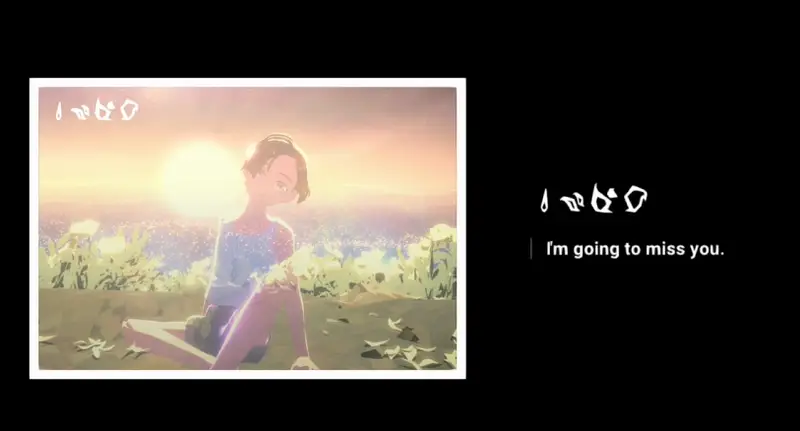
We begin as Eugene, age 5, on an outing with our grandfather. We quickly learn to some facts that will shape Eugene’s life. Eugene’s parents fight and ultimately split, they don’t like the nickname Eugene’s grandfather uses for him, but Eugene clearly loves his time with his grandfather. In these small tender moments we also learn the basics of the game. We also get to hear directly from Eugene, including being able to shape our version of Eugene early on. After the glimpses into his childhood, he gives us the TLDR on his life. At least, the bits he is willing to tell us this early.
As is the case with growing up, we age, we lose those close to us, and we have to go through a mourning period. This where we catch up to Eugene in the present day and one car crash later, our story truly begins. It’s also because this is where we meet our new young friend. Once we meet her, we learn about the shade and how we must get her to the mountain. We will need to save her and get her home to the mountain and along the way we’ll come to terms with much of our life.
This is also where the game gets deep. We don’t come to terms with our past by way of speaking directly with those important people. Instead, those important to Eugene are represented by animal spirits. As Eugene, through your photos, through deciphering their riddles, it is up to you to understand who they are and if you can truly see them. Not just see them with your eyes, but understand them at their core. Only through perseverance, empathy, sympathy, and hope, can Eugene and his new friend make it back home.
They used to say with age comes wisdom, but Eugene doesn’t embody that. Honestly? It makes him more relatable. Perhaps it’s because 40 is right around the corner, but I could see bits of myself in Eugene. Younger gamers may not be able to relate quite as much to the midlife crisis Eugene is experiencing, but others will absolutely feel it. It’s the beauty in the tragedy of how he reacts to everything happening that hit home so many times.
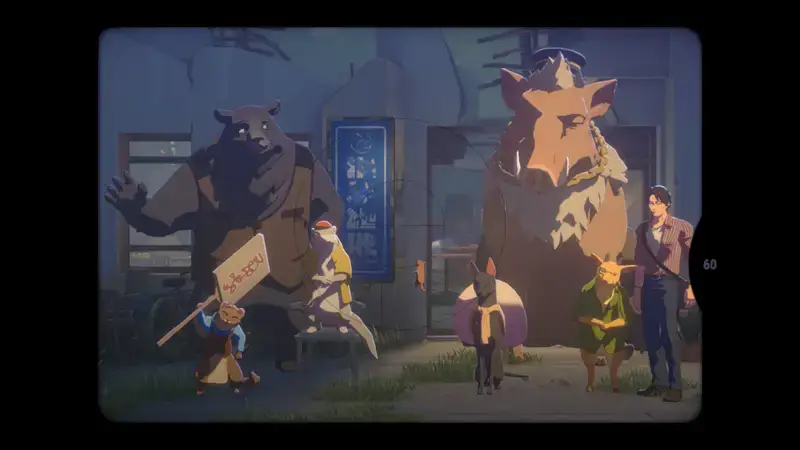
Proceed with caution and take your time with this game. While the game is short in terms of play time, it is not easy to power through due to the topics. I want to give a quick content warning before diving into the gameplay. This is also a bit of a spoiler, so please read with caution. Don’t want the spoilers? Please skip past the image of the animal spirits.
Quick Content Warning
Throughout the game, loss is a big recurring theme within the game. Loss of Eugene’s grandfather is what spurs his journey but this isn’t the only loss that we see. As you progress through the game you will come to understand that Eugene loses more than just jobs, his mentor, his friends, and his wife. This is your last statement before spoilers.
Eugene shows that he is abandoned by his mother. The relationship Eugene has with his father is tenuous which some may see as emotionally difficult. There’s a sense of his father wanting Eugene to move on and get over it. Get real. Grow up. There isn’t always a true sense of support. Unfortunately, as Eugene’s grandfather ages and loses his sight, the relationship between Eugene and his grandfather becomes very strained. We see bits of Eugene’s father in Eugene as well in his reactions at times. None of this is easy especially for those who have gone through something like this. Aging parents or grand parents is a very real issue for many millennials and older so be prepared to deal with this story line being in your face.
However the one that may hit the hardest is the reveal that Eugene and his wife once had a baby. Unfortunately within months, they lose the baby. It is through the ways that both Eugene and his wife deal with the loss of the child that contributes to their divorce. It is also mentioned that this happened after multiple attempts to have a child. For those who have or are dealing with fertility concerns, this can be a difficult scene to watch and uncover. Anyone who has lost a child, this can be difficult to watch. For those who can’t imagine a life without their children, that what if can also be a hard pill to swallow. Seeing Eugene’s wife lash out, even briefly, is a bitter pill to swallow. Also one that players are unlikely to forget anytime soon.
That’s the last bit of warning I’ll provide before hopping into the gameplay itself. The game is bittersweet, emotional, but at times, hopeful and peaceful. If the warnings haven’t thrown you off because you can’t handle them right now, I implore you to play the game. However, please, as always, be sure to take care of yourself and play when you are ready. Emotions can be heavy in this game but it’s quite an impactful experience.
Gameplay
While you begin without a camera, that doesn’t mean one shouldn’t take a look at everything around you. Get used to this mechanic. This game truly is about seeing everything. Be the seer. But how does one do that? You’ll want to interact with everything you find to earn seeds. Players earn seeds on the first time you investigate an item. You’ll use the seeds at lit fire bowls throughout the game. These seeds will help you continue to unlock camera upgrades once you get the camera and allow you to progress the story at times.
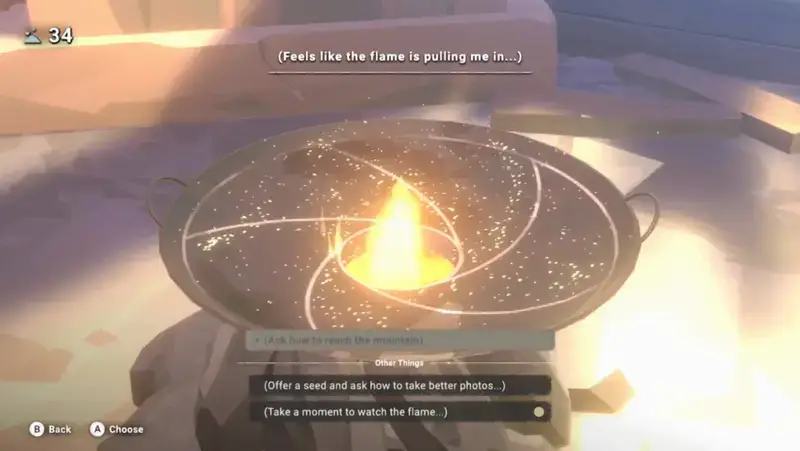
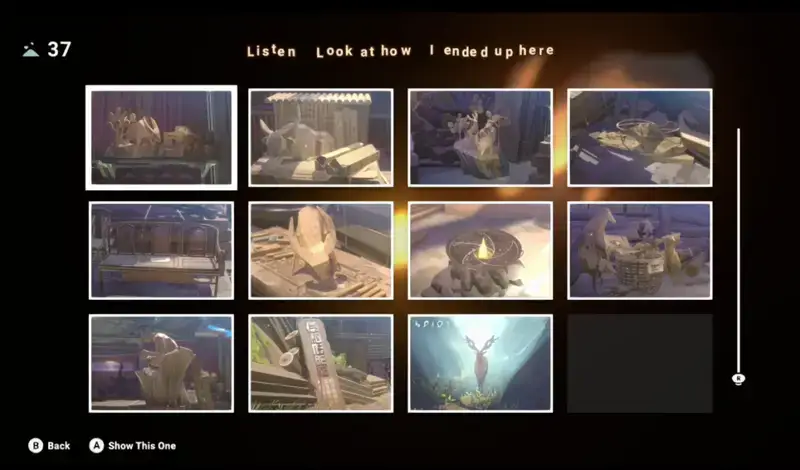
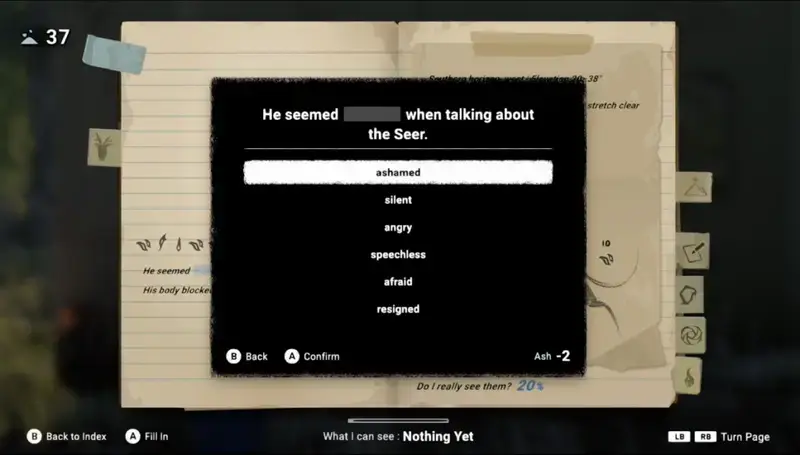
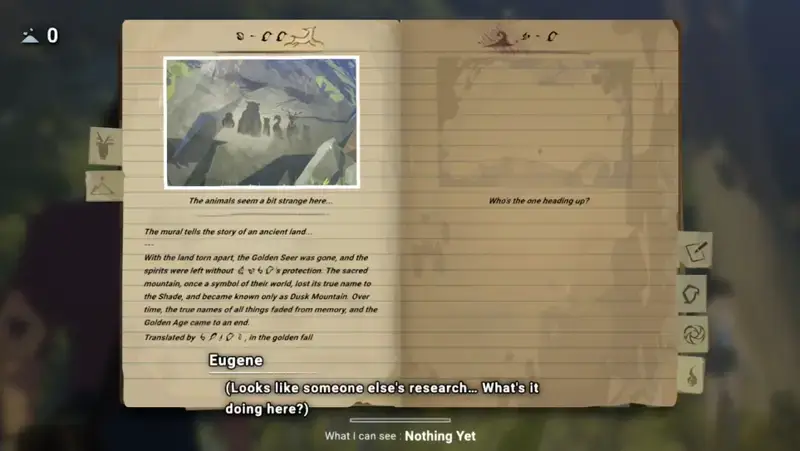
While some camera upgrades are truly just for aesthetics, you’ll find a few that will help with your journey. How else will you be able to decipher this language of those who came before? Additionally, the photos you take with your camera can be fed to the fire to understand the animal spirits more. Learning about these spirits will allow you to fill the pages of the journal you are taking with you. Each page dedicated to a spirit will ask if you really see them. As you explore more you will enter information about the spirits to make sure you do understand them.
This is where you have to make sure you are actively listening to the spirits as well as showing them pictures that make them feel seen. Interpersonal relationships are hard, we know this. OPUS: Prism Peak wants you to pause and reflect on what the characters are telling you so that you can understand them. It is not enough to just listen but you must be an active listener and the game tests you in the book. The fire is not the only place you’ll show these photos as sometimes, you’ll show them to the spirits themselves so be ready.
The book has quite a few more pages. There is a story to be told in the book but only if you take photos of all the murals in the game and paste them in the right pages. Only then will the full story reveal itself to Eugene. You’ll notice in the book there is also a page of song lyrics but you don’t know how to decode them yet. You’ll have to take pictures of all the cipher codes along your journey.
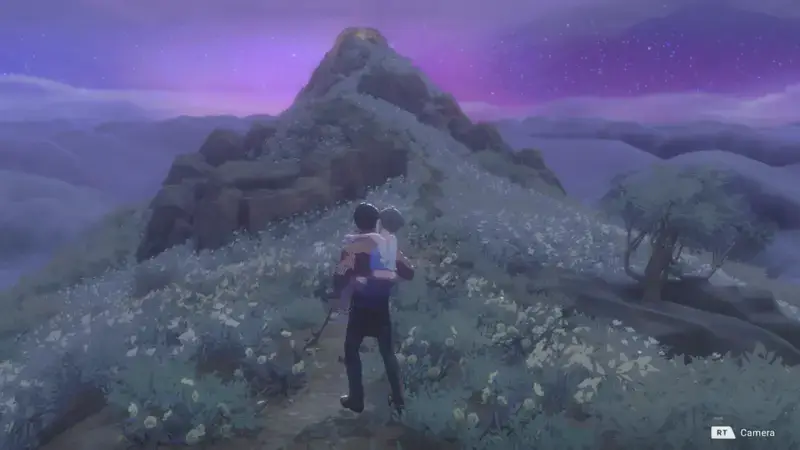
Occasionally there are more active moments of gameplay. Carry Ren, your new amnesiac friend, on your back and run away from the darkness as it tries to swallow you both whole. Other times flash it with your camera light to scare it away. These moments, while very different to the rest of the game, manage to not feel disruptive or out of place. These scenes help highlight how the pacing of life can shift in an instant.
None of these mechanics, be it the photo taking, the running away, or the entering items in the journal, is difficult. However it does take patience and focus at times. Sometimes literally fixing the focus on the camera. Enjoy future photographers!
Riddle Me This
While the book allows you to decode the language and see if you understand the spirits, there are other puzzles that come up that require photos. When looking at the fire with animal spirits you have to understand what they are trying to say to know which photo to show them. I’ll be honest, I did not always know which photos to show. Some of the spirits also seemed much more patient with me than other. Of course this could be due to the characters they represented. Sometimes, I wasn’t 100% sure of what to take pictures of as well to have options. On a positive note, if you mess up, after completing the game once, you can go through a chapter select to complete puzzles you may have missed or been locked out of before.
The game doesn’t truly have many puzzles to solve except for the story in the journal. Looking at the murals you’ve taken photos of to know which go where isn’t always the easiest either. In fact, at times I found myself just code jamming pictures in, but thankfully I had plenty of ash to do so. It’s not an ideal way to do so, but I found myself being confused on what certain images were trying to portray. This is perhaps the one are where I wish it was a bit clearer but then there might not be much of a challenge for players who are great at riddles.
Voice Acting
When there is voice acting in a game, it truly can make or break the emotional tug at one’s heart. Thankfully, the voice cast in this game is great. It’s worth giving each of these actors their due because they truly contribute to the overall game in such powerful ways.
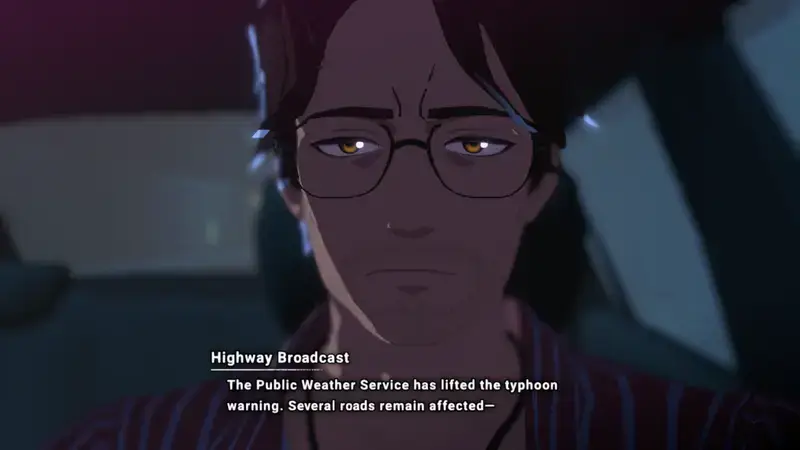
When Eugene is broken, hurt, sorrow filled, Eddy Yeung nails it. As I see Eugene clutch at the protection amulet and say “please just give me a moment” in a certain scene, my heart aches. In that moment I want nothing more to console this character. It’s not because the music evoking the emotion (although it helps). But because I hear in that moment the pain, the grief, the what ifs. Conversely, when I hear Ren, played by Diana Garnet, giggle with a thirst for life and joy I find myself smiling. These two characters at the opposite extremes at times play off of each other so perfectly. It’s been a while since voice acting of a game has hit this hard.
Of course, their supporting cast is equally as excellent. It’s almost difficult to call them a supporting cast because of all they bring to the story. With Brian Jeffords as Grandpa, you feel the love he has for Eugene, the stress of losing his sight, and a knowledge that seemingly knows no bounds. At his lowest, when he loses his sight, even his stress doesn’t seem as pointed just frustrated in a way that many of us would understand and not blame him for. Hannah Grace as Irene brings a solid performance that breaks my heart as a character that barely seems to be herself anymore. chiisa as Jean with her occasional barks and stubbornness make me laugh but are quite endearing.
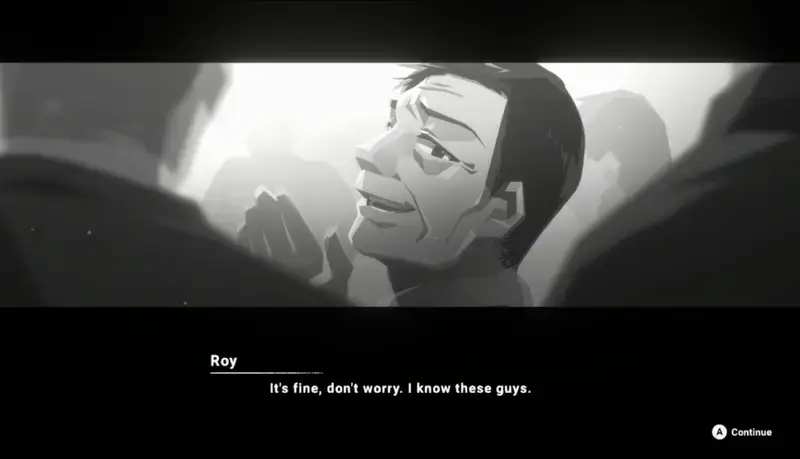
Peter Von Gomm as Morris and Connor ‘CDawg’ Colquhoun as Roy bring a wiseness to the older mentors that Eugene has had in his life. They are rounded out by Eric Kelso and Adrian Howard as the friends who stick by no matter what but also show tough love during Eugene’s life in the city. His parents are played by Soness Stevens and Maxwell Powers, who deliver their lines in ways that make me believe their attitudes shaped the Eugene we meet early in game. Chris Nelson plays the childhood/hometown friend that many wish we had or miss in our adult lives. If only any of us are so lucky.
Visuals & Ambiance
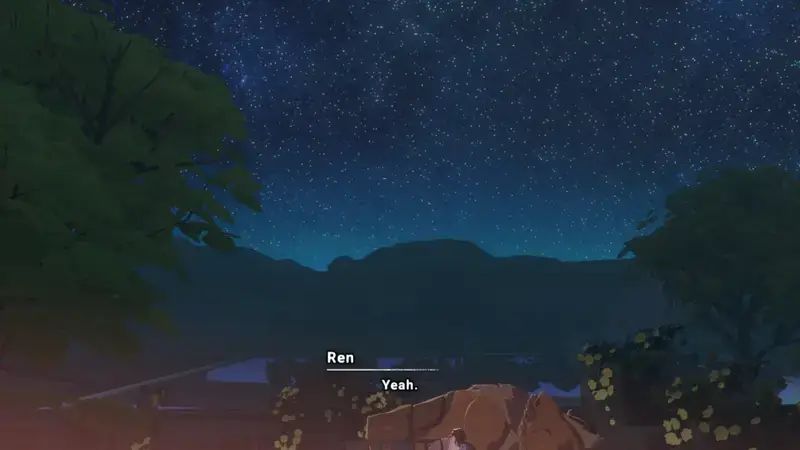
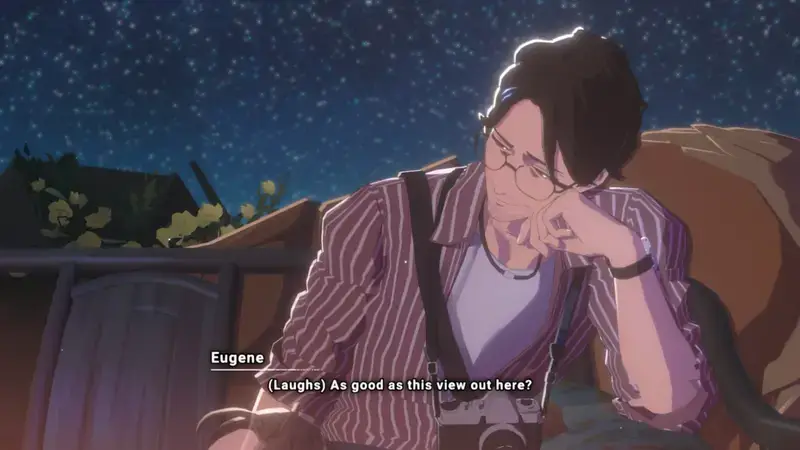
The visuals in this game are at times haunting for their simplicity and nostalgia while at other times being bright and hopeful. There’s a darkness behind Eugene’s eyes at the start of the game and yet somehow later on he seems lighter. Eugene has a pep to his step that was missing at the start. The small nuances add up to how you can view the game.
It’s not just the characters but also the backdrop they are set against. Peaceful colors in times of rest, relaxation, calm. Yet when the darkness comes to try and swallow up our characters, the vivid reds rushing feels like it mimics the blood pumping through Eugene’s veins as he tries to get to safety. The coloring and ambiance is quite perfectly matched to the overall story and the emotions it needs to evoke.
Then there is the music that accompanies it. Prior to reviewing this game I was familiar with Kevin Penkin’s work as he had composed music for anime and video games prior. Most recently, I had heard his work on an anime short Bâan: The Boundary of Adulthood so it’s no surprise he absolutely nails the emotional notes for in his contributions to OPUS: Prism Peak. “I am Farewell Itself, I am Life” is the title of the song he wrote music and lyrics to and there may not be a better way to sum up this game. Life is a series of farewells, but that’s also because you have to start with a hello.
Penkin is not the only composer to add his musical talents. Triodust also returns as a co-composer. If anyone has played the previous OPUS games and enjoyed the music, this name may be familiar. Triodust has worked as a composer or co-composer on the three prior OPUS games in the series. The music is melodic and easy to listen to on repeat as this reviewer is doing to ensure the names included in this review are correct.
Final Thoughts
I find myself with a knot in my throat just writing about this game. OPUS Prism Peak feels at times a lot less like a game and more like a work of art. That is if you can handle the joy, the loss, the pain, or in other words, life. It is cathartic, it is real, it is beautiful, and it is sad. The jadedness of adulthood, the naivete of youth, joy of life, and the journey we take to get to our endings. But also that there is hope, there is a future, sometimes we just need to take a photo, pause, and reflect.
Playing through it and feeling all these emotions for a game that you can complete in about 10 hours is such a roller coaster ride. Admittedly, it is not a game for everyone. Some may want something a bit more action oriented. Others may not be ready for such an emotionally challenging story. This is a game to take your time with if you can. However, when you are ready, this may be one of the best narrative journeys you can take.

OPUS: Prism Peak was reviewed on PC. Gamer Social Club would like to thank SHUEISHA GAMES and SIGONO INC. for the review code.
OPUS: Prism Peak will be released on Steam, Nintendo Switch, and Switch 2 on April 16, 2026.