
I am definitely a gamer who likes to try playing many different things. I also love a good management, strategy, and simulation game when they come across. It’s been a while since I’ve played any, but I decided to try and dive back in and see how the game would fare up against memories of those that came before. How does Theos: Cities of Myth stack up? Well, let’s waste no time shall we?
A Fair Warning
I will start this off by saying Theos is not very beginner friendly. I struggled even during the tutorial of the game to understand how to use some of the mechanics. The game was like an awful trainer, telling me what to do but not how to do it. The help menu didn’t provide much assistance either and it felt like I was spending quite some time just trying to practice mechanics. Although, to be fair, they don’t call it a help menu; they call it a guide. However, it would be nice if the guide were to actually provide you with information that you were looking for. The language also isn’t the clearest. For example, were it not for some tips provided by the developers, I might’ve pulled out my hair when it came to the warehouse behaviors.
Now if you’re someone who is new to city builders, this is your warning to look elsewhere. If you’ve been down this road before, read on.
Adventure/Story Modes
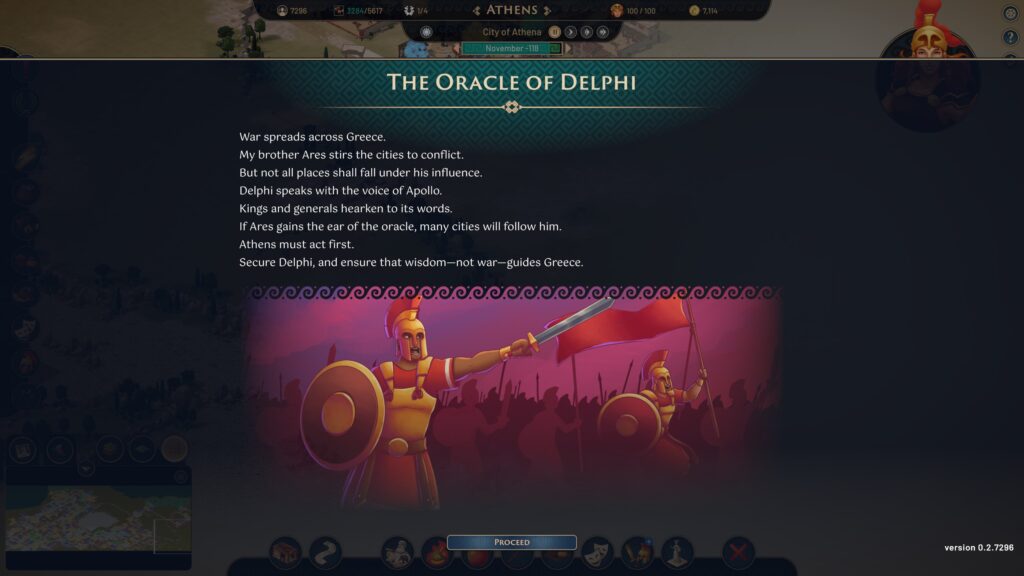
You can pick which god to start with although they do all have varying degrees of difficulty. The easiest one is Athena, who feels like a bit more of a war monger than I would’ve expected for her story. Especially since she’s justifying it all based on the others around her. Why did we start the war instead of Ares again? Either way, she wants the perfect polis, and she feels very quick to anger and not easy to apologize to.
Thankfully, should you find yourself getting bored of one god, you can start a different adventure without losing your progress in others. So I played through a bit of Hera, Zeus, and Athena to see how their starting items and areas varied. There is a bit of variation to their starting food, livestock, and resources but this doesn’t change the gameplay up much. You’re still being given tasks to complete as you progress through the adventure to build your polis.
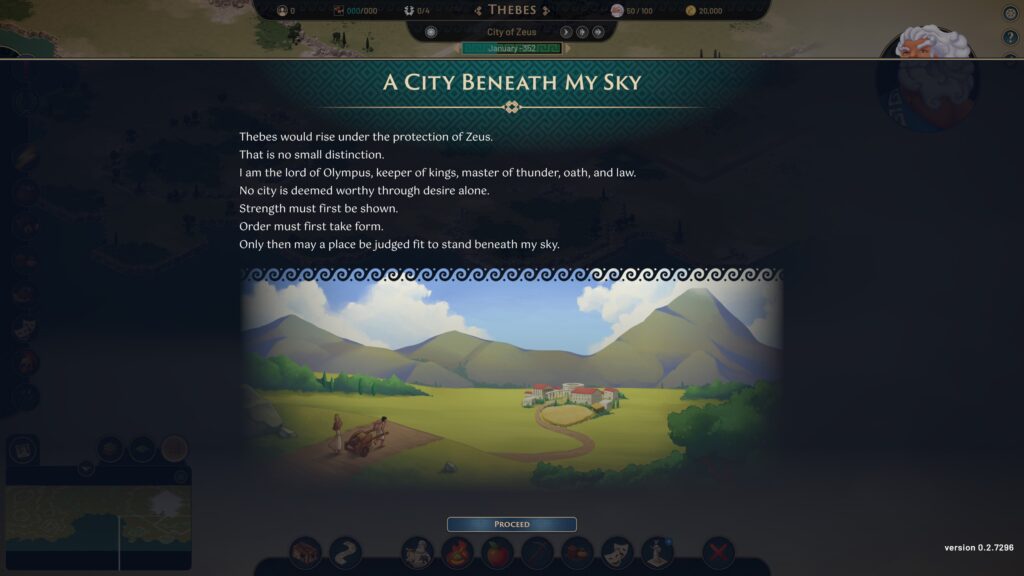
These epic adventures span a variety of chapters with different tasks and goals to complete. However, I’m not sure I’d call these epic. While Athena takes on some war, some ego, trading, and having heroes and great people, at times the story itself feels a bit dull. The next bit of a story will appear on the screen for you to read with a static image letting you know you’re ready to move on to the next story bit. These areas could definitely use a bit of sprucing up. I know not everyone is into a voice over, but this game feels so silent; the voices might be nice.
Yes, there’s no voicing in the game. Not from the people wandering around your town. Not during the story reveal. It just doesn’t exist. If the music during the adventures was good, this probably wouldn’t be too big of a deal. However, the music is so forgettable that if you asked, I’d say I didn’t even hear it. I don’t expect award winning music from a game like this but something that sticks with you, at least for a bit, after 20+ hours feels reasonable.
The War Mini Game
I love a good strategy game. Pick your best warriors, send them onto the field to win a battle, celebrate. Yay! And while I didn’t go into this expecting XCOM or Fire Emblem sort of combat, I was ready to try out this mini game. You don’t have to play the war mini game, and you can let it auto battle, but I felt the need to explore it. It did give me a bit of hope that the warriors I had trained and the hero I recruited would be the ones going into battle. Awesome.
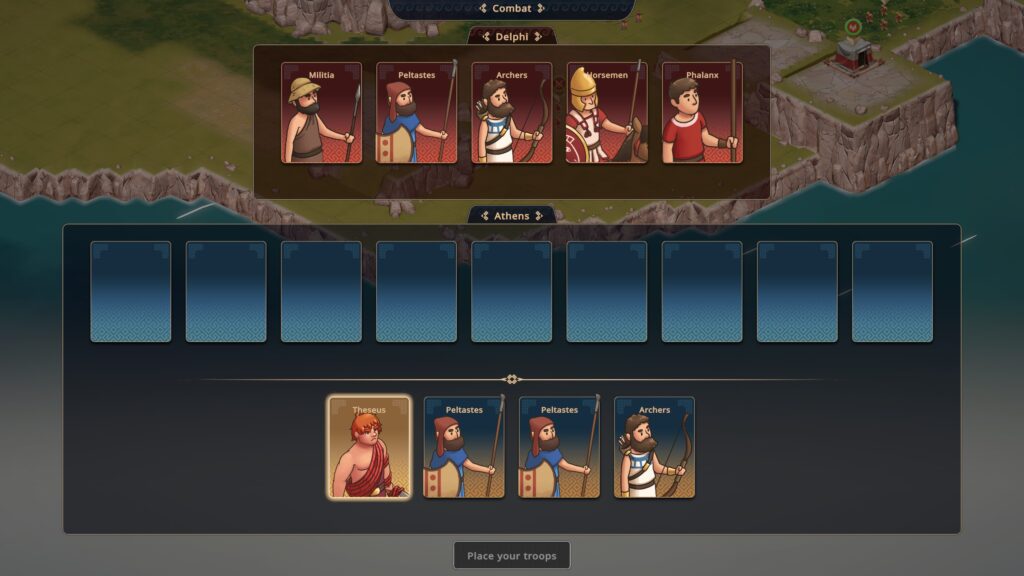
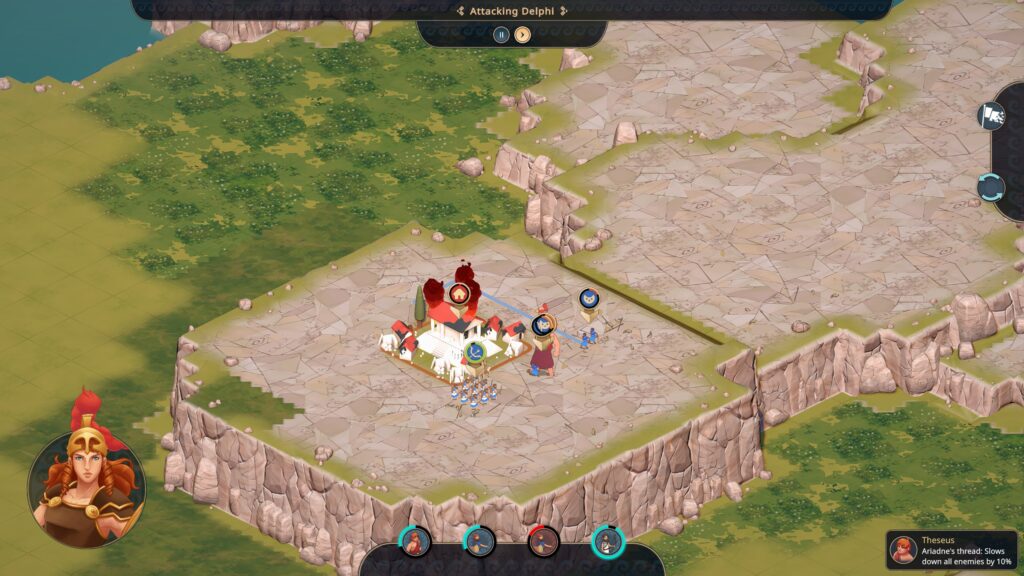
Some of my joy ended there though. The lines of combat for the warriors always looked clear, yet at times I found them going further than I had wanted them and instructed them to move. Occasionally, my hero would ignore my orders and just keep going in further than expected. This also led to him being taken off the battlefield pretty quickly.
The strategy here really is to have a nice mixture in your army and take out something one at a time. Which sounds ideal until they also have archers fighting you from above, taking out your troops while you try to individually take out their horsemen. The fights aren’t awful, especially since, as long as your god isn’t mad, you can do some spying beforehand. See what their map looks like, what their military strength is, and the like. It’s great o get an idea before you go marching in, but with enough patience, even going in blind is fine most times.
Sandbox
This is fine if you can’t be bothered with some of the goals of the main campaigns. This is where you get to pick the deity you’d like, which means all of their blessings and special buildings along the way. However, you’ll get an option of a few depending on your location so it isn’t all free choice. While it is a sandbox, you aren’t mixing and matching everything to your heart’s content. I would have had a lot of fun mixing random gods together.
It was nice to be able to have access to everything to build right away. Of course, that comes with a price. The price being, you don’t have enough working residents to fill every job. Which also means you may not have enough architects. Or enough people gathering food, selling food, or helping to create culture. You do start with lots of money though, so the urge to build too big too fast is strong. Could you build out a whole civilization with the game paused if you just want to set up something visually? Sure. But you won’t know if it works.
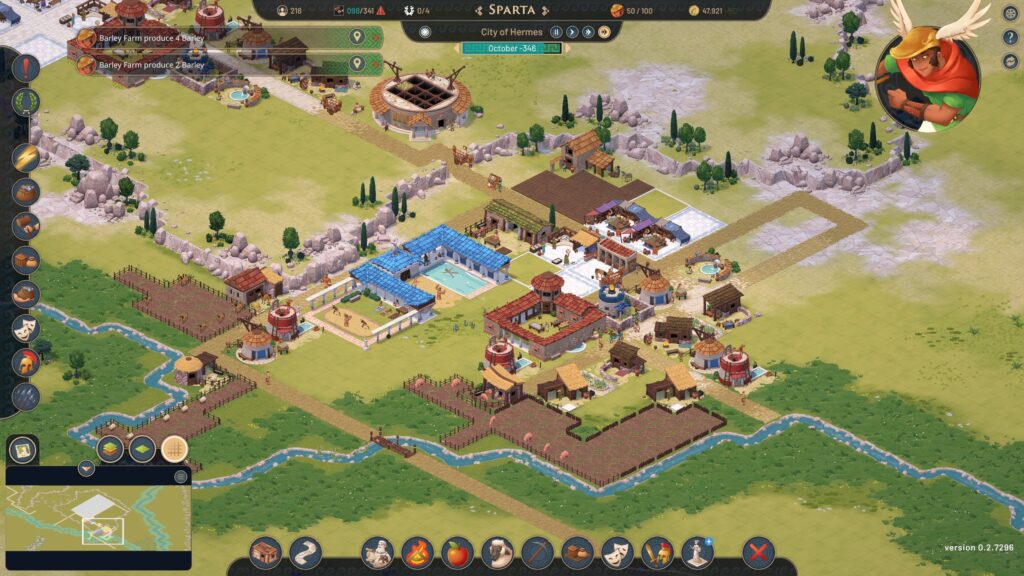
So again, while Sandbox is fine, you do need to still have a general understanding of how everything works and how your polis will build upon each other. You’re also still going to get requests from other polis asking you for money. So while you can play on a map of your choosing, you will have some constraints. Constraints being: do you have enough money? Have you built out too big too fast? The metaphorical training wheels are off, but there’s still some guardrails along the way.
Bugs/Glitches
Like any other game, it isn’t perfect. Unfortunately, I did encounter quite a few bugs throughout my time with Theos. For some reason, many times when I would save, it would give me a weird flash. It didn’t impact the gameplay, but I’d notice the screen flash as it saved. The first time I thought perhaps I was imagining it, but I did notice this happened very often. Occasionally it would happen during the autosaves as well. This happened much more when I had the game speed at max speed.
Another odd bug or glitch or just lack of proofreading, is the objectives screen. For whatever reason the chapter listings are incorrect, with a Chapter I appearing after Chapter III, IV, and many others. Not a huge deal, but a bit confusing if you find yourself trying to follow the story.
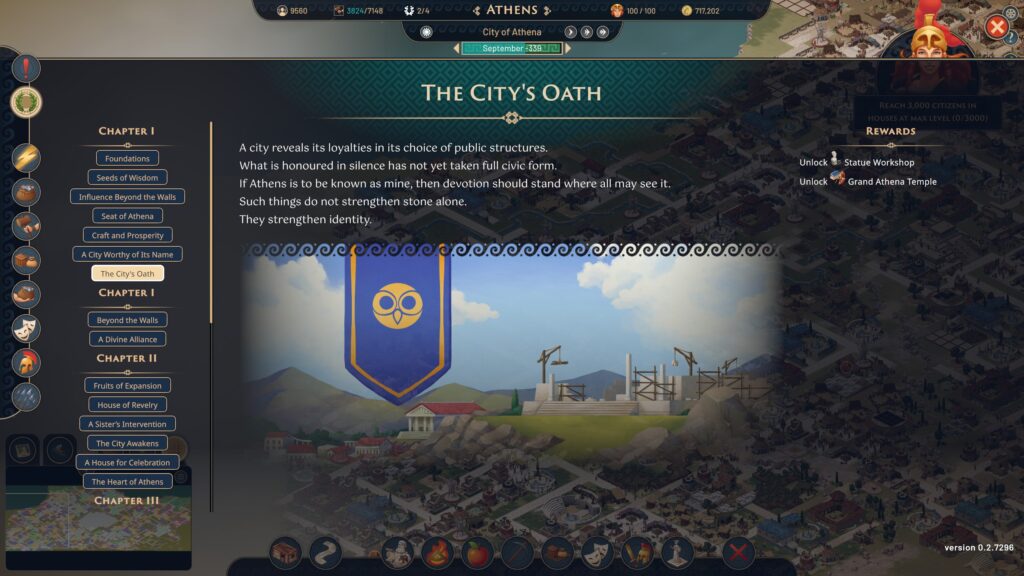
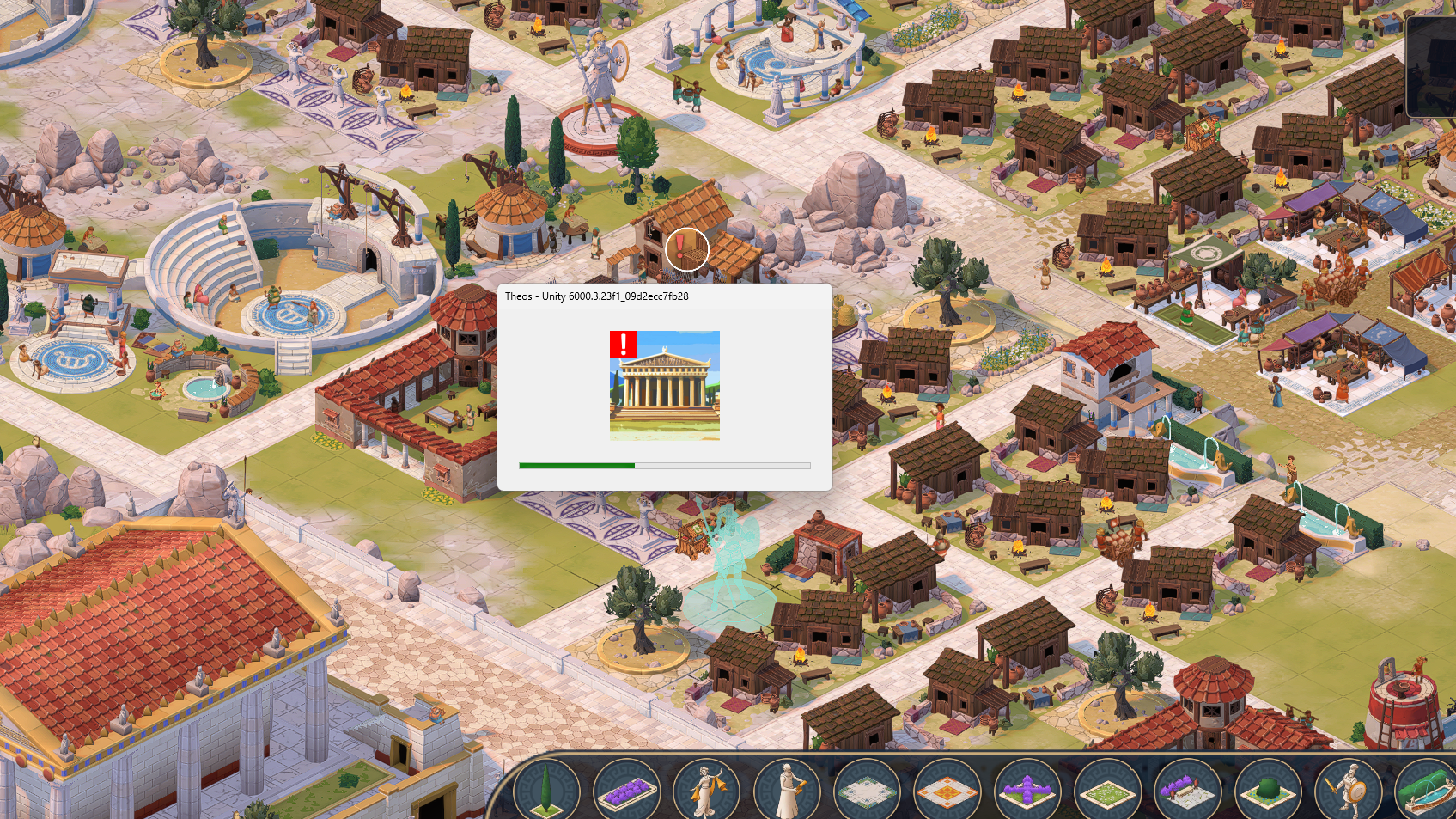
A few times, while trying to place statues to raise the desirability of my area, the game would crash. Oddly enough, this happened many times while trying to place the Minotaur statue. I understand that Theseus only took out one Minotaur, but that doesn’t mean I don’t want to celebrate it in a few areas of my growing polis! As I got closer to the end of Athena’s story, this also happened when I tried to place olive trees near my houses. This was by far the most frustrating, with one game session of about 2 hours having 3 crashes. I’m usually pretty calm with a crash or two, but seeing this so often when trying to do the same task is frustrating. Especially when it is in hopes of making the area more desirable to meet the next objective.
There were many times when I would try to use the auto-patrol option, and it would still give me a walking path issue. Even after trying to set up a walking path, the flags would seem to stay indicating the path is marked, and once I would validate it, the path would disappear. I would do the same thing twice before it actually truly stuck. As my polis grew bigger, I also noticed a few times where suddenly building such as my guardhouse said it no longer had a path. Was this because there weren’t enough employees or a weird glitch? No way to truly know, but it feels more like a glitch, as each time I clicked the building, it did have workers.
What Might Be Helpful
It feels weird to say that this game is gatekeeping itself from new players, but it truly is. If it’s been a long time since you’ve played one, you also may feel that this is all too unfamiliar to dive into. Some of the ways they tell you something new is available to you is the tiniest blue dot on your menu towards the bottom. If your screen isn’t massive, you may miss it and wonder how you’re meant to progress. A flashing light or some other indication would be helpful for those who may miss the pixel of blue at the bottom.
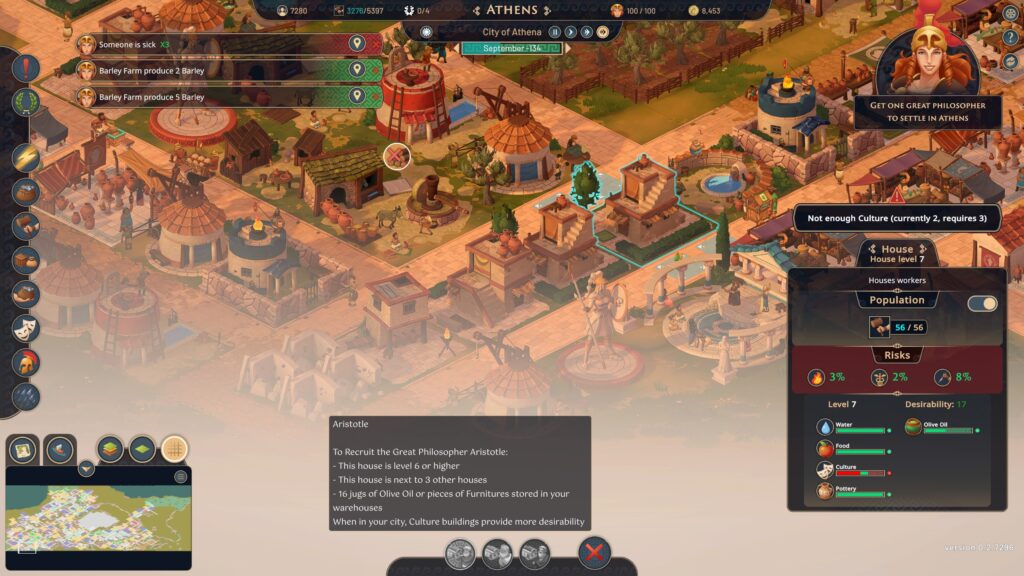
As your city grows, you most likely will have what feels like different districts. So when hero recruitment comes along, it can be a bit frustrating to try and struggle and toggle back and forth to see what you are missing towards a hero. The same is true when trying to recruit a great person, which had me struggling for far too long.
In the example below, to recruit Aristotle, the conditions are listed, but no true way and letting me know which are complete. The language is also a bit unclear, as it says next to three other houses. What this actually meant was more surrounded. Houses needed to be a combination of left, right, front, and/or behind the house. Not in a row. Personally, when I think of next to, I don’t think of those in front or behind as next to. This would have clicked for me if the game had perhaps highlighted the text in different colors or provided a check mark indication that the condition was met.
What Would Be Nice
A little bit of polish will go a long way. Voice acting for the story bits would make the game feel a bit more finished. For those who don’t want it, there can always be an easy toggle to turn this feature off and allow players to read it or skip it themselves.
Oftentimes I really wanted certain supplies to get to certain areas of the map. They didn’t. At least not easily. If there was some way to truly directly indicate to prioritize this shopping area to get wine, or any other resource, this would be great. If this feature is there and I missed it? Then it’s proof the tutorials could use a bit more work and clarity.
The guide is also all practically just words. A few images could go a long way. Is some of the information in the tutorial in the main menu? Yes. But that also means leaving whatever mode you are in, to go into the tutorial, to play the entire tutorial to learn something that might be explained in less than 30 seconds with a quick video or imagery.
Overall
Theos: Cities of Myth does call back to a time when games were a bit more, shall I say, difficult. This doesn’t really hold your hand very well, which may have been the intention. The problem with this, again, is that it also gatekeeps people looking to revisit the genre after way too many years or those with an interest but who have never played before. There are going to be hardcore fans who will enjoy the challenge but it does keep this very niche.
Even at its easiest level, it doesn’t do a good job of telling you what is missing or how to course correct. This doesn’t happen in the tutorial either, so it truly is a learn on your own sort of game. Again, this might be fine for some, but for others, it’s a very quick turn off. It’s not that the game doesn’t have potential, but it’s definitely not going to be widely loved or one that introduces many to the genre. It’s also not one I’ll be returning to any time soon.
Theos: Cities of Myth was reviewed on PC. A review code was provided by Triskell Interactive & Dotemu for the purpose of this review.