Nocturne badges itself as a RPG with rhythm based combat. It certainly does have rhythm based combat, but I’m not entirely sure I’d badge it as an RPG. Sure it’s got equipment slots that ostensibly change up your build, and experience for level ups but those appear to just be for extra health – as there’s no stats or level up choices to speak of. This isn’t that unusual, especially with Indie games, as more and more genres get mashed together to create new and exciting titles. So – is Nocturne one of those exciting titles? Let’s find out.
Black Mirror
You start Nocturne as Karma, waking up in a hospital bed. There’s no doctors around, and you don’t have any visitors. Don’t worry though, that’s not because no one cares about you, it’s because you’re dead. Again, nothing to worry about, this was all scheduled in as the afterlife is now digital and you’ve just been uploaded to the world of Maya. Grab your Keycard and a drink then you can head out to meet your brother and enjoy eternity together.
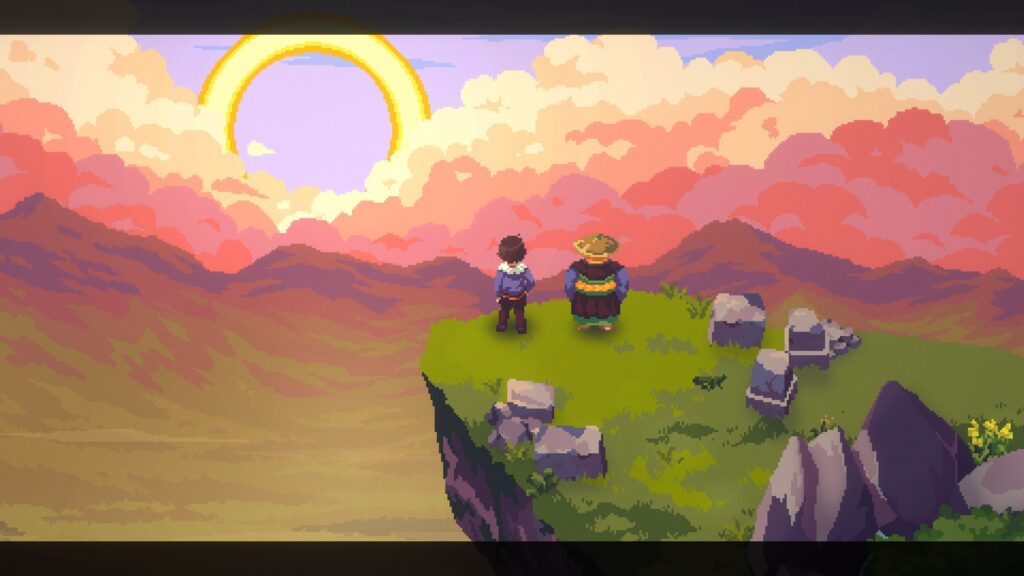
Now we come to the first thing to worry about. Spencer (your brother) isn’t here to meet you, and this digital afterlife is looking a bit run down for a utopia. You’ll quickly meet your main companion for the rest of your journey, a young, excitable boy called Kimothy. I’m not sure if it was an intentional reference but, given his character model, exuberance and penchant for ninjas he gave me young Naruto vibes. Which does mean he can be a little grating, but he means well and he’s clearly set up as a main moral pillar of the story.
After defending Kimonthy from a Crawler (strange, metallic bug-like monsters) you head back to the Welcome Centre to discover it in ruins. It hasn’t been around for 1000 years, and Maya has slowly started succumbing to the corruption. You’re the first person to be uploaded since the sun fell from the digital sky, and that’s definitely something to investigate.
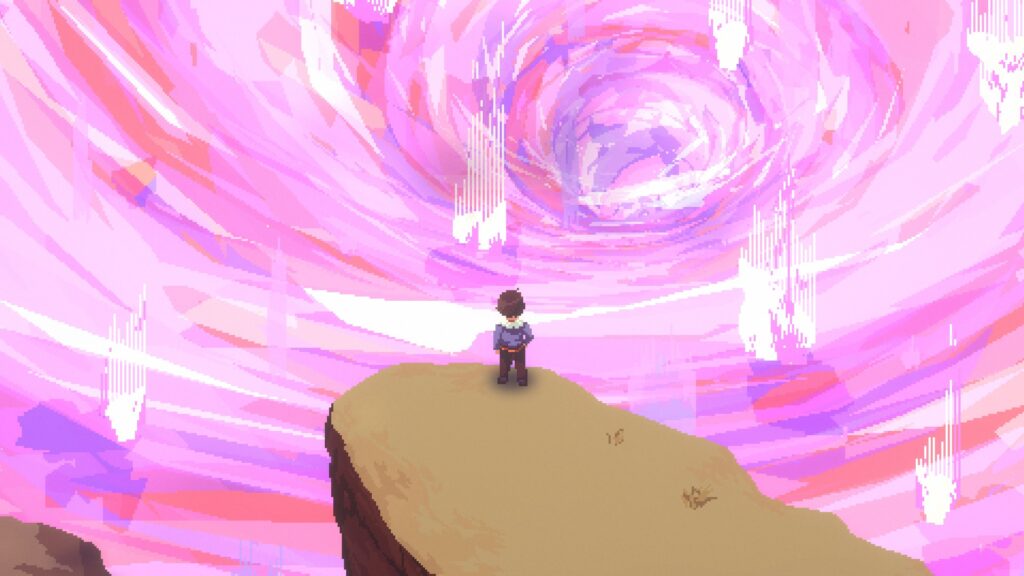
As you venture through Maya, you’ll encounter normal users – some with fun animal avatars – and Admins, those with power bestowed upon them by Nocturne (the AI that runs Maya) to change the world around them, for better or worse. Fittingly you also have the power to hear between the silence and change the world, by defeating and deleting threats to purging the digital corruption overtaking the land. What starts as a quest to find your brother, becomes a fight for the future of this digital afterlife and all the citizens in it. There’s some real Black Mirror moments, as you struggle with trying to do the right thing while battling with your own personal trauma, and trying to work out exactly what happened to turn what was supposed to be a permanent utopia into a world of monsters, corruption and slowly encroaching decay.
One, Two, Punch
The main way you deal with these threats is through the rhythm based combat in the game. As someone who isn’t amazing at rhythm games (especially on a keyboard) I did play on the easiest difficultly. Using the D, F, J and K keys you hit notes as the fall down the scree, Guitar Hero style, building up your energy to attack enemies. The system is well implemented, and those familiar with the mechanics shouldn’t struggle to pick it up. There are some twists with enemies inflicting status effects that slow your energy generation, or reducing your field of vision so notes are harder to hit. Others can drag the notes forward to switch up timings and there’s special notes you need to either avoid unless you’ll take damage, or take extra care not to miss or they’ll give your foe a special modifier. When utilised in the big set pieces, I enjoyed the system. However, during the standard battles it did become a bit of a chore.
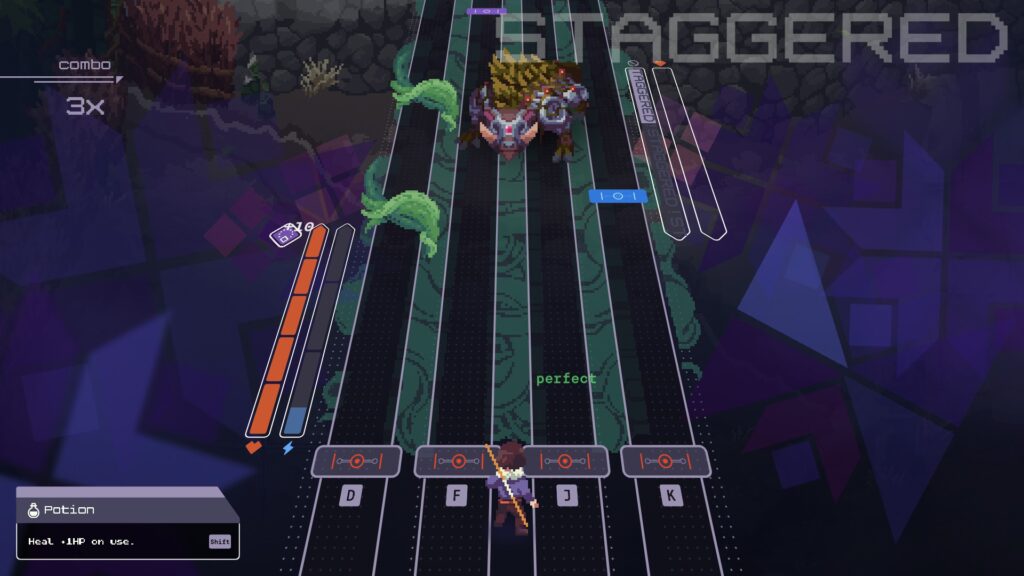
Each enemy has multiple tracks (and it must be said, the music is wonderful, really a highlight of the whole game) they can use, you unlock them based on getting better ranks during combat, but usually they’ll just use the standard tracks (with the others being selectable in the Arcade Mode). As you’ll likely be fighting a lot of standard enemies the repetition sets in pretty quickly. If you get an enemy’s health bar to zero you’ll cause a stagger, which means you can focus on getting some extra hits in or just charging up your energy, but there’s no way to end a fight faster, so you’ll just be playing the same tracks multiple times for small amounts of EXP. You can technically avoid enemies by staying out of their line of sight, but a lot of them are unavoidable and if they do happen to see you, Karma’s run speed isn’t usually enough to outrun them, so back to the combat you go.
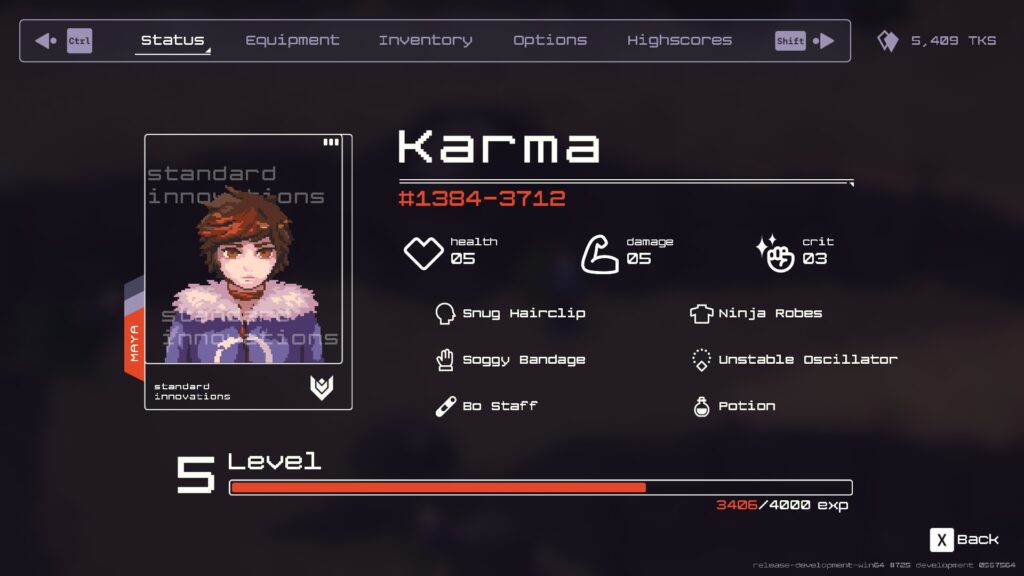
This also makes a lot of the items for build variety seem a little… pointless? You can increase stagger time, or stack crits to do more damage, but given you can’t actually defeat enemies I didn’t see too much of an incentive to use some of the more interesting sounding abilities, as it still amounted to doing the same thing. Hitting the notes, critting or riposting when the enemy attacked and getting to the end of the song. It’s also why I’m hesitant to call this an RPG. The Steam description mentions that “Nocturne features all the traditional RPG systems, from leveling and stats, to items, equipment, shops, cutscenes, bosses, exploration, and secrets.”, but there’s only two stats – HP and Damage, and they don’t meaningfully change how you engage with the combat. Again, there’s a lot of items, but the builds don’t feel different so going out of your way to buy them or track down chests containing them isn’t really incentivised.
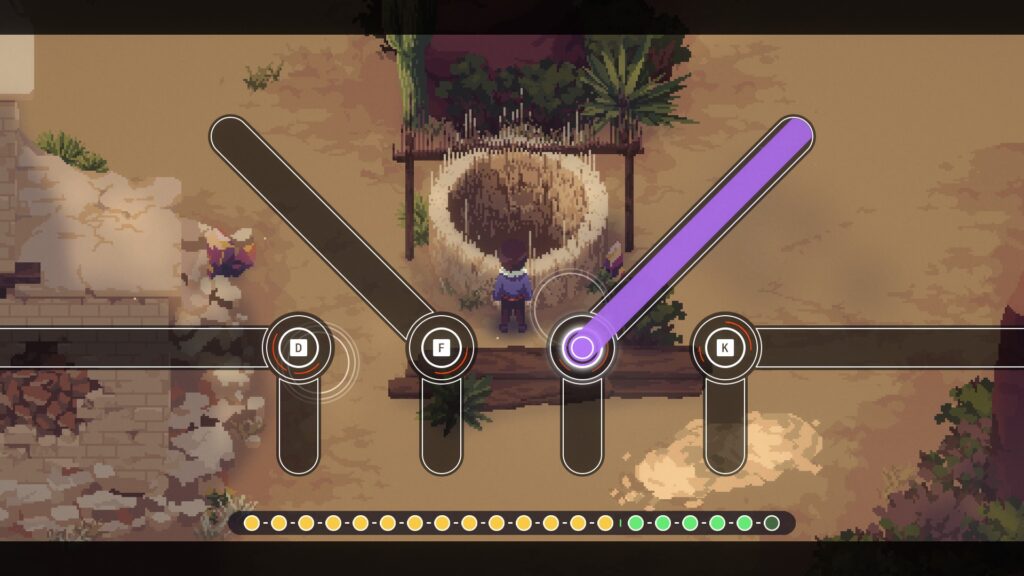
The rhythm system is also what you use to clear the corruption around the world. It uses the same keys, with different mechanics each time, like the notes disappearing, changing position or moving around the screen. It’s a more interesting way to use the system than the combat, but has its own slight issue of wildly differing difficulty based on what the notes chose to do and how good your brain can cope with the change. This, at least, I recognise is a skill issue on my behalf, and rhythm game pros probably won’t have much difficulty at all.
Final Thoughts
Nocturne ultimately delivers a what could be a fascinating digital world trapped in a paradox. It sets up an intriguing sci-fi narrative, with an interesting take on what might actually happen if a digital afterlife is left to decay over 1000 years. However, the narrative potential is constantly undermined by the game around it.
The core issue lies in how the mechanics are handled. Standard top-down RPG exploration transitions into rhythm-based combat encounters, but the implementation feels hollow. The RPG elements lack any meaningful depth, leaving you questioning why they were included at all beyond basic padding. Combat encounters quickly become a grind; recurring standard enemies share identical tracks, turning what should be engaging musical battles into a repetitive chore. While systems like speed-up gauges attempt to mitigate the tedium, they cannot mask the underlying shallowness of the mechanics. Optional dialogue interactions with companions when examining objects provide brief moments of environmental flavor, but they do little to salvage the sluggish pacing.
Nocturne aims for an ambitious fusion of sci-fi storytelling and rhythm strategy, but the grindy combat and superficial RPG systems prevent it from coming together effectively, making it difficult to recommend.

Nocturne was reviewed on PC. Gamer Social Club would like to thank the devs for the code.