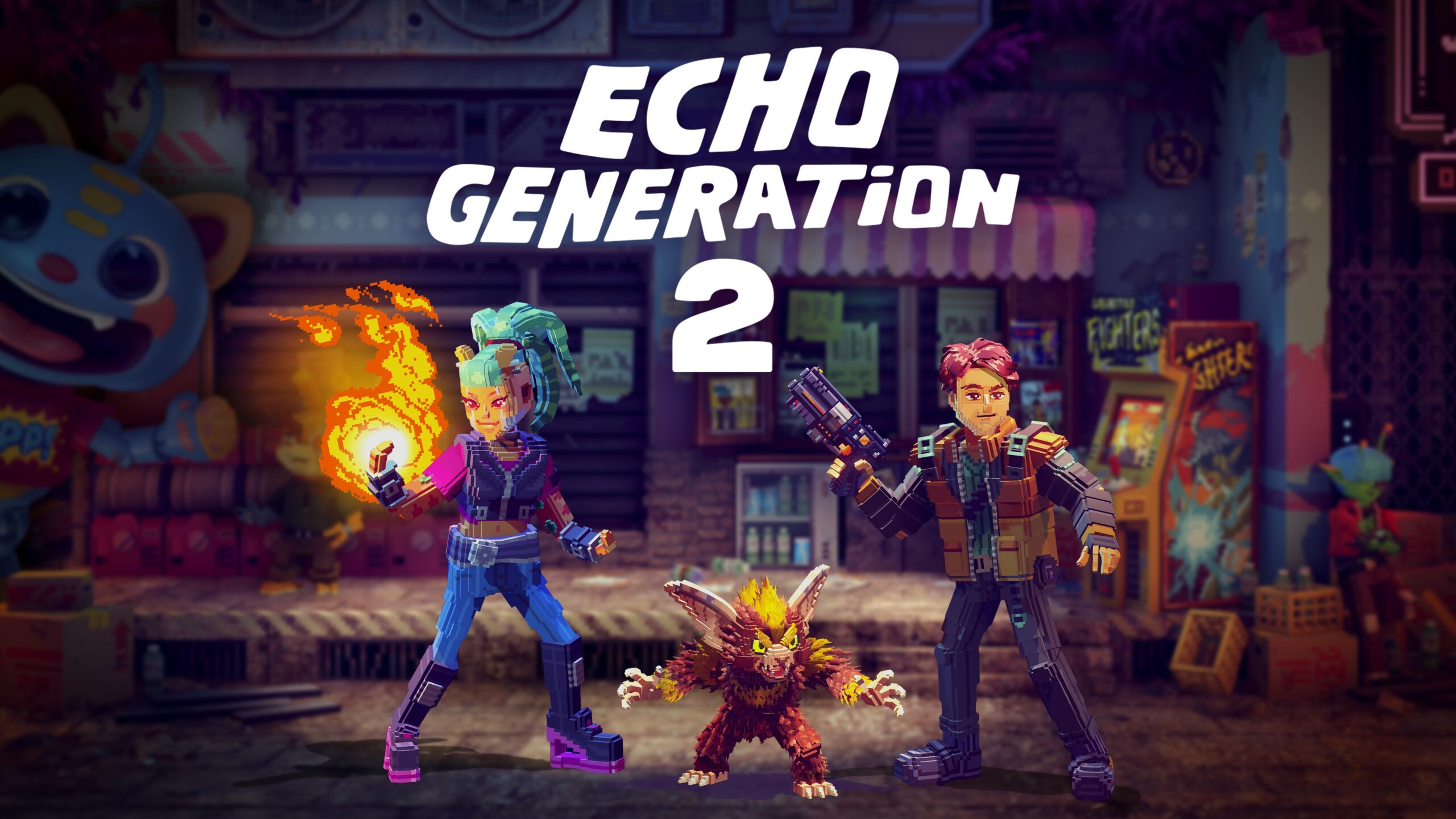
The good folks over at Cococucumber are back, this time returning to the 80s movie vibe of Maple Town in the prequel to their 2021 game Echo Generation, slightly confusingly titled Echo Generation 2. If the first game was channelling Stranger Things and 80s schlock horror, then the second title is leaning more on my favourite type of 80s movie – weird sci fi. Fans of the first game probably remember it also had quite a lot of sci fi beats, but the prequel really dials it up. We’re not just dealing with aliens in our backyard this time around, we’re bounty hunting on an alien planet, teaming up with an angry extra terrestrial gremlin and trying to save the world.
It’s Time to Duel
One of the biggest changes in Echo Generation 2 is the combat. The first game used a more traditional turn based RPG combat system with QTE style attacks, where the prequel has fully embraced the zeitgeist and added a card system. There are 6 unique character you’ll get the chance to play as throughout the game, and the each have their own unique card mechanics and deck synergies. Now I consider myself somewhat of a deckbuilder connoisseur (hello Slay the Spire playtime), so I was pretty excited for this change, especially after playing the demo earlier this year.
While it’s not as deep a system as a more tradition deckbuilder, the combat was very fun to get to grips with. As mentioned, there’s 6 different characters and they all play very differently. Jack, our “main” protagonist makes use of the Mark mechanic, which when applied to enemies allows his attacks to do a variety of secondary effects (more damage, heal himself up, etc). Bulder – the aforementioned gremlin – has recoil on a lot of his attacks, but others do different things when his health is below certain thresholds. Annata Z (a zombie) stacks virus and poison; Noliva (our alien bounty hunter) applies burn, then consumes it to power up and her adorable canine Skriff uses shock to debuff enemies but also heal up himself and others.
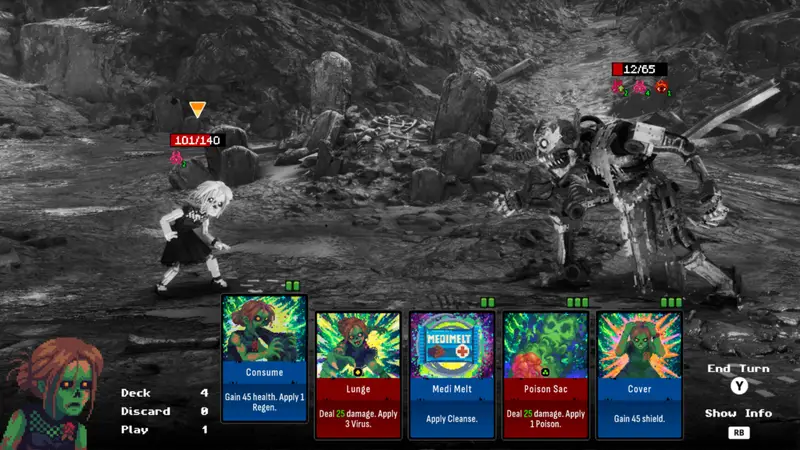
Obviously the mechanics go deeper than this, and you’re free to build your decks slightly differently to mine (Jack also has a variety of ammo for instance for debuffing enemies) but this is a review not a deck building guide. I will mention though that most cards have an energy bar that gets depleted each use, meaning you can only use them a certain amount of times per fight as a mechanic the game either completely glosses over or maybe doesn’t explain at all because I certainly don’t remember it being flagged.
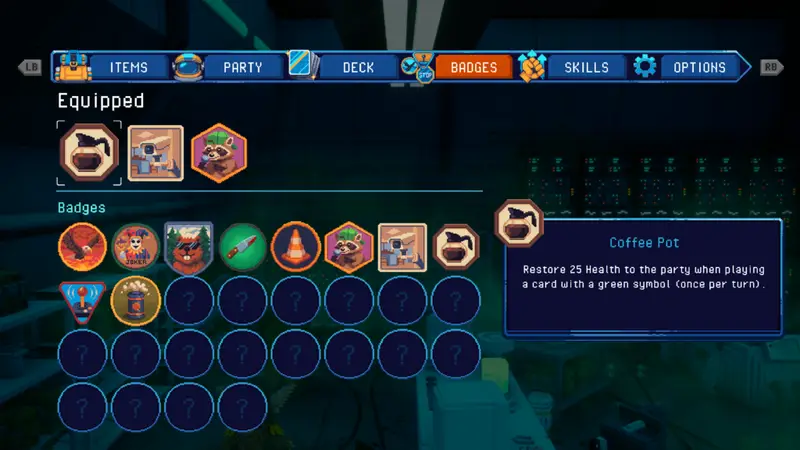
The game also has a badge system, where you equip up to three badges you find in the overworld for one time, or continual use buffs throughout fights. I will say, some of the badges seem very situational, and maybe one or two didn’t seem to be working correctly – the most obvious one being the coffee pot, which says it can be activated once per turn but only worked once per combat making it effectively useless. Due to the chapter based nature of the game, you’ll only have access to badges found by that specific character (or group of characters) in that chapter. This makes sense, but some chapters are much more forthcoming than others. I think I did a pretty good job with exploration, but both Jack and Noliva seemed to have loads of badges in their chapters, where Annata Z didn’t have many and the ones she did get were almost exclusively focused around multi enemy fights, making them moot in the endgame.
There’s also an abundance of status effects, perhaps too many. A lot of them seemed pretty inconsequential unless you really focussed in on stacking them, and even then the health bars get pretty large as the game progresses and the enemies hit super hard meaning you probably don’t want to prolong them longer than you need too, in order to build up a big bleed stack. This goes for the status’ used against you too. Most of them can be pretty easily ignored – especially as cards that remove them are almost exclusively only used for that and take up a slot in your limited 10 card deck. There is one specific status that is very noticable, but I’ll talk a little more on that later.
Choose Your Own Adventure
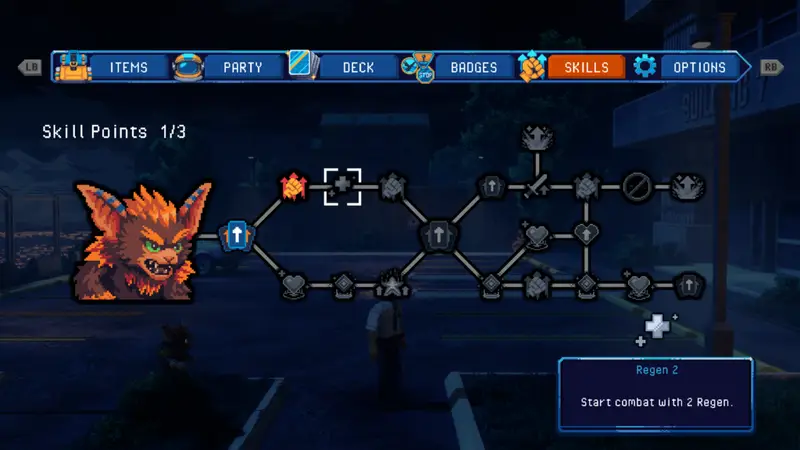
Unlike the first game which has a pretty linear story, Echo Generation 2 is chapter based. You have to start with the Sister M chapter (the 6th character not mentioned above) and those that played the demo will be pretty familiar with it. Sister M is essentially used to introduce the mechanics of the combat, as well as set up the events of the game. She doesn’t really have a specific playstyle, just a good variety of cards for you to play around with as the game explains the card, skills and badge systems. Each character has a skill tree, so they’ll all start at level 1 where you can only play one card per turn and slowly level up to a max of 11. Sister M does this rapidly in the intro chapter, so fair warning that it only seems easy at the start.
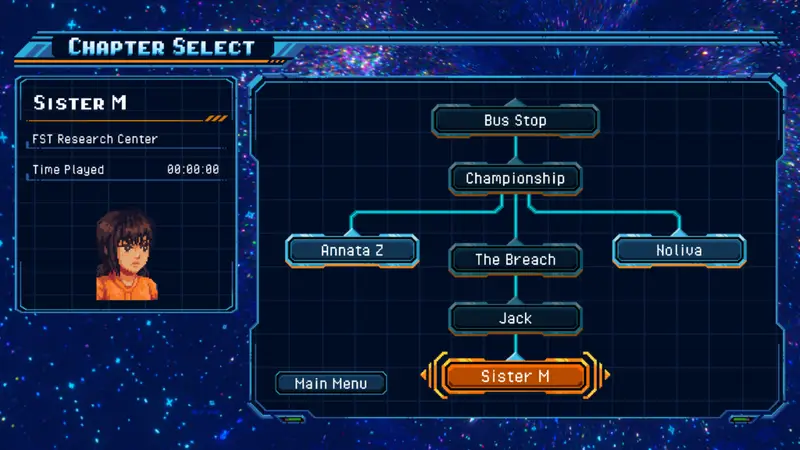
You’ll begin trying to breakout of the FST HQ, fighting through soldiers and mechs all rendered in Cococucumber’s signature voxel art style before you can then chose to play as Jack, Annata or Noliva in any order. I really enjoyed the sharp contrast in locations and art styles for each of the characters, and the writing has that slightly off beat, reference filled humour of a lot of 80s throwback media. There’s a lot of references to the first game too, like the dancing cat skeletons on Fisterra guarding another grave and, in Jack’s first chapter having your kids (the protagonists from Echo Generation 1) join you in combat with a selection of QTE attacks.
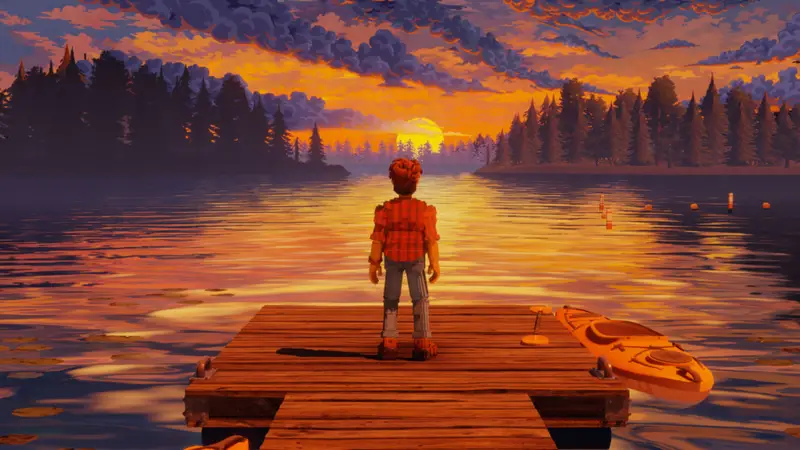
I really want to shout out just how good Echo Generation 2 looks. Voxel art can be a little polarising, but Cococucumber have really mastered their craft with this game. The locations of each chapter are so unique, so well suited to the genre each one is going for I found myself hitting the screenshot button in almost every new area. Looking out over the lake in Jack chapter one, seeing the gorgeous sunset reflecting on the water before grotesque zombie crab creatures come shambling out the woods. Fighting holographic ninjas as Noliva and Skriff in a swarming cyberpunk planet full of Blade Runner style noodle bars frequented by weird aliens. The bleak completely black and white wasteland of Fisterra where Annata Z shambles around trying to find her daughter amongst towering mechanical monstrosities. Each one is dripping in style, made even better by the outstanding dynamic lighting.
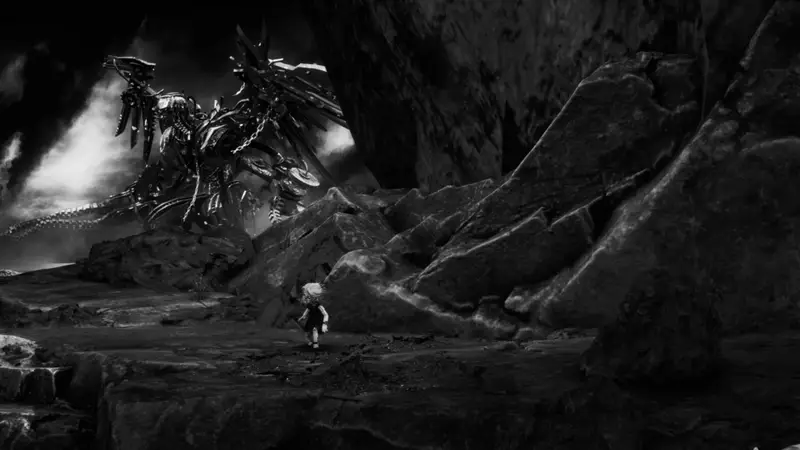
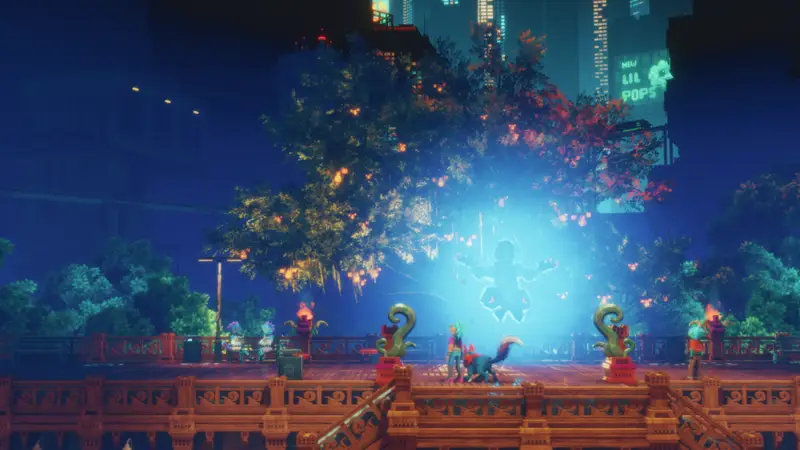
While the individual chapters were a lot of fun, especially given the massively different vibes and aesthetics, I’m not sure how well they serve the overall story. We spend a few hours with each character, establishing their motivations and loose connections to the main “plot” but none of what happens towards the end of the game seems to be set up in any of them. Yes, there’s a mysterious portal gone wrong in a shady government complex, but quite what that has to do with the final showdown isn’t really made clear. The main bosses don’t really seem to have a fixed motivation that I could decipher, and only one of them plays a major role in any of the chapters, with another merely referenced. I don’t want to spoil the ending, but if you’re looking for some concrete answers to some of the unsolved mysteries of the first game I’m not sure you’ll find them.
Boss Rush
As I said above I’m not going out of my way to spoil the story beats, but I need to talk about the ending sequence and how it functions mechanically, so read at your own risk.
The game ends on a boss rush. All of the characters come together and you pick a party of three to take on this segment. You start one on one, then two on one, then eventually your fully 3 man team is assembled for the final few fights. I didn’t mention in the combat section, but each enemy has a shield that is comprised of different symbols, that must be broken by playing a card with that symbol against them. Throughout the game it pays to have spread moves in your deck, as you’ll frequently be up against multiple enemies at a time – not so in the end game, so a lot of benefits to those cards and by extension badges that are geared around multi enemy fights are removed. You also cannot modify your deck or skills through the entire sequence (apart from one) so if you level up then… tough I guess.
Now despite these foibles, I was having a pretty good time in this boss rush. The fights were challenging, but not unfair and I felt reasonably positive that I could strategise and synergise around what was being thrown at me. Until the final boss. One of the most frustrating and powerful ways to shut down strategy in a deck builder is to stop the player from being able to see what card they are playing. It’s generally used sparing (I think 2 boss blinds in Balatro use it in very limited ways on your hand, another on your Jokers), especially where cards don’t have infinite amounts of uses. Not here. The final boss can repeatedly use a move where you cannot see your cards, the effect can stack, and it is the only effect in the game (bar maybe stun) that cannot be cleansed.
This means, in a deck builder where cards have limited uses, you can end up not seeing what any of you party has in hand multiple turns in a row and there’s nothing you can do about it. My record was six. SIX turns in a row where I had no idea what card I was playing (apart from being able to deduced it was a heal as it auto targets you instead of the boss). I had to rerun the final gauntlet 4 times, almost purely due to RNG and I had to sleep on writing this review after completing the game because it damn near soured the entire experience.
Final Thoughts
Echo Generation 2 left me in that awkward space where style, charm and mechanical ambition shine brightly, but the final stretch stumbles hard enough to leave a bruise. Cococucumber have crafted a gorgeous, imaginative prequel with some genuinely clever ideas; its card based combat is snappy and satisfying (mostly), its cast is varied and fun to experiment with, and each chapter feels like stepping into a completely different flavour of 80s sci fi oddity. When the game is firing on all cylinders, it’s an absolute delight.
But the uneven badge balance, the occasionally muddled storytelling, and that punishing, RNG heavy final boss undermine what is otherwise a confident evolution of the series. It’s frustrating because the foundations are so strong; the game clearly knows what it wants to be, and for most of its runtime it absolutely nails it. The ending just doesn’t play fair, and it’s a shame to see such a stylish adventure lose its footing right at the finish line.
Despite the missteps, Echo Generation 2 is a bold, imaginative follow up that fans of the original – and fans of quirky sci fi RPGs in general – will find plenty they enjoy in. Just be prepared: the final duel might test your patience more than your deck building skills.

Echo Generation 2 was reviewed on Xbox Series X. Gamer Social Club would like to thank Cococucumber for the code.
Echo Generation 2 releases on 27 May 2026 and is coming to PC, Xbox Series X/S and Xbox Game Pass.