
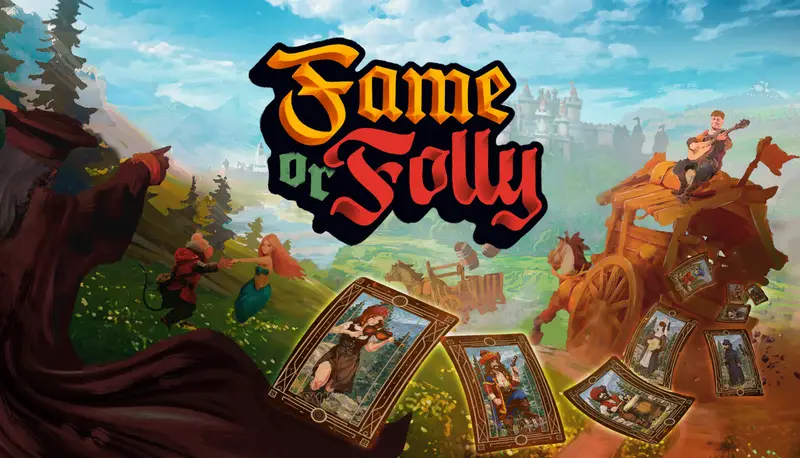
Every so often, a game comes along that does not politely ask for your attention. It grabs you by the collar, drags you onto a stage you definitely did not agree to stand on, and demands you perform. Fame or Folly is exactly that sort of game. It does not ease you in, it does not gently explain itself, and it certainly does not care if you are ready. Instead, it flings a troupe of misfits at your feet and says, Right then, make them stars. And for the most part, it works. For the most part.
Outrageous!
At its core, Fame or Folly is a roguelike deckbuilder, but calling it that undersells how frantic and theatrical it feels. The whole thing is framed as a Renaissance style performance war, where rival troupes battle for prestige, applause, and the chance to perform at the Grand Festival. It’s a wonderfully silly premise, and the presentation does a lot of heavy lifting. The pixel art is gorgeous, the card art is even better, and the whole thing has a confident charm that is hard not to like. It feels polished, expressive, and very aware of its own style.
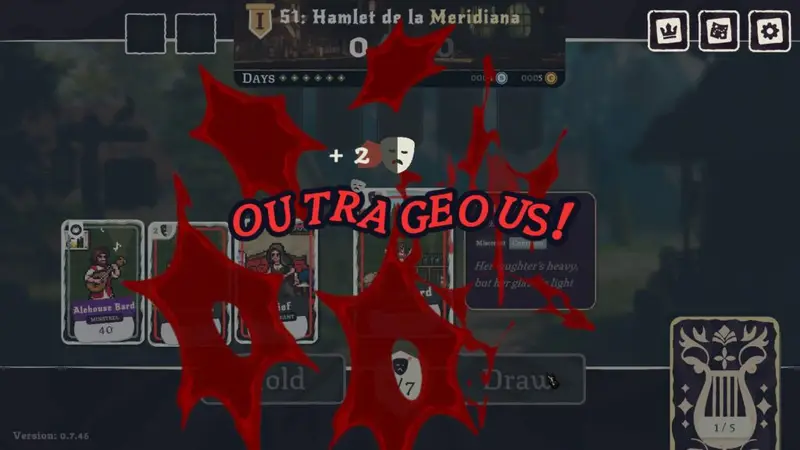
The pace is where the game really stands out. Most deckbuilders give you time to settle in, build a strategy, and slowly refine your deck into something coherent. Fame or Folly is far more chaotic. Your deck is constantly shifting as you hire, fire, upgrade, and reshuffle your troupe. It’s a deckbuilder where you are not just building a deck. You are managing a cast of unpredictable little gremlins who all want to be the star of the show. It’s lively, messy, and often very funny (when you fail and get pelted by tomatoes, the game shouts Outrageous! at you in a ridiculous “Olde English” tone and I genuinely laughed out loud).
Performing Arts
The five classes, Minstrels, Vendors, Mystics, Outcasts, and Wardens, each bring their own flavour to the chaos. Minstrels are your reliable point scorers, Vendors keep your economy afloat, Mystics bend the rules in ways that feel borderline illegal, Outcasts are high risk lunatics who can either win you the run or tank it instantly, and Wardens help you manage tension and keep the crowd on your side. It is a clever setup, and when the synergies click, the game can feel genuinely exciting.
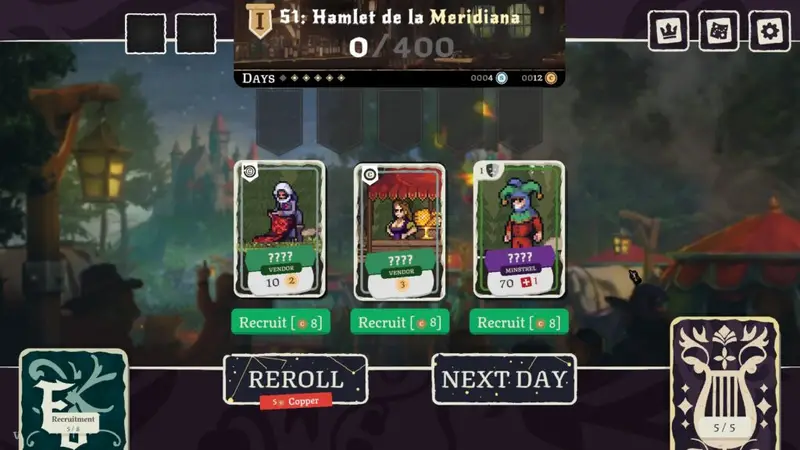
But this is also where some of the cracks start to show. The strategic depth is there, but it’s not always as strong as the game wants you to believe. Some builds feel far more reliable than others, and certain combinations can fall flat no matter how much you try to coax them into working. The game encourages experimentation, but it doesn’t always reward it. There are moments where you can feel the design stretching, as if the systems want to be deeper than they currently are. It isn’t a deal breaker, but it does mean some runs feel more like you are wrestling with the game rather than mastering it.
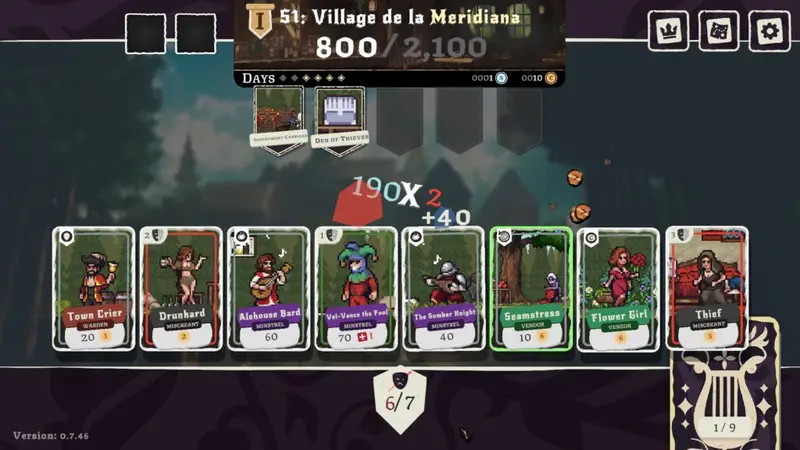
Juggling
Banners act like jokers in Balatro, offering passive bonuses that can reshape your strategy, and props give you one off boosts that can save a run or push a good one into the stratosphere. These are fun to play with, but again, the balance isn’t always consistent. Some banners feel essential, while others barely register. The tension system, which punishes you for pushing your luck, is a great idea on paper, but it can feel a bit blunt in practice. Sometimes it adds drama. Sometimes it just feels like the game is slapping your hand for trying something interesting.
What surprised me most is how intuitive the game still feels despite these issues. There’s real depth here, even if it’s uneven. The game trusts you to experiment, to fail, to try again, and to slowly piece together how everything fits. It has that same just one more run energy that made Balatro so dangerously addictive, but with a personality that is entirely its own. It’s playful, stylish, and occasionally unhinged, in a good way.
Of course, it wouldn’t be an early build without a few hiccups. There were some bugs during the preview period, mostly involving shops and recruitment, but they have already been patched. Even when they did appear, they didn’t ruin the experience. The core loop is strong enough to carry the game through its rough spots.
Final Thoughts
What really sticks with me is how Fame or Folly manages to feel both familiar and fresh, even if it doesn’t always hit the heights it’s aiming for. It borrows ideas from physical deckbuilders, roguelikes, and theatre management sims, but blends them into something that feels cohesive and confident. It’s not trying to reinvent the genre. It’s just doing its own thing, and doing it well enough that you want to see where it goes next.
By the time you have finished a few runs, you will know exactly what kind of game this is. It’s the one you open for a quick session and suddenly it’s midnight. It’s the one where you swear you will stop after this run, only to immediately start another because that banner combo was almost good and you want to see if it can actually work. It’s the one where you find yourself muttering at your performers like a frazzled theatre director who is two rehearsals away from a breakdown.