
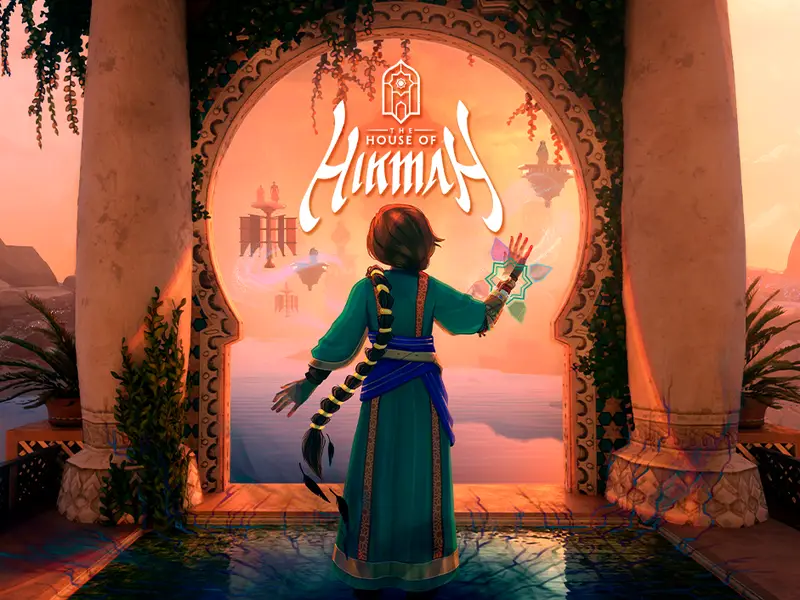
The topic of grief, and all of its trappings, is a powerful and difficult topic to tackle in any form of media, let alone video games. While it may be universal, with everyone likely to experience grief at some point in their life, if not handled with care, it can easily miss the mark. Thankfully, I can say that The House of Hikmah does not have this problem, as it has clearly been designed and developed with sincerity and understanding, resulting in a game that is both enjoyable and moving.
The House of Hikmah is a 3rd-person, narrative-driven puzzle platformer, and the first game developed and self-published by Lunacy Studios, a fully remote Indie developer. You play as the bright and inquisitive Maya, a 14-year-old girl who travels to the House of Wisdom in search of answers in the wake of her father’s passing. With only visions of her father and a mysterious device he left to her called the Key, Maya must traverse the marvellous realms within the House of Wisdom’s walls, assisting its resident scholars, and walk a path of discovery, understanding, and healing.
As someone who has lost a parent, I immediately related to Maya and her motives; the need for answers, justifications for what has happened, or even just something to provide a semblance of closure and hush the nagging thoughts. But reaching those answers can take time, and as Maya explores the awe-inspiring House of Wisdom, assisting larger-than-life versions of Islamic scholars from history, she quickly discovers that she is not the only one who is burdened with grief. A Shadow has seeped into the House of Wisdom, its origins deep within the Mystic Realm, and the death of Maya’s father appears to be the catalyst for its arrival.
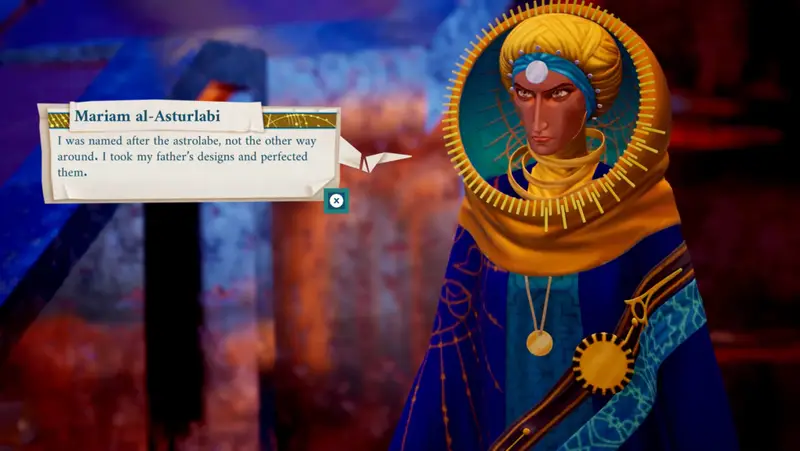
The emotional and narrative core of The House of Hikmah is brilliantly executed, with a fully-voiced cast bringing the game’s story and characters to life. Meeting each of the scholars and watching Maya interact with them was an absolute treat, from the calm and collected Ibn Sina to the erratic, bordering on paranoid, Hasan Ibn al-Haytham. They are all charming in their own way, and I enjoyed Maya’s conversations with them, steeped in their respective scientific or philosophical fields of study. That being said, apart from one character who does not appear until late into the game, I think Maya’s performance is my favourite and the most impressive. I felt every one of her exasperated sighs, stutters of hesitation, and sobs of grief, and was very moved by her story. Paired with delicate facial animations and nothing more, every emotion is thoughtfully conveyed to the player in a way that feels so natural despite the static framing of each scene.
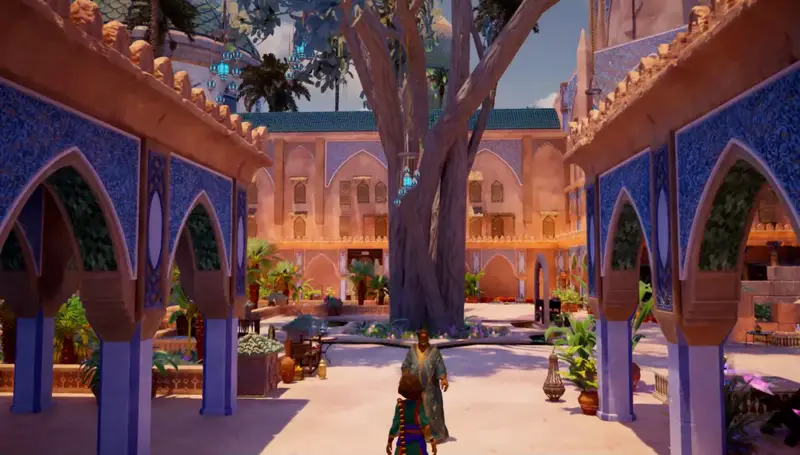
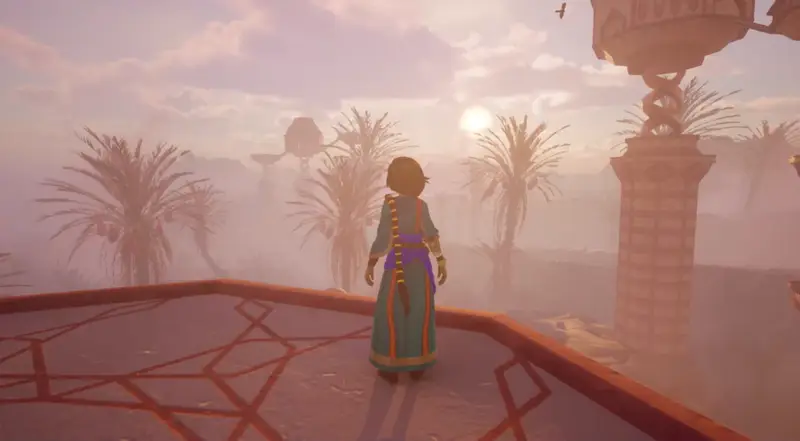
As soon as she arrives at the House of Wisdom, Maya is tasked by Fatima al-Fihri with delivering messages to all of the scholars to return to the House’s Atrium. The Atrium is a sun-soaked courtyard filled with potted palms, water features, and seating areas consisting of colourful cushions and ornate teasets, and acts as the game’s hub, with mystical doorways leading to each scholar’s “study”. In front of each portal are spots for a Loose Page and a specific item that are hidden in that realm, with pale imitations sitting in their place until the real versions are recovered. There is also a very cute, vibrant purple owl that likes to perch in front of the next door Maya needs to go through, whom Maya can chat with and pet, which is delightful.
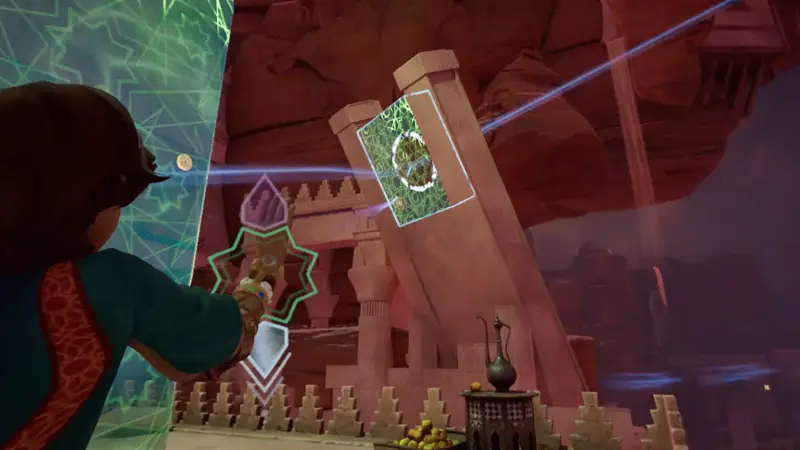
The House of Hikmah’s gameplay is a mix of environmental puzzle-solving and gentle platforming, with the cryptic Key strapped to Maya’s forearm as the focus. The device lets Maya transmute the matter of certain objects, unlocking different options as she progresses through each of the scholar’s realms. Bending light through glass, lowering a platform by transmuting its core to metal, and walking through immaterial walls of ether are just a few of the things Maya can do with the help of the Key. I loved how each new form of matter was introduced and neatly integrated into the overall game and puzzle design, building in complexity but not without first explaining its principles through smaller, easier challenges. It felt great to experiment with Maya’s abilities, learning the game’s rules and then applying my newfound in-game knowledge to the next obstacle. Add in activating mechanisms with levers or weight-based floor panels, riding in wind tunnels, and one-way teleporting fissures in space, and you’ve got some incredibly engrossing puzzling to dig into.
Matching much of The House of Hikmah’s excellent game design and narrative is its art direction and subtle blending of styles. The game’s environments are depicted in a realistic style, with amazing architecture everywhere, and items and surfaces given accurate, detailed textures and finishes, from soft, delicate drapery to the metallic sheen on a candelabra. The scholar’s various realms are all stunning in their scale and beauty, and I stopped to marvel on more than one occasion in each just to take in another breathtaking view. A colossal planetarium floating among the stars, a never-ending library strewn with giant floating sheets of parchment, and a palatial structure held aloft by giant whirligigs amongst towering palm trees are just a few of the spectacular locales you get to visit, each more fantastical than the last.
The House of Hikmah’s cast of characters has a more stylised aesthetic in contrast with the world’s art direction, and I think it looks fantastic. So much attention has clearly gone into sculpting each character’s face, giving them a unique but grounded appearance, if somewhat lightly detailed. The game is awash with colour, but none more so than Maya and the scholars, whose wardrobe is just one beautifully put-together outfit after another. Lavish, draped robes adorned with tassels and embroidery, matched with dramatic headresses, appear next to more muted tones, with delicate script adorning the folds, reinforcing the respective wearer’s personality, whether severe or serene.
Maya’s animations are lovely and smooth, with her long braided hair draped over one shoulder as she runs, climbs, and floats through each realm. The game also features some excellent particle design, and I must shout out the very tidy and stylish UI that forms around Maya’s wrist when she uses the Key. Plus, the game has great lighting, with it at its best in the Atrium, creating stark shadows under the palms, adding to the hub’s calm ambience. Honestly, I could imagine putting my hand on one of the walls and feeling the sun-baked heat emanating from it; it looks that good.
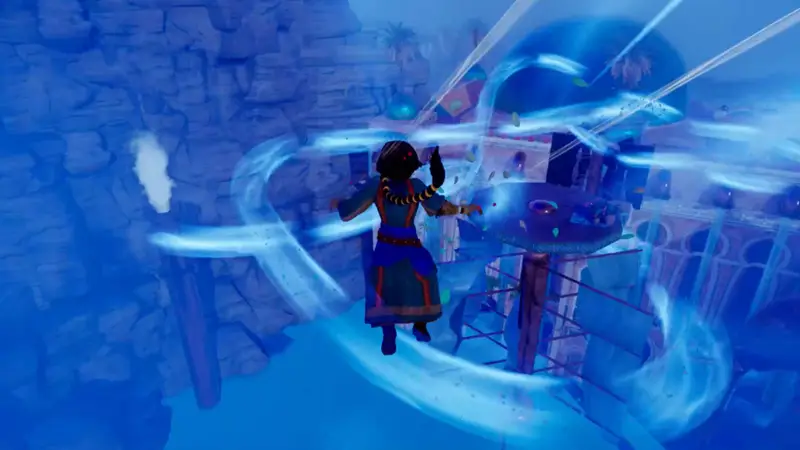
The final element to bring it all together is The House of Hikmah’s melodic and often meditative soundtrack, composed by the award-winning Austin Wintory (Journey, Stray Gods, Sword of the Sea). Using a variety of culturally significant instruments, the game’s soundtrack gently swirls about Maya as she navigates the mysteries of the House of Wisdom. It has a generally soothing nature that I felt not only meshed well with the art design but also complemented the gameplay, adding a balm to any frustrations I faced. Much in the way the wind currents carry Maya, The House of Hikmah’s music carries you through the game, a calming constant that envelopes you in the soft wrappings of history.
Unfortunately, my time with The House of Hikmah was not without its hiccups. Other than having quite a few loading screens, which all featured the same text hint, I did experience a few technical problems. There were two occasions when the game crashed on me, and there was a serious amount of pop-in when starting in a new area. Maya’s mantling animation is also a bit finicky, leading to me often jumping again after climbing up just to avoid slipping off the edge. While these were just mild annoyances, I was disappointed to find that the game didn’t have the best tracking when it came to the game’s collectibles, and would force you to replay a level as it was in the story, as opposed to a free roam option. Hopefully, these few grains of sand can be cleared from the gears, leading to a smoother overall experience.
Final Thoughts
Maya’s journey through the House of Wisdom is a thoughtful and heartfelt story of grief and how we carry it through life, and simultaneously an incredibly entertaining and engaging puzzle-platformer. Despite some technical issues and a few quality-of-life/design discrepancies, the game’s beautiful narrative, art direction, music, and gameplay all work in harmony to create a fulfilling experience. A beautiful celebration of Islamic culture and history, as well as those who are no longer with us, The House of Hikmah teaches us not to let ourselves get lost in the shadows of grief, but to persevere, to lean on others, and maybe even learn to appreciate that weight in our hearts.

The House of Hikmah is out on April 8th on PC.
The House of Hikmah was reviewed on PC with a controller.
We would like to thank Lunacy Studios for providing the review key.
Will you be picking up The House of Hikmah? Let us know in the comments below, and join the Gamer Social Club Discord to chat with others about your favourite games, play in community game nights, take part in giveaways, and more!