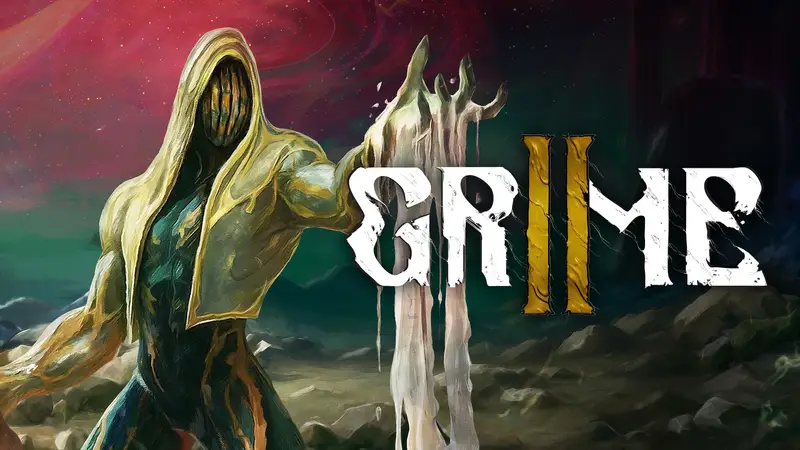
There’s something to be said about how previous experiences and relationships shape you into the person you are. Whether it’s strange vocal mannerisms (who knows who I picked up “Good Grief” from) or unusual fears from long forgotten childhood events. Grime 2 from Clover Bite takes this concept a stage further, and lets you – a formless – literally absorb your defeated foes to power you up and find your meaning in its surreal paint drenched world.
Breaking the Mold
If you can extrapolate a trend from the first Grime, it’s that Clover Bite are genuinely interested in doing something weird with the soulslike-metroidvania crossover.
One of the core systems in Grime 2 is the Mold absorption system, and it’s worth talking about at length because it’s a very fun and interesting addition to the game. You stun an enemy; through parrying, dodging or using abilities and then you dash into them to absorb their Mold. That Mold can then be equipped and summoned during combat to do all manner of things: hurl projectiles at other enemies, create decoys to draw aggro, stun foes, or even physically flick enemies into hazards. You can hold up to four of them at once (although one is temporary), and you manage them through a resource called Paint, which depletes as you summon Molds and refills as you damage enemies or find items.
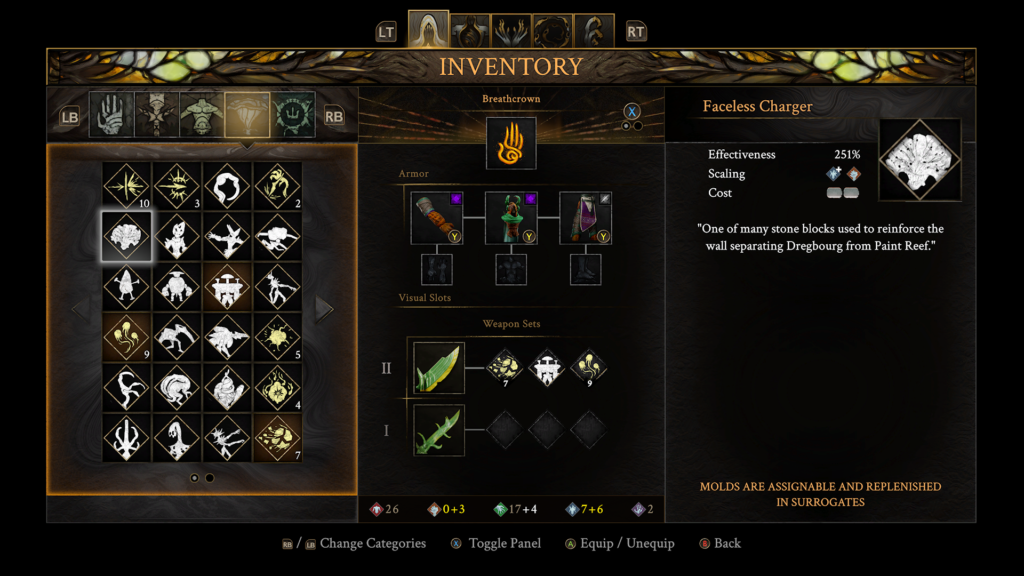
That said, and this is important, the system does have some rough edges. The Paint economy can feel tight, particularly early on when you’re still learning what each Mold does. I’ve had moments where I’d get greedy with summons, run out of Paint mid-fight, and have no way to refill it quickly enough. It’s moments like this when I think the game could have potentially used some consumables to quickly refill a bit of paint (or health) just to let you engage with it a little more smoothly.
The actual combat beyond the Molds is solid. The parry system has a few variations, a standard parry with a forgiving window, a “Grasp” that lets you latch onto vulnerable enemies (indicated by white dots) for positioning and combos. There’s also a stamina resource called Force that when above a certain level gives you a damage boost, and Breath, which is essentially your healing charges. You steal Breath from enemies, so you’re incentivised to engage with combat rather than run past everything. The weapons (there are 30+ of them) are varied, so you can pick ones that fit your playstyle. I prefer a fast weapon, so stuck with some daggers I found incredibly early for almost the full playthrough, with a bow in my second slot – but big bonk enjoyers will be equally well catered too.
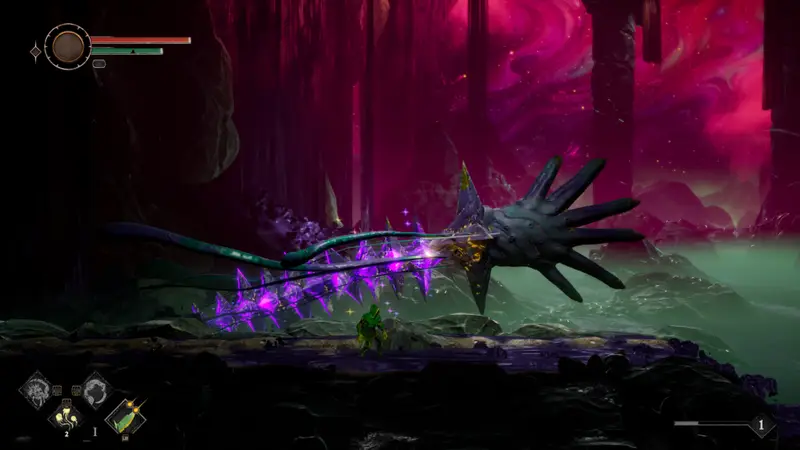
The bosses are incredibly fun, and also incredibly challenging too. At the beginning of the game, they’re simple enough – teaching you how to use the games multiple mechanics. Towards the end you’ll need to use your movement abilities to backflip around arenas to dodge massive AoEs, grasp weak spots and break barriers to stun them so you can inflict damage or backflip and dash into obstacles to stop them for smacking you for massive damage. They are a highlight of the whole experience and a testament to how, with a little effort you can incorporate all of the aspects of a games mechanics into making an tough but fair encounter.
The World as an Art Project
Here’s where Grime 2 genuinely excels: the world design is phenomenal. Each region, Marah’s Orchard, the Paint Reef, the Naileglade; feels like it was designed by someone who actually cares about what they’re creating. The art direction is the game’s strongest suit. Where the first Grime was more monochromatic and oppressive, Grime 2 embraces colour. Marah’s Orchard is vibrant and organic, full of strange botanical forms. The darker zones are genuinely eerie in a way that feels intentional rather than just “grimdark for grimdark’s sake.” There’s a cohesive visual language – themes of hands, creativity, artistic expression bleeding through into the environments. It’s surrealist in the best sense of the word.
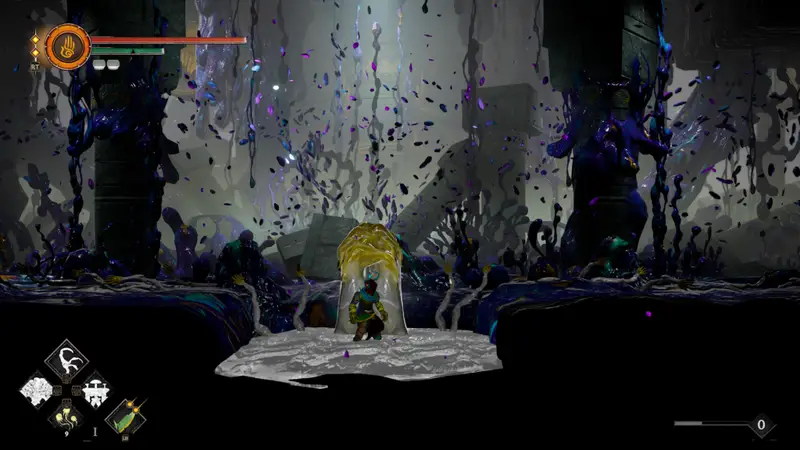
As to be expected from a Metroidvania, there’s a lot of backtracking and interconnectivity to the map. You’ll unlock shortcuts that make sense geographically, and there are genuine moments of satisfaction when you open a door and realise “oh, that’s where I was three zones ago.” The level design encourages exploration, there are hidden compartments and optional paths tucked away in places that reward careful players, but how good the rewards are might depend on your playstyle. For every new meaningful upgrade (health, paint, etc) there’s what feels like 20 more that reward you with a small amount of currency, experience or armour piece. Given how challenging some of the platforming can be (someone really loves spiky walls), and the limited nature of healing, spending a good 5 or so minutes working through a tough section to get another new pair of shoes lost a bit of its lustre about 15 hours in.
While there are a lot of good ideas, and when you successfully string together a chain of moves to get through a tough section the game feels great – some of the traversal is tedious. There are sections where you’ll backtrack through the same corridors multiple times, and whilst the art direction means each area is beautiful, beauty doesn’t make repetitive navigation less repetitive.
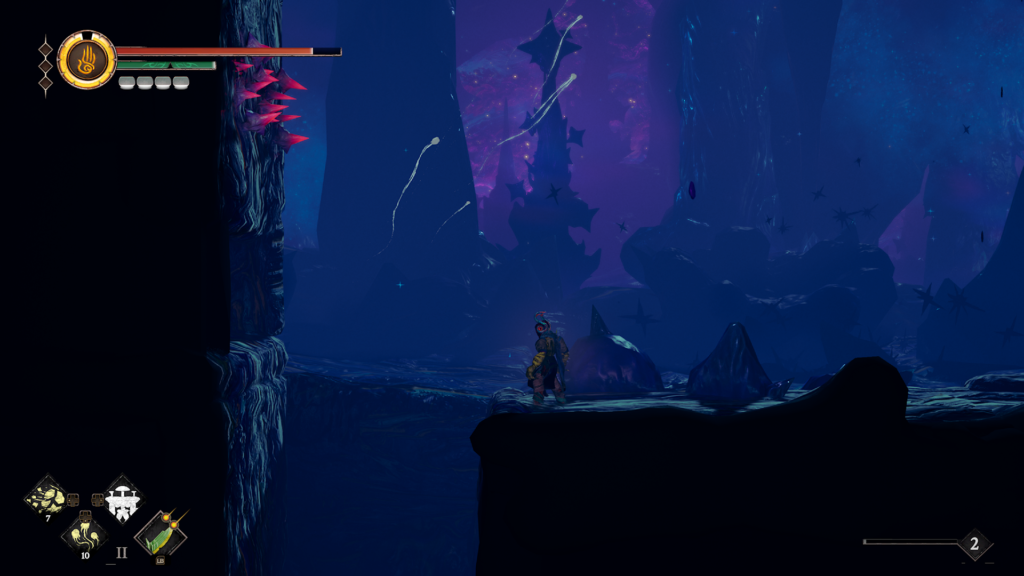
Each area also adds new obstacles to interact with for platforming, which usually involve holding the dash at the correct moment (easier said than done), or grappling through them to avoid an insta reset obstacle. These obstacles are always spikes (even when they’re embedded in waterfalls), so you take damage every time you fail, and given that health recovery is tied to fighting enemies it can make exploring feel unnecessarily punishing at times. Then there’s one of the mechanics added very close to the end of the game that allows you to slide on walls. I found this particularly difficult to get to work when have to dash into a wall and slide down due to the directional inputs, and question a little as to why you’d need to change quite a fundamental way of how the movement works so late in the game (except maybe as an excuse to put even more spikes on the walls).
The Performance Grumble
This is the bit that genuinely frustrates me, because a lot of the platforming gripes I have could definitely be chalked up to a lack of skill, but not the ones caused by performance issues. Grime 2 has a bit of a stuttering problem. In certain areas with a lot of particle effects and background details I had consistent stuttering during movement, dodging, and boss fights.
I had one boss completely glitch out, so the camera kept snapping out of the arena until I got pummeled to death. Another where the camera would snap back to the entrance at the beginning of combat usually resulting in a big hit. And two crashes – one to the homescreen and another where I had to restart my Xbox.
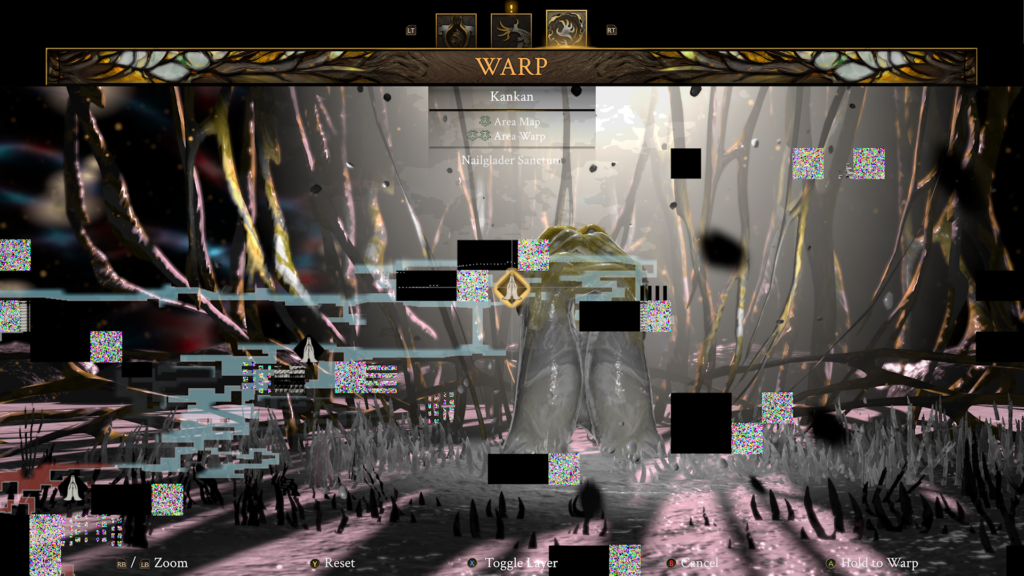
This is the kind of thing that chips away at an otherwise excellent game. You’re trying to execute a precise parry during a boss fight and the game stutters, and suddenly you’re dead and you’re not quite sure if it was your fault or the game’s.
Final Thoughts
Grime 2 is a genuinely good game hamstrung by technical problems and some level design issues. The Mold absorption system is clever and forces you to engage with combat in interesting ways. The world design is beautiful and rewards exploration (mostly). The art direction is top-tier and the NPCs are interesting and occasionally hilarious. But the stuttering problems, the occasional finicky platforming, and the stretches of repetitive backtracking keep it from being the excellent game it could be.
If you’re willing to tolerate performance issues (or you’re lucky enough to land on a hardware configuration that plays it smoothly), and if you enjoyed the first GRIME or are just interested in weird, artistic soulslike metroidvanias, it’s absolutely worth playing. The game respects your intelligence and your ability to learn systems, and there’s a real sense of progression as you absorb more Molds and unlock new areas. But go in knowing that there’s parts of the game that may frustrate you – intentionally or not.

Grime 2 was reviewed on Xbox Series X. Gamer Social Club would like to thank the devs and publisher for the code.
Grime 2 launched on 31 March 2026 for PC (Steam), PlayStation 5, and Xbox Series X/S.