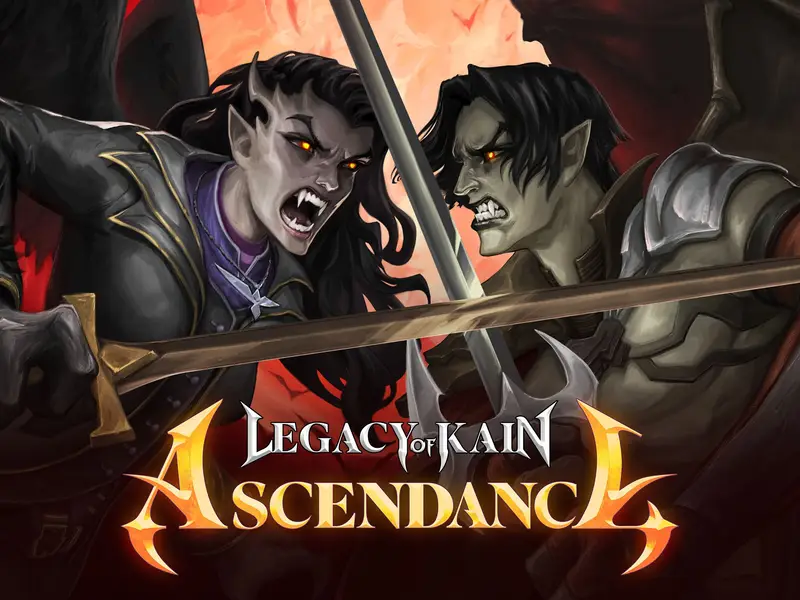
The Legacy of Kain series has slowly risen from the grave, and after 23 years, it finally has a new entry in Legacy of Kain: Ascendance. The Legacy of Kain: Soul Reaver 1 & 2 remaster and LoK: Defiance remaster pushed open the coffin lid and pulled the franchise to its taloned feet, respectively, but Ascendance was its chance to spread its wings and soar. While the sixth entry in the Legacy of Kain series may not take it to new heights, it is another entertaining, albeit short, chapter that weaves a doomed tale about love, revenge, and, as always, fate.
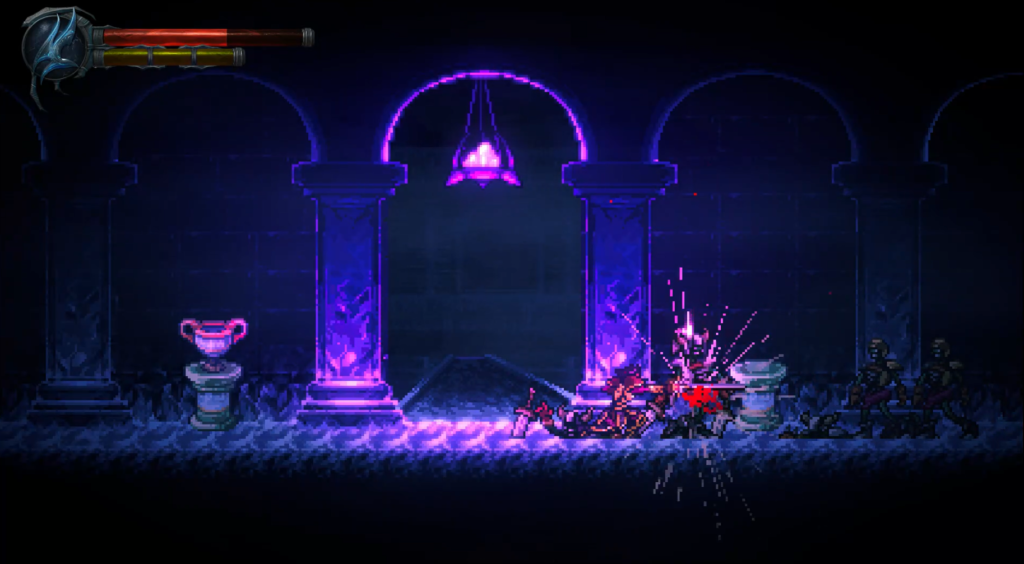
Developed by Bit Bot Media and FreakZone Games, and published by Crystal Dynamics, Legacy of Kain: Ascendance is a 2D sidescrolling, pixel art action game, the first of its kind for the series. Spread over 12 chapters, you play as four different characters: the titular vampire and ruler of Nosgoth, Kain, Raziel as a Sarafan and a vampire, and Raziel’s vampire sister, Elaleth.
Ascendance’s narrative is a linear one, well, about as linear as any narrative set in the Legacy of Kain series. It focuses on Elaleth and her quest for vengeance against her brother, Raziel, for killing her lover, Matthias, who had been turned into a vampire and bitten Elaleth as well. Now she is a vampire herself, and cursed by Moebius the Time Streamer to be warped across Nosgoth’s timeline, with only Ky’set’syk and his crow familiar for assistance. While the game is short, it does a good job of relaying its story clearly to the player, all while neatly interweaving it with the many other twisted threads of Legacy of Kain’s lore. While the reception to Elaleth from the LoK fanbase has been lukewarm, I think the dev team has cleverly used her in places that neatly fill in the gaps without disrupting the flow of what has come before. It also has a fitting ending that can be taken as walking off into a fiery sunset or the door opening on future events.
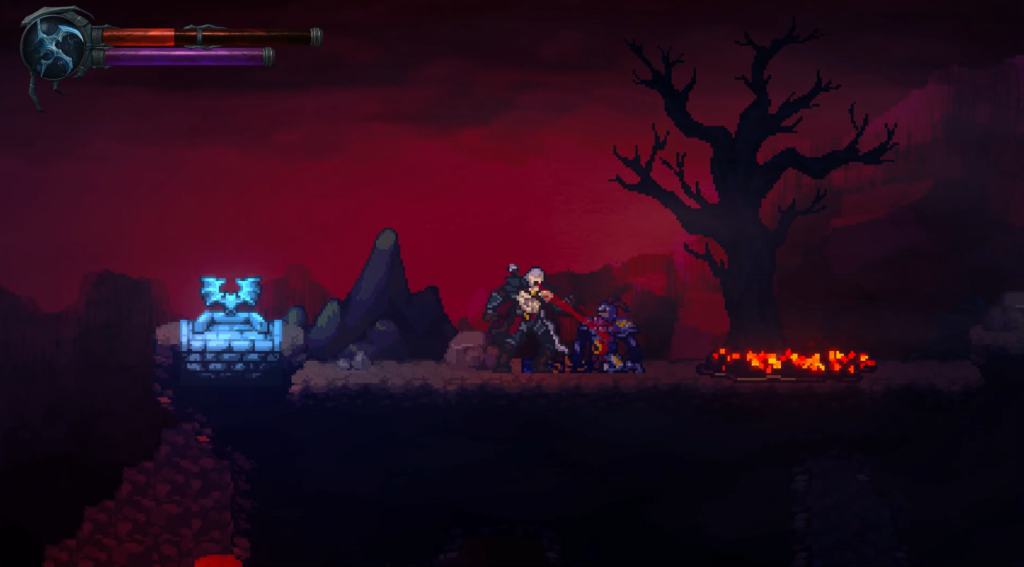
Each of the four characters has its own moveset, abilities, strengths, and weaknesses. Kain, Elaleth, and vampire Raziel must feed on blood from their enemies or hapless victims they find to keep their health meters from depleting. This is a fun mechanic that both forces constant progress toward finding their next meal and ties into the series’ lore through the vampire’s curse. Sarafan Raziel does not have to worry about this, but instead must use fire to burn the bodies of the vampires he slays, else they return to overwhelm him. He also does not benefit from the many other abilities that the other three enjoy. Elaleth and vampire Raziel can fly using their wings, diving down on enemies with a targeted attack, as well as a quick dodge to get behind their target. Kain cannot fly, but can still leap and wall grab like the other two, as well as being able to turn into mist to pass through metal gates or a cloud of bats to fly to certain statues or his prey.
Combat in Ascendance is fairly straightforward. Each character only has a single primary attack rather than a combo system, which makes encounters easy to read but also somewhat limited over the course of the game. Positioning and timing become more important than complex inputs, especially when using dodges or aerial dives to avoid damage. A parry mechanic adds a welcome layer of depth, briefly opening enemies up for a counterattack if timed correctly, but the lack of additional attack options means combat can begin to feel repetitive during longer encounters.
There is a decent variety of enemies throughout the game, from Sarafan soldiers wielding bows, axes, and swords, to leaping vampires and fire-spouting demons. Each type pushes the player to approach encounters slightly differently, whether that means closing distance quickly to stop ranged attacks or carefully dodging lunging strikes. Playing through on normal difficulty felt well-balanced, with fights remaining engaging without ever becoming frustrating or unfair.
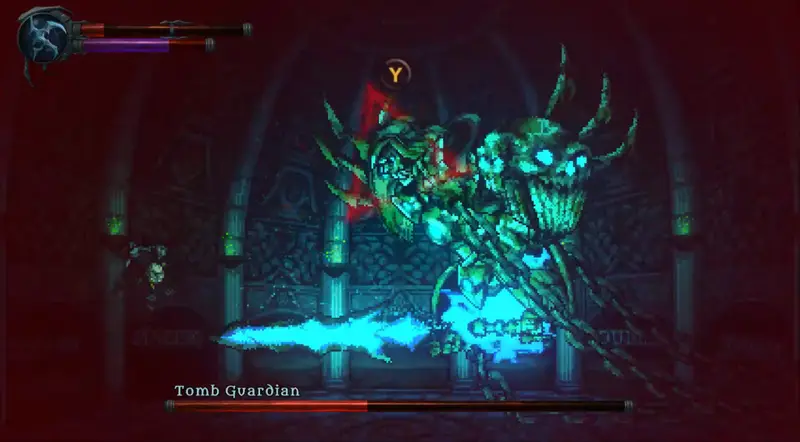
One level early on has you play as Sarafan Raziel, and it is easily the weakest point of the game. Not only is the character’s moveset the most limited, but it also means that the level design is very simplistic, consisting of ramps leading up and down between pieces of flat terrain. In contrast, the levels where you play as any of the other three have far more diversity and verticality. In a way, it’s a great contrast, showing the power the other three wield in comparison to Sarafan Raziel, and I had a lot more fun playing as Elaleth, Kain, and vampire Raziel. I do hope the devs add the option to change the flying mechanic to hold instead of tap, as I think some players will struggle with some of the later levels, which require a lot of flying to progress.
The levels also reward exploration with hidden collectibles tucked away in alcoves or hidden behind invisible walls, spotted by their telltale sparkle. These secrets encourage players to explore with each character’s mobility abilities, especially flight, to reach places that aren’t immediately obvious. They’re never essential to progress, but they provide a satisfying reason to poke around the edges of each stage. Some impart more lore from the Legacy of Kain series, while others bestow passive buffs that persist throughout that playthrough, such as lowering the cost of using your Lore Meter.
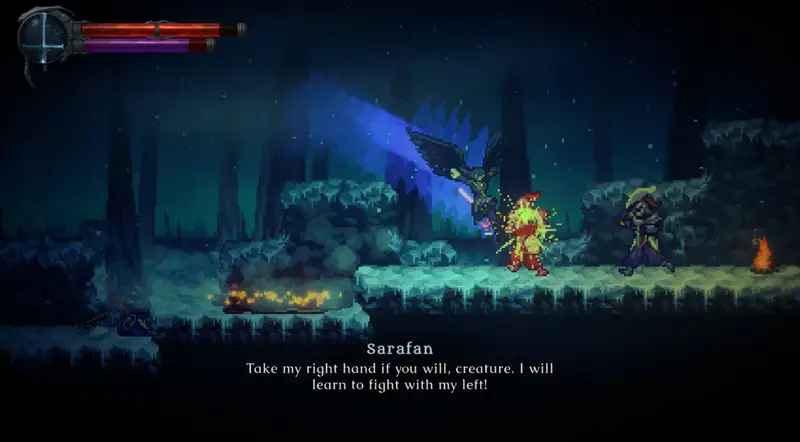
Where I think Legacy of Kain: Ascendance is at its strongest is in translating the brooding, gothic atmosphere and dramatic themes of the series. Gameplay sections are rendered in detailed pixel art, with large, distinct character sprites with black outlines that stand out against the layered backdrops of Nosgoth. Each region you visit during the course of Ascendance has a distinct look and feel, including ice-covered plains whipped by wind and snow, dank catacombs sparsely lit by wall sconces, and the war-ravaged plains of Nosgoth, littered with camp sites and flaming braziers to push back the dark. Elaleth, Kain, and vampire Raziel also have to contend with other traditional vampire weaknesses, like fire and water, so some levels become as much about navigating these hazards as they are about slaying your foes, with sprays of blood aplenty.
But the team didn’t stop with just pixel art, much to my surprise. A single chapter is done in 3D, with the simple camera and model movements conjuring up my memories of the original games back on PS1. There is also a fully animated cutscene close to the end, which I thought looked fantastic, and has me wanting a series! I appreciate the risks taken with Ascendance’s art direction, as well as the devs’ commitment to trying several new looks; stepping away from the series’ 3D roots is not easy, but I think it has worked out very well here.
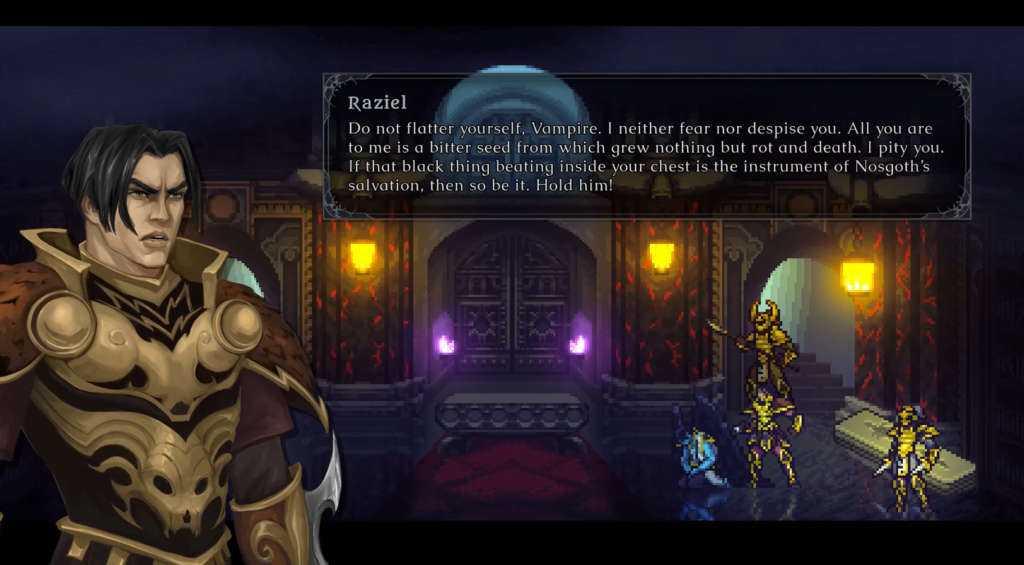
Flying as high as the game’s art direction is its music, sound design, and voice acting. The original voice cast returns, with Michael Bell, Simon Templeman, Anne Gunn, and Richard Doyle reprising their roles of Raziel, Kain, Ariel, and Moebius, respectively. Everyone in the cast gives a fantastic performance, with Templeman being a standout, bringing Kain’s acerbic and cruel nature to life once again. Accompanied by beautiful, lightly animated portrait art during dialogue sequences, I was always happy to hear these characters go back and forth, like some vampiric Shakespearean tragedy, the same level of verbosity and angst as ever.
Ascendance is scored by musician and producer CellDweller, who has worked across a wide range of genres since the 90s. As was highlighted in the Making of Legacy of Kain: Ascendance trailer, CellDweller used a lot of hardware that would have been available in the 90s and early 2000s, when the Legacy of Kain series began, giving Ascendance a sound that I like to call “industrial orchestral”. Most of the game’s levels are paired with an exhilarating blend of choral chants, piercing strings, undulating synths, and fast-paced drums like a thundering heartbeat. From swooping down upon my prey as Elaleth or vampire Raziel, to turning into a cloud of bats to reach my next victim as Kain, the soundtrack matched everything I did with equal energy, a constant driving force to persevere, much like their endless thirst for blood. Along with its visceral sound design, a cacophony of slashes, snarls, howls, and guttural screams, Ascendance might be the best-sounding game in the series.
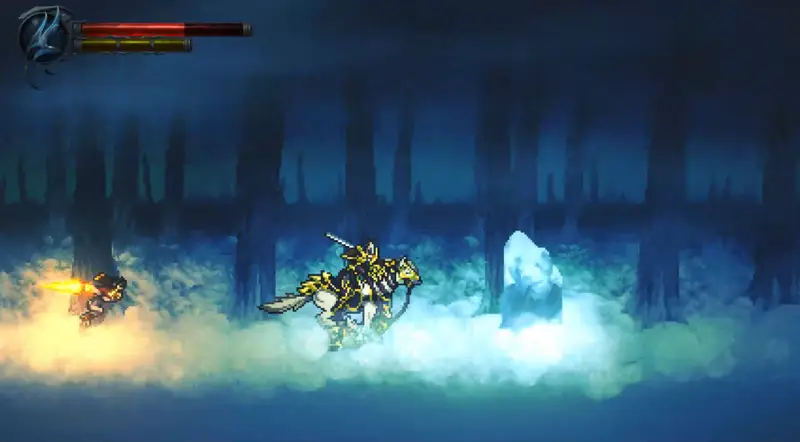
My time with Legacy of Kain: Ascendance was smooth from start to finish, with not a single freeze, crash, or even visual glitch to speak of. With only a few collectibles to find throughout the game, there is very little reason to replay the game more than once, other than playing it through on a harder difficulty. It would have been nice to see more accessibility options, such as toggles for health or Lore Meter depletion, allowing players to focus on exploration without the constant pressure of survival mechanics.
Final Thoughts
Legacy of Kain: Ascendance may not be the triumphant return that long-time fans have hoped for, but it is a confident step toward bringing the series back into the spotlight. Its moody pixel art, stellar voice performances, and thunderous industrial-orchestral soundtrack capture the gothic soul of Nosgoth remarkably well, even in a new 2D form. While the straightforward combat and brief runtime keep it from reaching the heights of the series’ best entries, the game still delivers an entertaining slice of dark fantasy that respects the lore and legacy that came before it.
It might not be the type that all Legacy of Kain fans wanted, but Ascendance is the fresh blood the series needed; I just hope it’s enough to sustain it.

Legacy of Kain: Ascendance is available now on PC, PlayStation 5, Xbox Series X/S, and Nintendo Switch 1 & 2.
Legacy of Kain: Ascendance was reviewed on PC with a controller.
We would like to thank Bit Bot Media for supplying the review key.
Will you be picking up Legacy of Kain: Ascendance? Let us know in the comments below, and join the Gamer Social Club Discord to chat about your favourite games, play in community game nights, take part in giveaways, and more!