
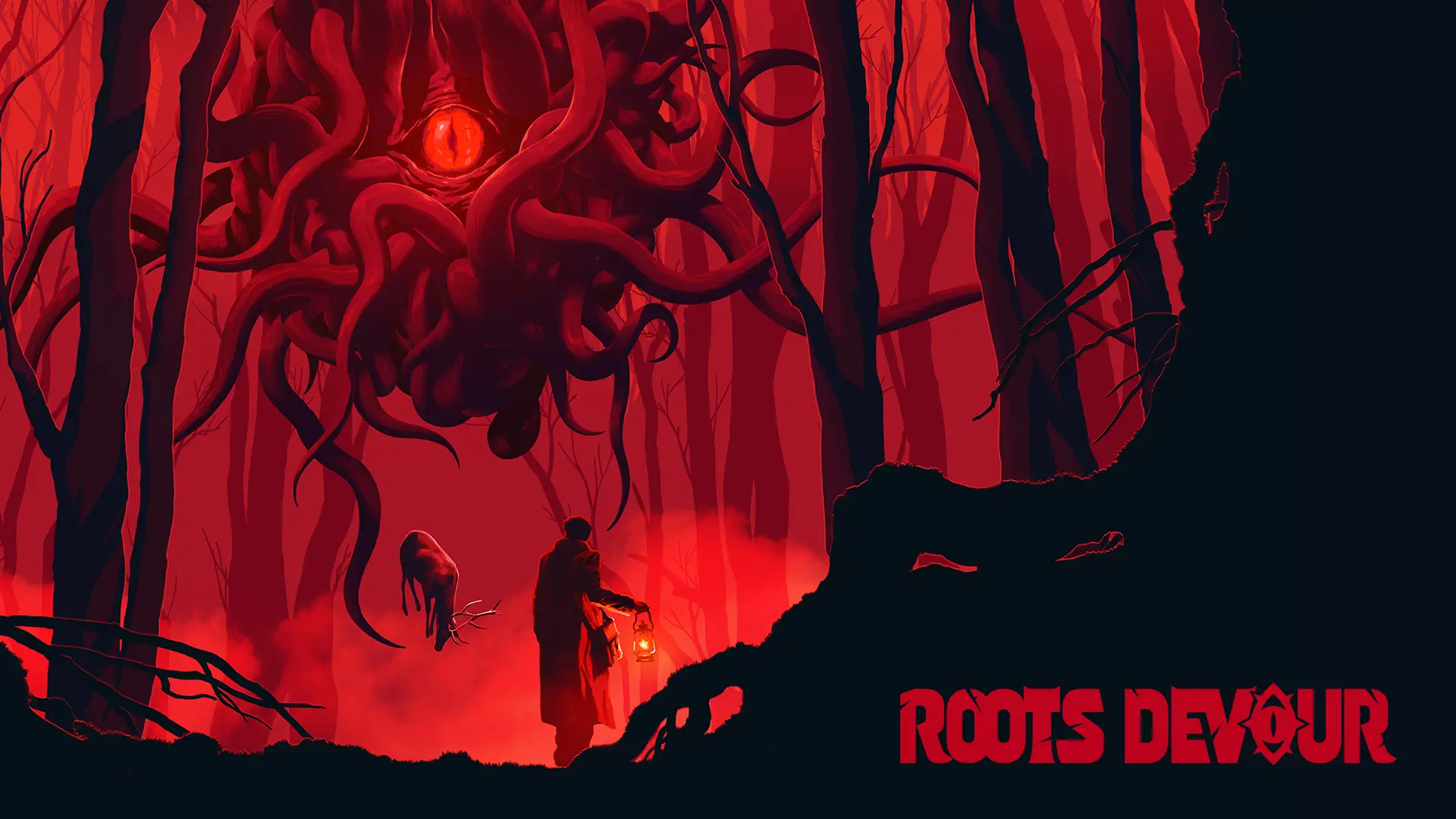
I’ve got a soft spot for esoteric card games. I think it started in 2018 – I’d just got out of a 7 year relationship and bought myself a Chromebook as a treat. The day it got delivered I download a game called Cultist Simulator from the Play Store. I played it for almost an entire day, and if you asked me if I did well at any point I would not for the life of me be able to tell you. What I can say is dragging the cards around to murder policemen, or generate knowledge for my cult was a blast.
When I saw the Roots Devour demo on Steam at the start of this year, I immediately thought of the game Carrion – a game I also love, as you play as a gory tentacled abomination writhing through a lab murdering everyone in your path. When I played the demo, I was immediately brought back to that Sunday in 2018, where I didn’t really understand the systems but had a great time anyway. Now after playing the full release; was Roots Devour as much fun as the demo made it look? Let’s find out.
The Thing
You start Roots Devour as a guy. Surprisingly. This doesn’t last long, as your real form bursts forth in a mass of blood and vines while a mysterious voice encourages you to spread your roots and hunt the cultists that summoned you from the abyss. This involves connecting cards already in your network of roots to other visible cards on the map. You drag your roots from one cultist to another – using up blood to grow, but draining more from their bodies as their dying gasps lament their hubris.
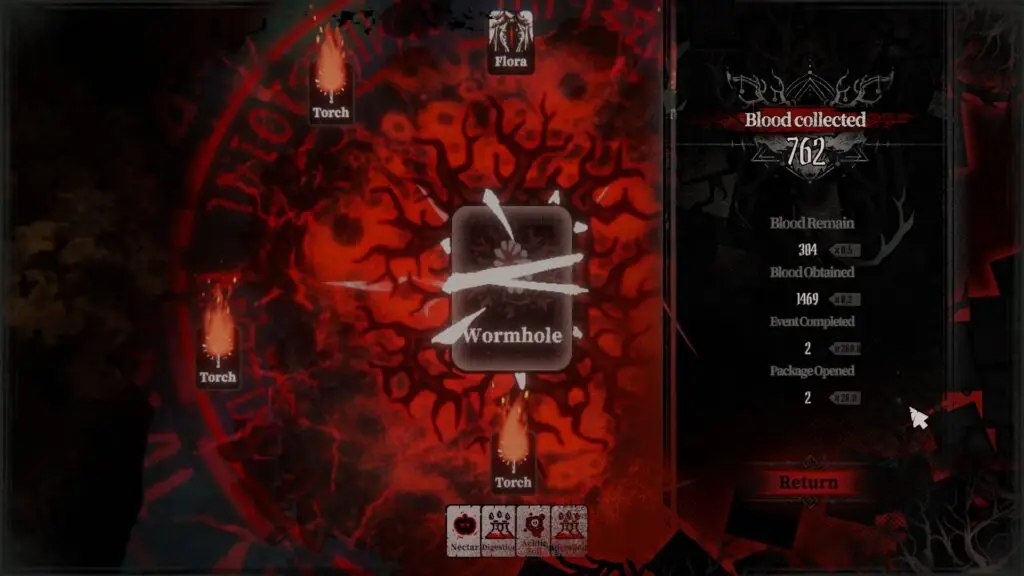
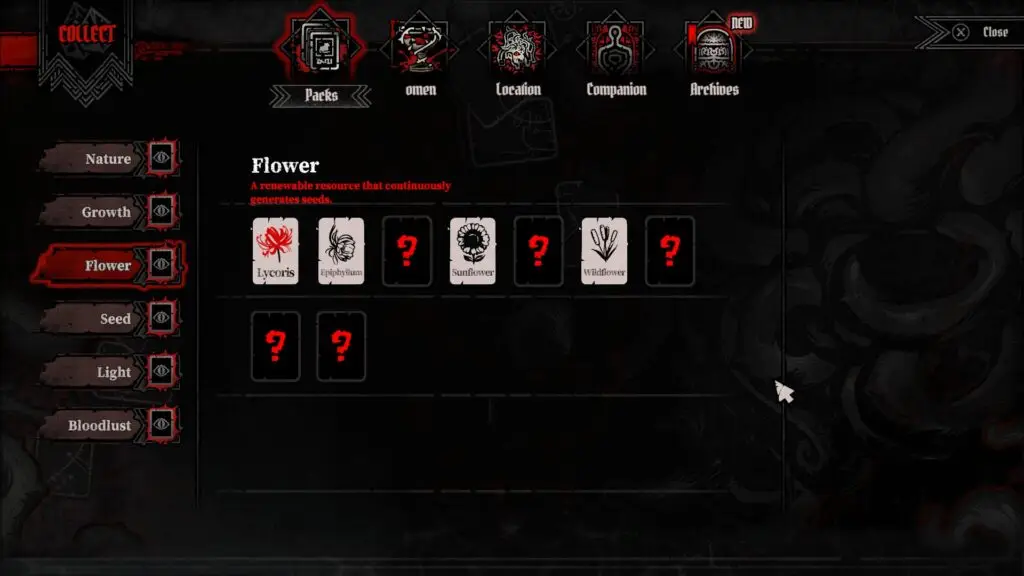
A few moments later you’ll be introduced to Flora, who transports you back to a grove where you offer your collected blood to an entity called Mother for upgrades. The upgrades unlock extra resources (blood & water), new cards for the packs you can open on runs and omens – which act as quests you can fulfill for relics and extra blood. You unlock these using the same system as the main game – spreading your roots across nodes and absorbing their traits.
The Heart of The Cards
You’ll notice I mentioned the words card and run in the previous section, but please don’t think Roots Devour is a roguelike deckbuilder. You can open card packs as you move around the map – but they don’t drive the gameplay. The maps are fixed with the cards in set places and you’ll find nodes on each map that unlock new starting locations. I will say that it would be nice to be able to look at the area map when selecting your starting point, as they can been quite complex and I didn’t always remember the name of the closest one to my desired destination.
The different starting locations becomes useful in areas where you need to interact with cards in different ways; for example in the swamp there are big blue collections of spores that frequently block off pathways. These can be cleared by connecting your roots to a specific card and the subsequent puff of spreading green spores dispersing them – importantly the direction in which they spread is determined by what direction you connect to the card. So if you need to clear a spore, you need to connect in a specific direction. Now it took me an embarrassingly long time to figure this out, but once I did, I had one of those lightbulb moments that only strange little games, with strange little mechanics can bring. The satisfying mix of “I’m a genius” and “oh my lord, has there ever been a dumber guy”.
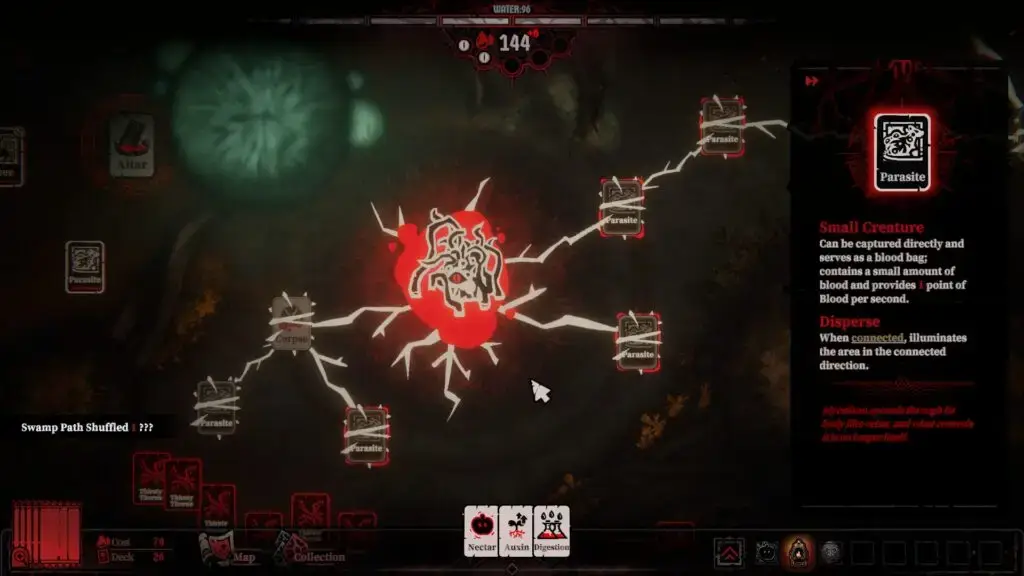
The way you actually use card packs in Roots Devour is to drag one onto the map and hope it doesn’t give you a roadblock root in the worse place humanly possible. There are usable cards like Digestion and Auxin that can be picked up and put in your hand to be used later – these occasionally spawn on the map but will disappear after a short time so be alert. These useables help you move around in tight areas. Some interact with blockages (those Roadblock Roots I mentioned), others give you a hand to reach cards just out of sight or water range. They are limited, random and add a layer of strategy to getting to your destination.
If you happen to run out of blood or water whilst decimating the unfortunate animals and unlucky humans trapped in the nightmarish world of Roots Devour, you’ll automatically return to the grove, ready to unlock some new upgrades and venture back out for the glory of the Mother.
Dark and Writhing
Visually Roots Devour is all stylised gothic horror. The colour pallete is almost exclusively greys, reds and blacks – with sickly greens and pallid yellows occasionally washed over the landscapes to show their rot and decay. I’m a big fan. The card art is clear – even when it’s something grotesque, like a pile of corpses or a flesh chunk – which is important when each thing you’re connecting too has different properties. Of course you can click on a card at anytime and the right side of the screen will give you a more detailed description of what it is, and how to potentially deal with it.
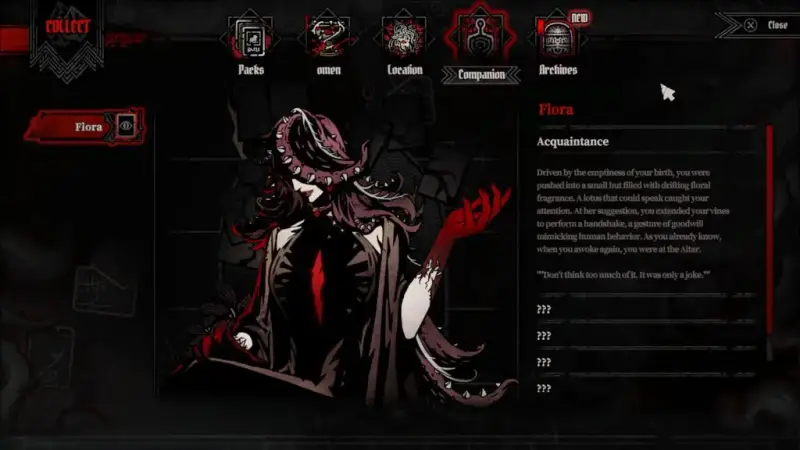
It’s all very slick, the UI, the art direction and the soundtrack keep things in the horror trappings, so even when you’re reading about how to navigate through a deer you’re thinking about digesting it and feasting on it’s essence. There are a few instances that I encountered where in game text hadn’t been translated from the original Chinese, but it didn’t detract from my enjoyment of the game, and I’m pretty confident it’ll be patched after release.
Eldritch Horror
As you may have surmised, Roots Devour leans heavily into horror themes. You are a eldritch abomination, driven by your hunger for blood, ready to server the Mother in her dark machinations. I won’t spoil the story, but there’s mystery abound – what are you, who is Flora, will the gnawing hunger of the earth ever be satisfied? It’s exactly the unusual game I was looking for after I played the demo – a simple game to play but difficult to mechanically figure out, while I get to revel in the specific type of escapism role-playing as a otherworldly horror brings.

The creatures and people you meet (well, eat) are caught up in this living nightmare. Some, like the Fish Men in the swamp may think they’re the real antagonists as they hunt explorers to sacrifice to their own horrifying gods. And they may well be, in the H.P. Lovecraft stories that the Roots Devour devs clearly have a great fondness for, but not here. Here you are the horror. You are the thing moving just out of sight. Writhing. Hateful. Ravenous.

Roots Devour was reviewed on PC releases on the 28th of January on Steam. Gamer Social Club would like to thank the publisher for the code.