Introduction
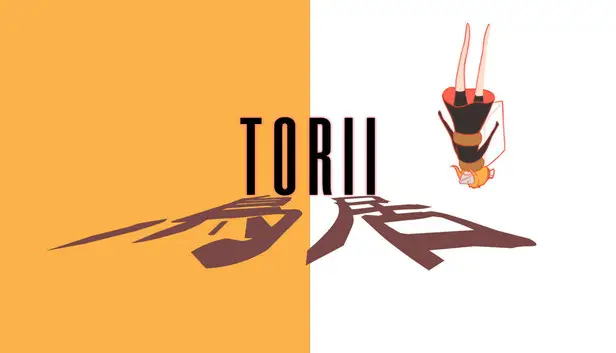
Art, in its many forms, allows us the opportunity to experience someone else’s viewpoint or interpretation of something, even going so far as to let us witness something truly personal or difficult to talk about. Torii is one such piece of art, a game that takes the player on a journey through a multitude of challenging themes and emotions. While the game may still feel a little rough around the edges, and originally released on PC back in 2022, it’s a short, introspective journey that kept me curious throughout.
Premise
Torii is a third-person arthouse-like experience, consisting of light puzzle and stealth elements as its gameplay. You play as Ipa, a young girl wearing a mask and a large, talking backpack called Moswig (the name of the studio), which reminded me of a Mahjong piece. Ipa is on a quest to find her little sister, Lulu, traversing surreal dreamscapes that would imply an introspective, psychological journey for the game’s protagonist. Ipa is plagued with fears and guilt, originating from an event that involved Lulu, and it is her journey to some form of acceptance or reconciliation that we witness.
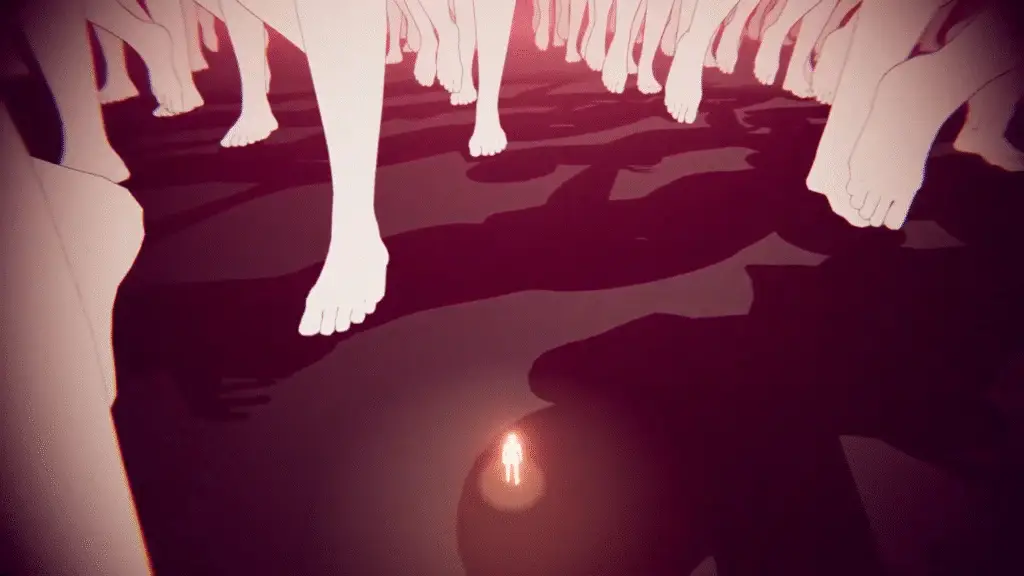
The game opens with a brief message, highlighting the themes and subject matter it deals with, which is good because Torii isn’t straightforward by design. The strange nature of the world you are in, the characters you meet, and the things you do, feel symbolic in many ways, but due to the disjointed, almost confused way the game unfolds, I found it hard to follow what was happening. Perhaps I was too focused on finding the meaning in everything related to the opening message, and Torii is definitely a game that benefits from discussing it with others who have played it to compare experiences and insights.
Gameplay
As stated earlier, the majority of Torii’s gameplay consists of exploring large, abstract environments, solving simple platforming puzzles, and short stealth sections. You can walk slowly around each area, taking in the still, almost serene atmosphere, or hold down the right trigger to run and slide down slopes. Other than movement and an interact button used mainly to talk to NPCs, most actions are achieved by simply coming into contact with certain objects, making Torii a very straightforward and approachable game from a controls standpoint.
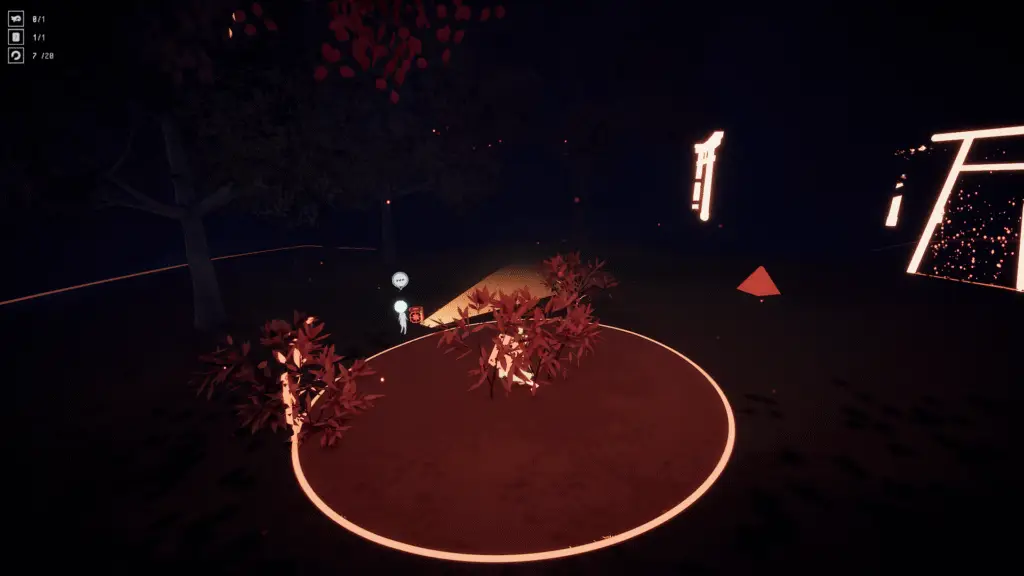
Torii splits its gameplay into two parts: the exploration of each level in one part, and the stealth sections and puzzles contained in another. Ipa’s goal is, more often than not, to collect memories and “Wings” to progress, which are earned by completing the stealth and puzzle challenges scattered across each level. Floating, glowing pyramids indicate the start of one of these challenges, and when touched, they pull Ipa into the Astral, a darker pocket dimension with a round border that returns her to the level when crossed. When inside one of these challenges, Ipa gets some other actions, like jumping and hiding in bushes, which are used to solve platforming and stealth puzzles, respectively.
The platforming puzzles introduce new elements as the game progresses, but never amount to anything more than performing the correct order of actions to help Ipa reach a memory, represented by a hand-drawn image and accompanying poem. The stealth sections are more interesting, as they involve hiding in bushes to try and capture unsuspecting Hums, little pale huanoids that wander about with vision cones you must avoid. These encounters also grow in complexity, and I found this to be far more involved and challenging, as they introduced triangle-headed Hums that would send Ipa out of the Astrum if they touch her, as well as needing to grab a pair of cherries to make the target Hum capturable. Having to devise a plan of action before each of these challenges was great fun and felt well-designed.
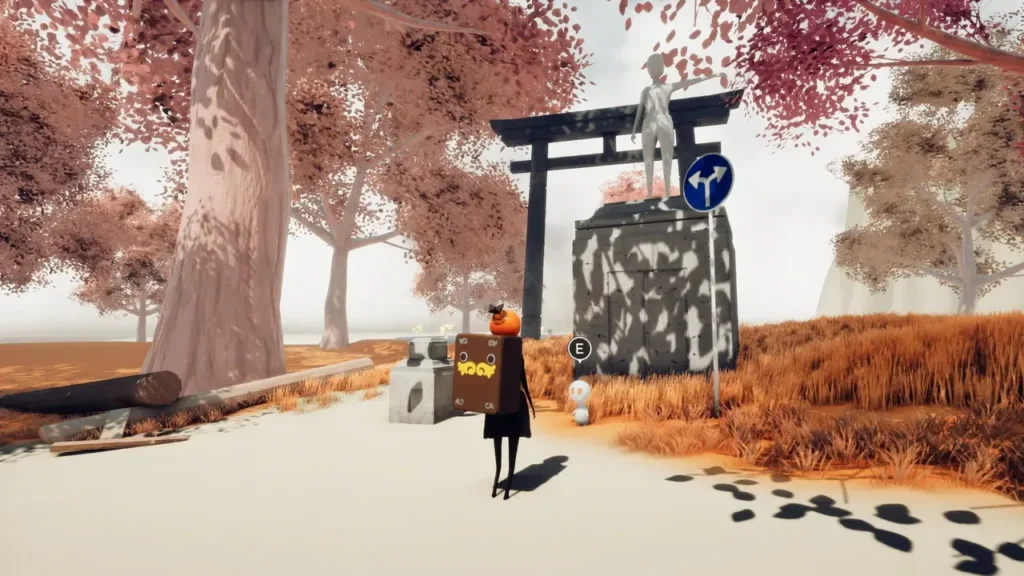
Other than that, you’ll spend most of your time exploring the strange levels you find yourself in, collecting seemingly pointless rings dotted about each level, and talking to NPCs. The majority of the characters you speak to are little stout humanoids with an odd, abstract design for faces called Kublins. They are a peculiar bunch, seemingly living in these surreal environments, even inviting Ipa to a party, but they are also very helpful. Many of the Kublins you find will act as tutorial messages, teaching you how the game works, while others will be more esoteric, much like the game itself. There are two other figures you can find in the game, who appear to be in similar situations to our protagonist, albeit at different points on their respective journeys. It’s the mix of all these elements that makes Torii such an interesting title; often, I would come across something new that should have felt out of place, but ultimately made just as much sense as the rest of the game’s design. Despite the heavy topics explored in Torii, the game more often than not has a playful nature, inviting while still eerie, bordering on unsettling.
Visuals
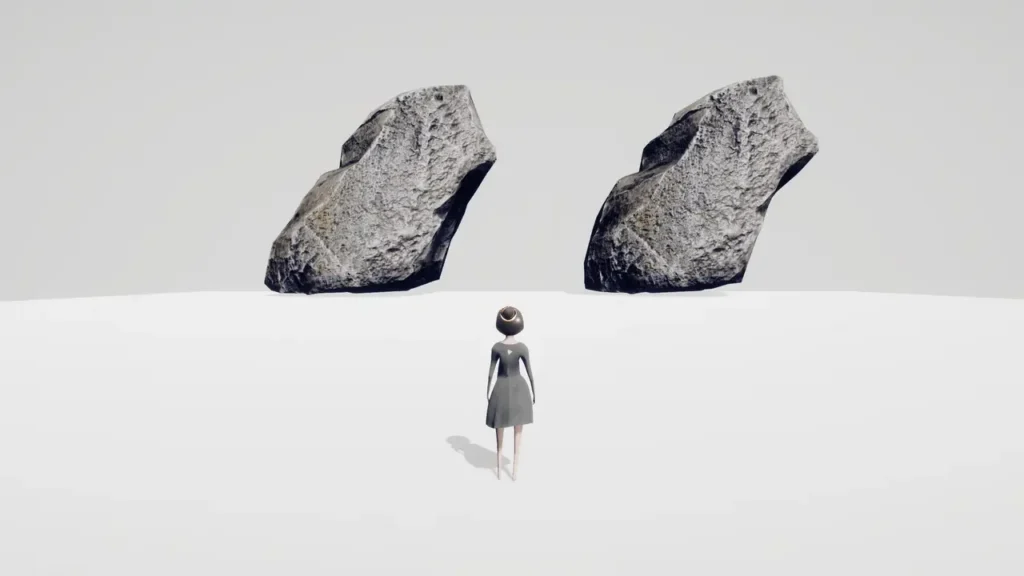
I don’t think I have ever seen an art style like Torii’s before, which makes it all the harder to describe! All of the adjectives I have used so far, abstract, surreal, and dreamlike, are accurate, but do it little justice to the game’s art direction. The game feels somewhat desaturated, with vast, open spaces punctuated by landmarks and dashes of colour, from Ipa’s bright red hair to the golden leaves on the boughs of trees. The Astrum is like a darker, neon-edged version of these same environments, but they are also limited by their arena size. As the game progresses, its imagery grows in scale and intensity, but retains a calm, almost serene quality throughout. Torii gates feature heavily, seemingly acting like thresholds; a marker of one’s journey from one place or state to another.
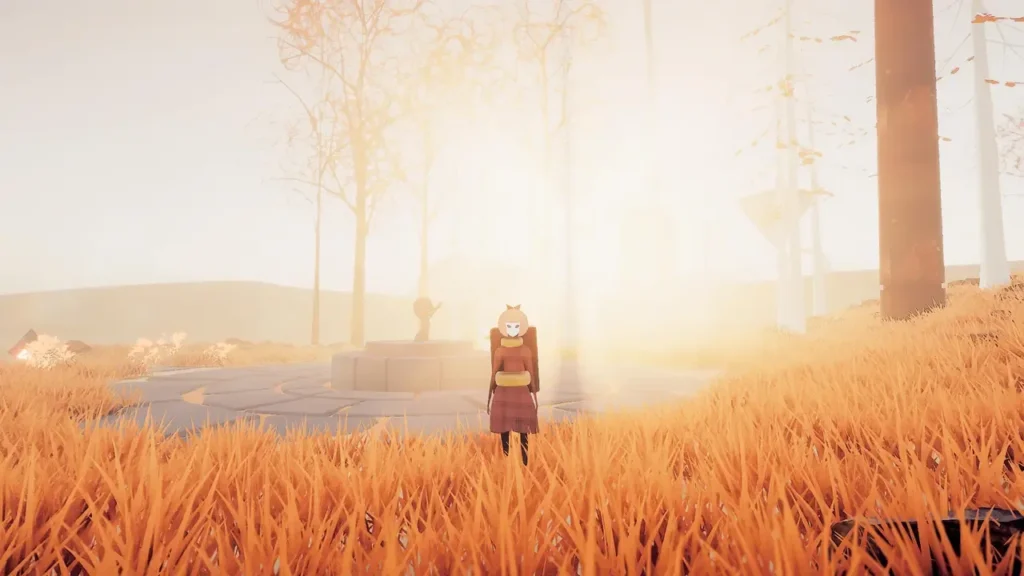
I found all of Torii’s visuals captivating, whether I was sprinting and sliding around bizarre structures jutting out between the rolling dunes, or immersing myself in some of the late game’s final, more intense and emotional moments. However, I do still find myself confused as to what a lot of it possibly represented, despite knowing what the themes of the game are from the very beginning. Nothing about the spaces Ipa finds herself in, or the objects and people she finds, is explained in any real way, no doubt with the intent being for players to find their own interpretation. I can respect that, but I do feel some may find Torii a bit obtuse and thus miss out on its themes and emotional beats.
Other than the camera getting a bit confused before righting itself a few times, my only gripe with Torii’s visuals is a particular particle effect that had Ipa producing bright blue sparks. It was incredibly irritating, as it made it hard to look at what was on screen and felt wildly out of place, like someone had forgotten to turn down the intensity. But don’t let that detract from Torii’s art direction and overall execution, as it stands out beautifully amongst a sea of amazing-looking titles this year.
Audio
Unfortunately, I do not have much to say with regard to Torii’s sound and music, as there isn’t very much of either. When the game does have music, it is used well, matching the serene, but ultimately melancholy nature of Torii. All actions are accompanied by appropriate sound effects, but nothing that bears highlighting.
Conclusion
Torii is a creative exploration of some very difficult and universal themes, as well as a thought-provoking and enjoyable gameplay experience that doesn’t overstay its welcome. While I may have come away not fully sure I understood what I had just seen and played through, I was delighted by its art direction, enjoyed its mechanics, and was compelled to see what came next, from start to finish. Rough edges and obtuse nature aside, I had a great time with Torii, and applaud the developers for their bravery in making a game like it.

Torii is available now on PC and will be released on November 27th for PS4, PS5, Xbox One, and Xbox Series.
Torii was reviewed on Xbox Series X.
We would like to thank the Moswig team for providing a review key.