
I love singing. I love to belt out a tune and singalong with my music. There’s very little time in my day when music isn’t playing. As some of you may know, one of my hobbies outside of gaming is performing in amateur theatre. Lots of musicals! I’ve performed in and off for the best part of 15 years.
Despite this, singing is the thing I’m least confident in performing. I often feel the most exposed when I’m singing in front of people. I lack confidence in my ability. I’ve been having singing lessons and that is the one former biggest things for you to overcome. If you get in your head you’re less likely to hit those more challenging notes. I am reliably informed that I do have the ability and can indeed sing well. Confidence, then.
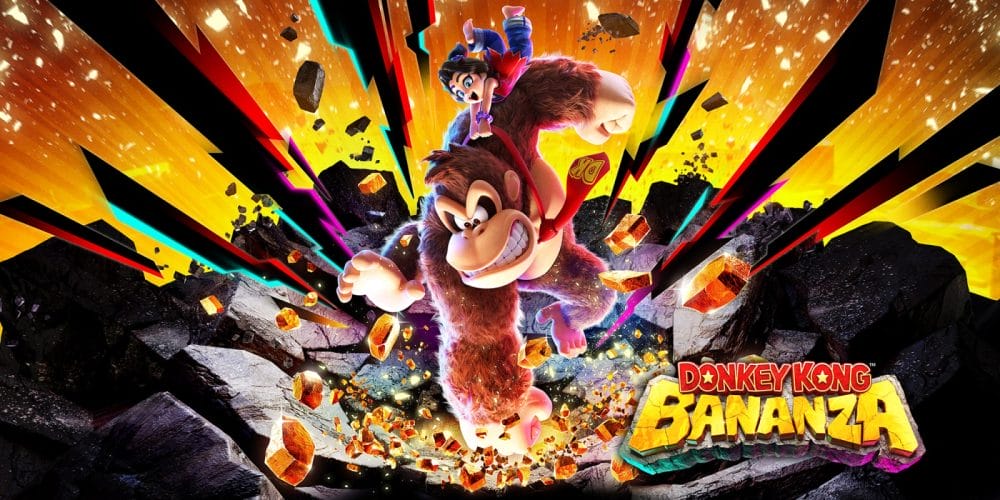
Donkey Kong Bananza is a story of confidence and support, bananas and destruction!
Setting the Tone
Our story starts on Ingot Isle, where DK is searching for bananas (for a change). It isn’t long before the whole of Ingot Isle, and the horde of Bananas you’ve found, are sucked into a tornado and thrust out of place. It turns out that you’re not the only one looking out for Bananas. You soon learn that a mining company, Void Co., is causing all sorts of trouble.
Led by the maniacal Void Kong, VoidCo is drilling and disrupting the ecology of the entire planet as they target the planet’s core. Supported by Grumpy Kong and Poppy Kong, VoidCo is going to do anything to get what they want. And why do they want to reach the planet’s core? The Banandium Root. Legend has it that the root at the planet’s core will grant anyone their dream wish.

So of course, the evil-looking mining Kong’s are after that delicious Banandium Root. Funnily enough, it could grant DK his dreams of all the bananas he could ever hope for! Amid everything happening, a companion is thrust upon you in the form of a strange, talking purple rock. This, of course, turns out to be a young Pauline, the singer from the OG Switch’s Super Mario Odyssey. Timeline-wise, Donkey Kong Bananza takes place before Odyssey, and the game gives us some insight to the adventures of Pauline before she found her fame.
Pauline’s dream wish is to return home, kidnapped by Void Kong, and now free, she’s placing her hopes and support into Donkey Kong. They team up to take on Void and his cronies, as well as save the multiple layers of the planet and restore a semblance of order to the planet.

Perfectly Pitched
I followed the story, I wasn’t expecting to be blown away by it, but HOLY MOLY was I. Perhaps I underestimated it, perhaps I expected the game to end sooner than it did, but I thought Donkey Kong Bananza was masterful in how it told its story. It’s a story about confidence in yourself, and how that might come from the support of others.
Pauline, as a young aspiring singer is nervous in perfroming in front of others. Through their adventures, she finds herself having to do it more and more, to support DK. This, in turn ends up giving her more confidence. You see her build in confidence throughout the game, and I thought it was done brilliantly.

DK in his dopier way is a great counter to the anxiety and overthinking going on in Pauline. He’s here to break stuff, grab bananas and support Pauline. And he is on point with that. We don’t see DK communicate out of a couple of written dialogue options. It’s almost like DK is an empty chair and Pauline is talking at the chair (check out The Empty Chair experiment, it’s fascinating) therapeutically. When you stop in the game’s ‘Getaways’, there’s often cutscenes where Pauline chats to DK as he’s falling asleep. These are just general musings and reflections from Pauline about their situation about what they’ve seen and these are quite endearing.
I get the calls for DK and other non-verbal characters to talk, but I think it works here. The other characters, such as Void and the other Kongs, all talk in those classic video game vocals of random noises to relay language. It’s a charm I’m certainly not fed up with.

THAT Beat
And it has some excellent story beats in it. At one of those points where I thought the game was done, a delicious moment occurred where I audibly exclaimed “HOLY SHIT”. What followed was another five or six hours of game where the stakes kept ramping up and it kept you guessing! No spoilers of course, but if you’re a DK fan, you’ll appreciate the hell out of it. I didn’t see it coming and I must give props to the community for keeping that story moment under wraps.
I really want to talk more about it, but I really won’t. But it made me appreciate the game’s design on a whole other level after that.

Layers Upon Layers
You’re heading to the planet’s core. You, of course, can’t just get there (how rubbish a game would that be). You need to climb down multiple layers of different biomes. Each of the layers is its own environment and ecosystem, often with additional sub-layers. Each layer is distinct and unique in the environment, and they are superbly designed. From the terrain, to the enemies, and inhabitants, each one is varied. They all serve their purpose within the planet, too.
From lagoons, snowy tundras, a layer full of giant food, a theme park dedicated to a giant banana burger, there’s a whole load of inventiveness and wackiness on show. Suspension of disbelief is required, of course; don’t ask why the layers exist like this, assume it’s something to do with a planet that has golden Bananadium roots flowing through it. All you need to know that it never gets boring to look at, and it’s a whole load of fun to destroy.

Each layer is designed with gameplay mechanics and elements within it. In the giant burger level, one of the enemies is a sluggy type enemy that creates an electrified ‘green muck’ that goops up everything and gets in the way. Thankfully, the burger level has a lot of natural salt deposits that can be used to dissolve the slugs and the green muck.
Upon Layers and Layers
But how does Donkey Kong Bananza play? Well. Exceptionally well. Amazingly well. Good, I suppose, is the message to take away from this portion of the review. In fact, it’s some of the most satisfying game play I’ve ever experienced.
As alluded to above, there are a whole most of mechanics at play. The terrain system is deep (pun very much intended). There are all sorts of terrain that range from super easy to destroy, to being very tough. Some terrain is indestructible and that’s probably for the best so you don’t fall off the map.
The use of terrain is excellent though. Many enemies are covered in different forms of terrain and this creates different combat challenges. Use of the different terrains and their elements, kind of like in Pokemon, can help you win battles.
The combat is really layered (again, intended). It starts off basic and every layer explored brings new components and elements. In fact, the combat systems have a lot at play, but it feels super natural and easy to embrace. You naturally lean into the different enemies and how to approach them. And if you can’t remember exactly, there’s probably another way round it too. It’s very open.

In fact, not just in combat, the game introduces a whole load of mechanics, and it never feels bloated or superfluous. And they’re all realised incredibly well. I was struck at one point in a lava-strewn level when I encountered a new bouncy terrain for the first time. I needed to navigate the area by bouncing, and it was just so seamless. Starting off easy and simple, the complexity increases in how they’re implemented. Never to the point of controller snapping difficulty, I might add. The same is the case in boss fights and combat, too.
Red Faction: Gorilla
You may already know that one of Bananza’s big selling points is the destruction. You can smash and destroy soooooo much. Like most things, and there are no restrictions. You want to spend your day smashing up every last little bit of the terrain you can. Go for it, and you’d probably have a great time doing it. Why? Because of all the dopamine hits along the way.
Just be careful, in some of the later layers, more harmful terrain appears (like lava, poison and electrified terrains), that you can unwittingly hit whilst you’re gleefully smashing.
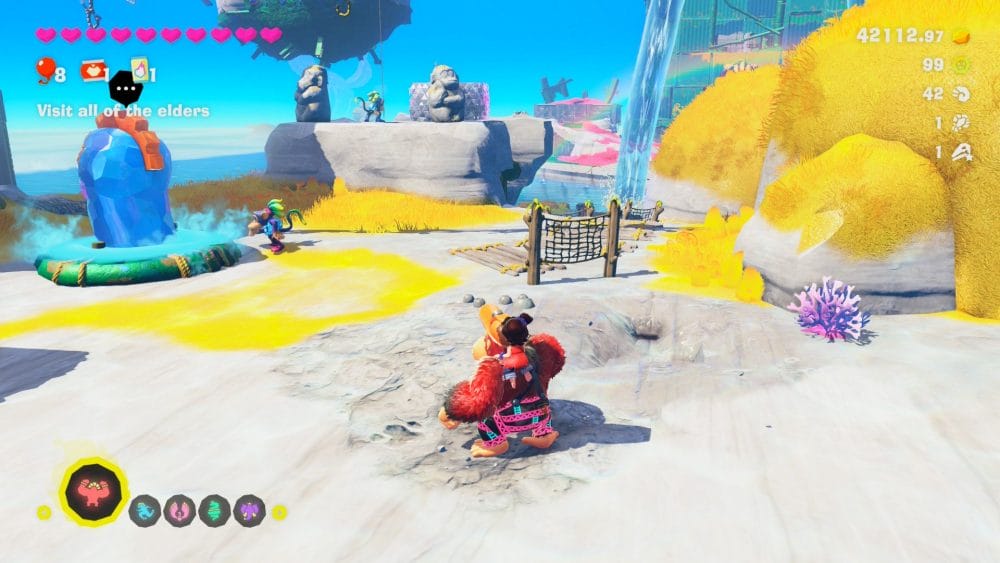
Gold, usable items, treasure chests with maps to other collectibles, collectibles, and, of course, BANANAS. There’s so much to find and explore that you’ll never feel that your time is being wasted doing it. All the while, the sensory feedback as you break up the terrain is glorious. DK’s grunts, the smashing of the different terrains, the visuals of destruction…this is what Battlefield 6 should be aiming for (maybe without the bananas).
Also, quick side note, the audio every time you collect a banana is addictive as hell. Going to make it my new message tone! “BANANA!”
The collectibles in each layer alongisde the Bananas are fossils that can be used to buy different outfits for Pauline and DK. These have modifiers to give you a boost in the game. Usually they extend the time of your Bananzas or reduce damage from particular sources. Each layer has different fossils to collect and you can only spend at that layer. Any acquired items can of course be used wherever you go once purchased. And they make DK look spiffing too!

Bossing It
Quick shoutout to the bosses in Donkey Kong Bananza, because they are super fun! At first I thought they were on the easy side, and for the time I’d been playing should have been providing more of a challenge. Then I realised it’s because I’d spent too long exploring and smashing up stuff in the first few layers that I thought I was further on than I was.
The bosses are super varied and embrace the destruction and mechanics of the game really well. Encouraging you to use what you’ve learned. Some of the later ones bring on twists to previously fought bosses. These were some of my favourites because, although not too hard, the difficulty did creep up and I enjoyed the challenge of working them out.

To get to the bosses, you usually need to clear out a layer by working through the various sub-layer challenges and clearing out any purple material left by Void. These usually require destruction of a small purple metal tanker. The layers are locked by a giant VoidCo lock that you either need to directly smash up, or unlock, and then smash up. The means for destroying these change as you progress, will often require the use of the Bananzas!
Oh, Bananza!
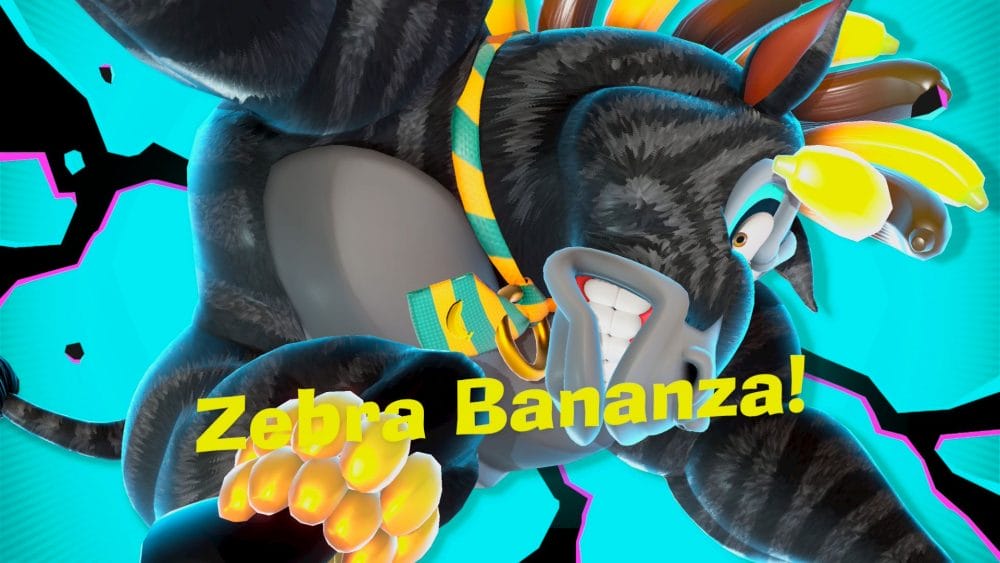
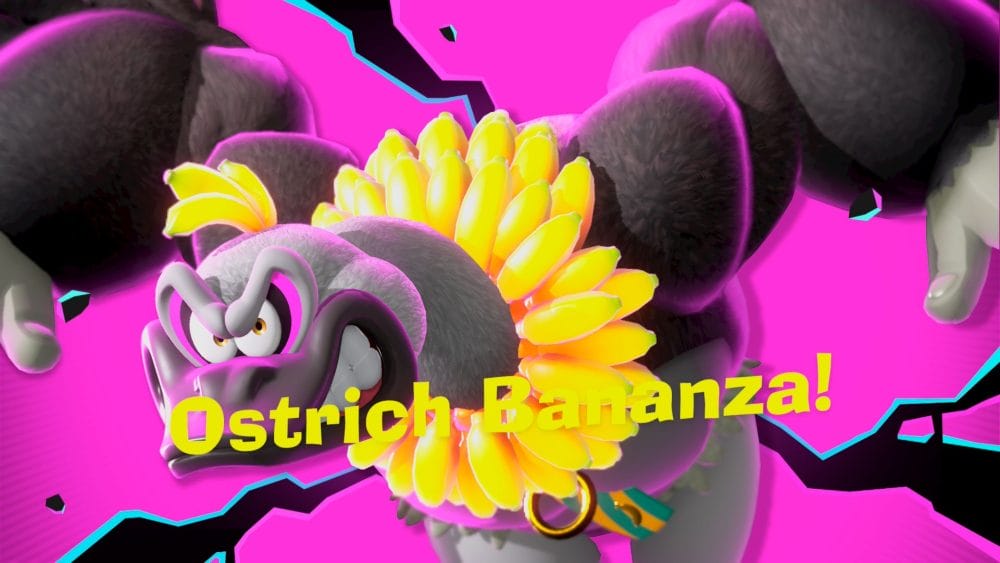
Bananzas are the game’s namesake and main feature. By harnessing the powers in Pauline’s vocals, DK can use the Ancient Records, held by the game’s various Elders. Each elder is a different animal, and you can transform into one of them once you’ve collected the Ancient Record (or its pieces). Each have different abilities and which gives you new things to play with, as well as mop up those left over collectibles and bananas!
Collecting the Bananas gives you skill points that you can use to unlock more abilities for each Bananza, too. They can also be used to improve your health and improve your damage against terrain (definitely prioritise this!).

Bananzas
- Kong Bananza – suped up DK, gives you a powerful punch that can break concrete. Great for combat
- Zebra Bananza – speedy transformation, runs quick and can run across unstable, collapsing terrain
- Ostrich Bananza – gives you the ability to fly and use fans for greater height
- Snake Bananza – gives you the ability to double jump and reach higher places with a charged jump
- Elephant Bananza – lets you suck up terrain and turn that terrain into projectiles
By holding the L+R buttons, you’ll enter Bananza (if you have your Bananenergy charged). Bananza time is limited but it’s a lot of fun to go wild with Kong Bananza and get all destructive. I used Kong and Elephant the most, but they all have their uses. If you want the 100% completion, then you’re going to have to harness all the abilities to get all 777 bananas scattered througout the game.


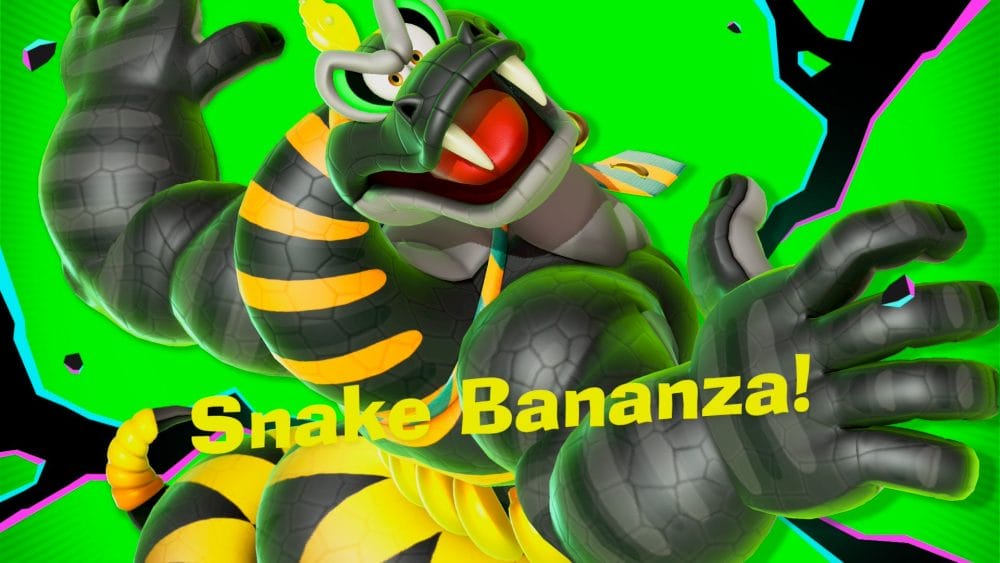
I learned, just as I was wrapping up that you can use the Joy-Con 2’s motion controls to mimic DK and smash your chest to activate Bananza and it brought me endless joy to repeatedly do it. You’re never told that you can do that either. I just happened on it, the care and attention in those details is amazing.
Apparently, you can even use the DK Bongos from the GameCube days to play (though less effectively).
Pull Out a Classic
Something that struck me about Donkey Kong Banaza was how much it respects and honours the franchise. There are classic characters in there (Kranky, Diddy, Dixie) as well as nods to your animal companions. I haven’t clocked them all yet, but I bet they’re in there somewhere. But they manage to do that without leaning on nostalgia and making DK Banaza feel fresh and new. Those characters are there, but they’re not the focus. To me, that’s the way it should be, unless it’s organic, of course, and not forced.
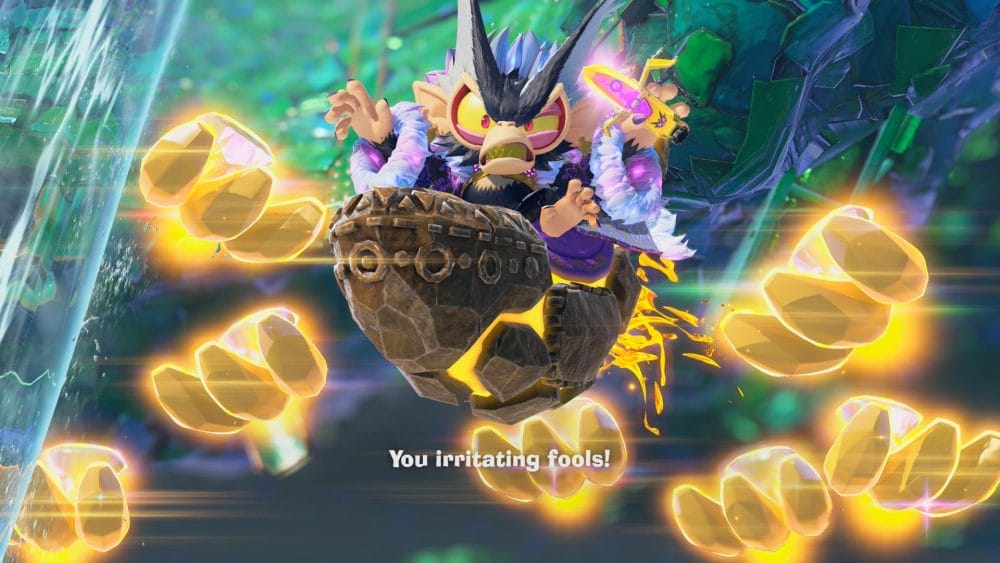
The game is littered with Fractones, crystal-like creatures that can form into a wide range of shapes and varieties. They inhabit many of the game’s characters, and you’ll spend a lot of time interacting with them. Fractones run the shops where you can buy outfits, exchange collectibles for Bananas, and buy consumables. They also give you clues to where to go next, and build your Getaways (where you can rest and restore hearts). They’re also entirely destructible (for the most part), and they’re seemingly ok with you accidentally smashing them to pieces.

On Repeat
And boy, will you likely be smashing a Fractone or two. There’s so much to do in Donkey Kong Bananza. Between the 777 Bananas, 100s of fossils and completing the various challenges, there’s plenty to do. There’s stuff to do after you’ve run the credits. More challenges and some extra story kick in. I’ve played nearly 35 hours so far, and I’ll be going back to 100% it for sure. It’s so, so compelling. In fact, I had to tear myself away to write this review.
The Bananza Rehearsals are great fun, and a bit of a challenge too. A run of different rooms to beat with your different Bananza transformations, where you can earn up to 10 bananas and a music disc.

There are 110 music discs to collect in the game. These are mainly acquired by defeating enemies, but some can be found in other locations, like the Bananza rehearsals. These discs are the different musical tracks used in the game, as well as a few classic tracks. The DK Rap is in there, as well as the classic DK theme. You can play these at your Getaways, and there’s something really nice about arriving at one and hearing the DK theme playing.
I said with my Symphonia ð„ž review that if your game is about music, the music has to be spot on. So it’s good news that it absolutely is in Bananza. From the boss battles to chilling in your Getaway, the music flows so well. Occasionally you hear flourishes of some classic themes from DK games gone by, and you can’t help but smile.
Pauline’s singing and songs are great too. The track played through the credits is fantastic, and I need to seek out the soundtrack.

Hitting the High Notes
Whether the 25 years since the last 3D Donkey Kong was a matter of needing to build up confidence so he’s ready to perform or not is unknown, but Donkey Kong Bananza is a triumph. He’s always had it in him; he just needed someone (Nintendo) to believe in him again.
Donkey Kong Bananza is the reason to own a Switch 2. It is not only the most fun I’ve had with a Nintendo game in decades, it’s quite possibly one of Nintendo’s best games ever. Layer upon layer, everything has been built with care and detail. It is fun, silly, joyous, jaw-dropping, and heartfelt. You simply must play this game.
An absolute Bananza from start to finish (especially the finish!).

Donkey Kong Bananza was reviewed on Switch 2.
It was released on 17 July 2025. It is available for the Switch 2.